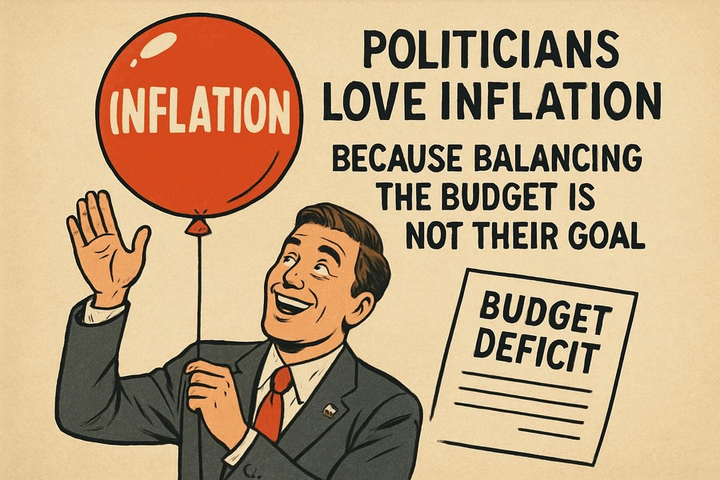
Shadow Inflation & the Price of Freedom

You’re not losing your mind, you’re losing your purchasing power.

Everything from groceries to rent to basic utilities has crept into unaffordable territory, but somehow the government insists inflation is around 3.3%. To most of us, that number feels like a punchline with no setup.

ShadowStats, which calculates inflation using methods from before the 1980s CPI revisions, suggests it’s actually over 9%. That sounds far more in line with what you feel in your bones and your wallet, doesn’t it?

The difference isn’t just mathematical, it’s philosophical. It determines whether you believe our society is slowly progressing or quietly deteriorating.

And at the center of that delusion sits the green tech movement: an ideal pushed by agreements between supranational organizations and state governments, built on commodities like silver, which ironically is one of the few tangible lifeboats left in an era of untethered money, misrepresented data, and unsustainable goals.


CPI: The Numbers Game That Makes Poverty Look Like Progress

In the early 1980s, the U.S. government began quietly redefining inflation. It didn’t look good on paper to say retirees needed 10% annual increases in Social Security checks. It looked even worse for Treasury bondholders expecting “real” returns.

So instead of wrestling inflation down, policymakers redefined how it was measured.

They introduced terms like:

  • Substitution: If steak gets too expensive, CPI assumes you switch to chicken. Inflation problem solved.
  • Hedonic adjustment: If your laptop is twice as fast, they say you’re paying less for it—even if it cost you more dollars (source, second bullet point).
  • Owner’s Equivalent Rent (OER): Instead of tracking what you pay in housing, they estimate what your home might rent for, based on surveys. (Crazy isn’t it?)

These methods were sold as ways to make CPI “more accurate,” but what they really did was make inflation more palatable to policymakers and debt managers. They also did it to make sure you and I kept racking up debt and consuming more each quarter.

Official inflation numbers rely on mechanisms that hide the erosion of lifestyle:
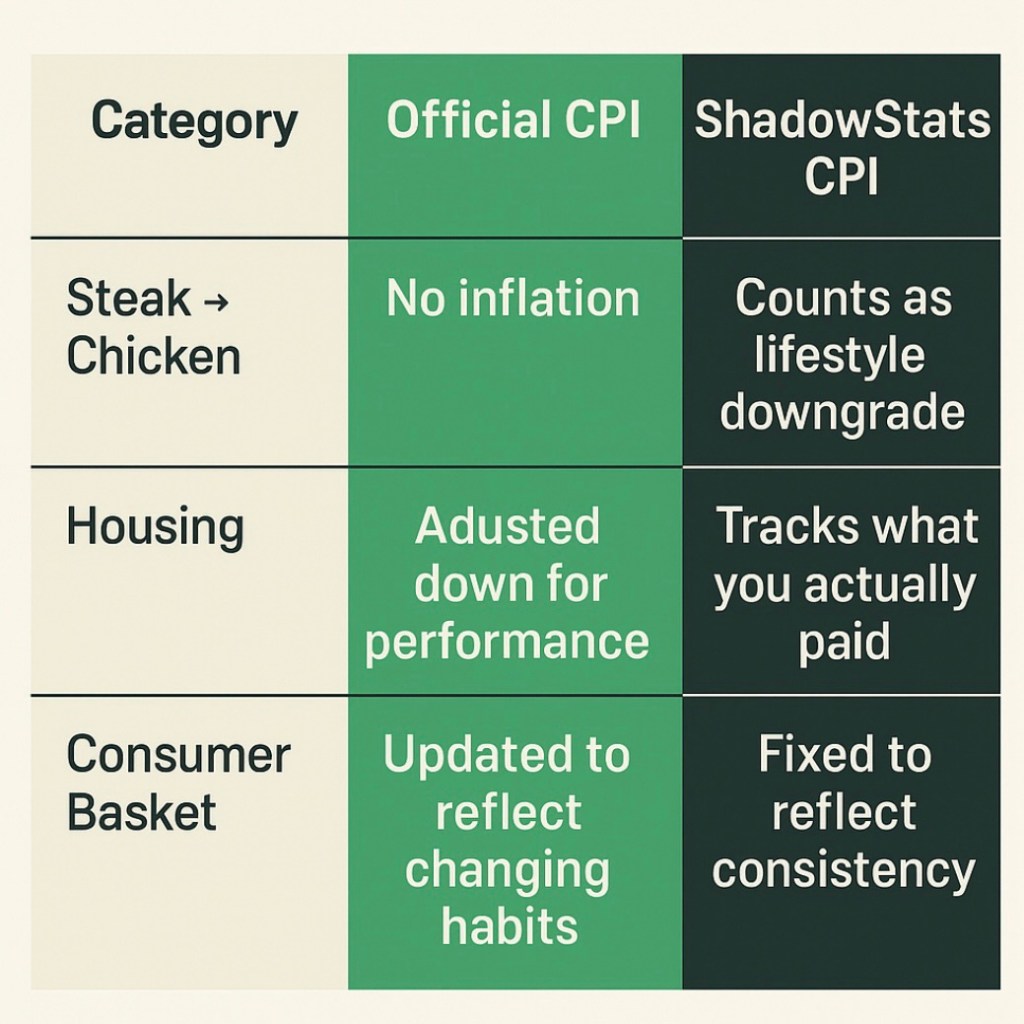
These adjustments treat your survival adaptations like buying cheaper food, delaying car repairs, moving back in with family, etc as market choices rather than signs of stress.

You’re not living worse, they say you’re just living differently.

Here’s what the former Fed Chairman Alan Greenspan said in 1995:

“If you are measuring the cost of living, you must measure the cost of maintaining a constant standard of living. If you substitute chicken for beef, you are not maintaining the same standard.”(https://www.nytimes.com/1995/12/04/us/inflation-gauge-may-be-too-high-experts-say.html)

The BLS has been doing the opposite for decades.


Green Tech: The Utopian Offramp Built on Industrial Scarcity

Enter the Sustainable Development Goals and the “just transition” to a greener future. Electric vehicles. Wind turbines. Solar panels. Battery storage. Carbon offsets. All tied to the years 2030 and 2050 as I’ve outlined in more than a few posts on this blog.

The problem? Every one of these systems relies heavily on silver, a finite, mined metal with growing industrial scarcity. According to the Silver Institute, solar panel production alone is expected to account for over 25% of annual silver demand by the end of this decade.

The price of silver has risen 43% year-to-date as of July 2025. Gold is up roughly 22%. Compare that to:

2025 YTD Return

NASDAQ +15%

S&P 500 +10%

DJIA +5.5%

So let’s check the math. If inflation is only 3.3% (official CPI), then those stock market gains look decent. But if ShadowStats is right, and inflation is closer to 9%, then:

  • The Dow Jones is posting a negative real return.
  • The S&P 500 is barely breaking even.
  • Even the NASDAQ, with its AI hype and tech surge, is only modestly positive in real terms.
  • Only silver and gold are delivering substantial real returns after adjusting for actual inflation.

This is the moment where you realize: only one entity will be paying for the widespread retrofitting and implementation of all this green tech that needs silver and it’s you. Either through willing compliance or taxation by the government so they can buy it with your wages and make you use it.


Hedonics, Hopium, and the Silver Choke Point

The CPI tells you that your phone is getting cheaper, even if you spent more on it, because it has better specs (source, first bullet point).

The ESG movement tells you your energy is getting cleaner, even if your utility bills are rising, because it’s coming from renewables.

But here’s what they don’t tell you:

  • Silver is irreplaceable in high-efficiency solar, circuit boards, EV contacts, and grid storage.
  • No large-scale replacement exists.
  • We are burning through reserves faster than we are discovering new viable deposits.

That means the very commodity needed to “fix” the future is becoming more expensive, even in inflation-adjusted terms. And that creates a dilemma no policy paper can solve.


Silver: The Honest Asset in a Dishonest System

In a world where official CPI is engineered to deflate your sense of decline, silver doesn’t lie.

  • It doesn’t get adjusted for quality.
  • It doesn’t get substituted.
  • It doesn’t get hedonicized.

It just reflects what a scarce, in-demand physical asset actually costs in a world of paper promises and underpriced labor.

And unlike fiat currencies or ESG credits, silver is outside the system. That’s why central banks don’t talk about it, and why retail investors who understand its utility in both monetary protection and energy transition are quietly accumulating at Costco before getting a hot dog and soda.


The Fatal Irony of Sustainable Progress

We are trying to build a green future using a grey metal whose supply cannot scale with our policy ambition. The Sustainable Development Goals require a miracle of material availability that simply doesn’t exist.

If silver prices are outpacing even ShadowStats’ inflation, then the affordability of the clean tech utopia vanishes on arrival. And if real inflation is devouring your market returns, then the dream of using “compound growth” to escape stagnation is mathematically dead.


Compliance or Sovereignty: There Is No Third Option

If you’re not holding assets that outpace real inflation (like silver or gold or the next randomly pumping stock) then you’re not preserving wealth. You’re slowly converting it into obedience.

Because what happens when your savings can’t keep up?

  • You’ll be offered government rebates for heat pumps.
  • Carbon credits for commuting less.
  • EV mandates.
  • Sustainability scorecards tied to your bank account (like that Aspire card I mentioned a few posts ago).
  • Access granted in exchange for compliance.

If you can’t buy your way out of the system, you’ll be forced to conform to it.

Green tech won’t be a lifestyle choice. It will be a behavioral requirement coded into policy, enforced by banks, and justified by a CPI that says “everything’s fine.”


Final Thought: Scarcity Isn’t the Problem—It’s the Lie

ShadowStats reveals how far we’ve drifted from price reality. Silver shows how tangible scarcity still has economic weight, how truth leaks out where it can’t be hedged.

And if you’re still counting on index funds and CPI-adjusted retirement accounts to protect you, ask yourself:

What happens when the growth you’re chasing is just inflation in disguise?

Silver isn’t just a hedge. It’s a mirror. And the reflection it shows is too uncomfortable for mainstream narratives to tolerate.

© 2025 Zakariyas James. First shared here at theruminationcompilation.wordpress.com.
Something to share

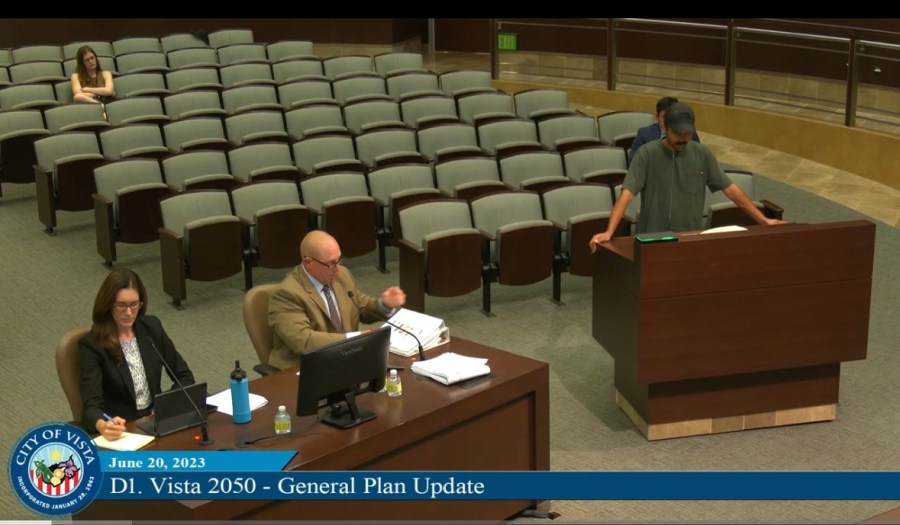
Last year, I spoke at a city council meeting in Vista, California where the focus was on the “General Plan”. This “General Plan” is Vista’s version of California state’s “Climate Action Plan”. Since 2011, California law has mandated that every city have a General Plan, but only recently have cities started hosting meetings and workshops to involve community members in discussing what citizens want in the plan and marginally clarifying what citizens should expect the plan’s fruition to really look like.

For context, prior to the meeting, I prepared 3 questions to ask the city officials regarding the General Plan & provided each a copy of the questions to follow along as I spoke. Admittedly, I didn’t expect anything other than outright dismissal of my questions but I was extremely wrong. I got a response I need to share with you.

Before I do that, I want to separately address any potential readers based on geography:

⁃ Citizens of Vista, if possible, start going to the meetings for the General Plan & listen to what’s coming. I know it’s hard to carve out time with all that life sends our way but if you have any level of concern for future of the city (or your place in the city) show up to one of these specific meetings & listen to the plan they have in mind for the city, bearing fully in mind what Commissioner Looney says from 6:30-9:42 in the video below.

⁃ Citizens elsewhere, google whatever state you live in along with the words “climate action plan”. If your state has has one, check & see if a law was passed requiring the city you live in to adopt a climate action plan (CAP) or general plan as well. Since 33 states already have, I’d almost bet on it, so if it happens to be so, I suggest watching the clip below & asking yourself “is what Commissioner Looney says from 6:30-9:42 going on in my city too?”

Sorry this is a long video (by today’s standards) but I wanted to show every city member’s response unedited.


If anyone wants to watch the entirety of the meeting:

Thank you for your time, I value it tremendously.

© 2024 Zakariyas James. First shared here at theruminationcompilation.wordpress.com.
Market Forces: Foreign Factors & Domestic Actors

Do you see it yet?

Assumptions aside, before progressing any further into this text, I’d recommend reading my post, “Environments & Requirements” – it serves as a backdrop for this discussion of ambiguous terminology employed by myself & others of far greater influence.

Admittedly, I was extremely reductive in my total description of the dissenting Justice’s vague reference to “market forces” that economically enacted the moderation sought to be legislatively achieved through the Clean Power Plan of 2015. I was pressed for time in a number of ways & opted to employ a tone as cryptic as the parties involved & for that I apologize.

Across the United States of America & most nations across the globe, contractually binding agreements focused on the years 2025, 2030 & 2050 are actively being implemented & exercised in ways that, more often than not, circumnavigates a nations domestic legislation & overtly neglects public opinion.

Nonetheless, we’re all pressed for time.

By a design I hope to properly explain henceforth, these contracts are primarily fulfilled through utilization of actors in two distinct groupings:

• individual members of domestic governments on the local or national level, party to, or at the very least aware of the contract & beholden to it’s terms. Throughout this text, we’ll refer to them as “domestic actors”.
• individual members of corporations & non-government organizations party to, or at the very least aware of the contract & beholden to it’s terms. Throughout this text, we’ll refer to them as “foreign factors”. (The video I have linked at the end of “Environments & Requirements” is a documented example of the second scenario.)

This aforementioned contract, oftentimes discussed as though singular in nature, is actually a consortium of contracts contingent upon an original that essentially grows through these compartmentalized amendments.

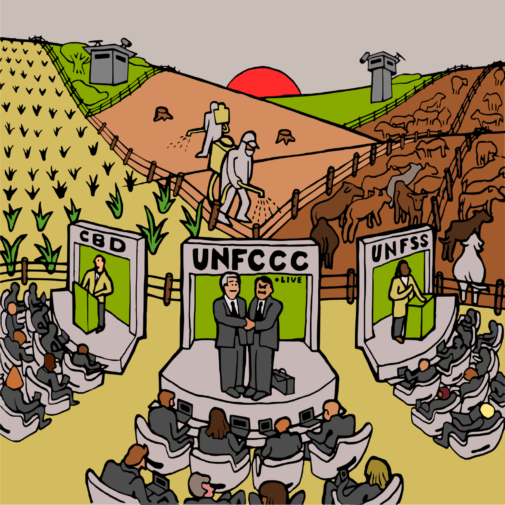
In 1992, the United Nations Framework Convention on Climate Change, described as a treaty of nations, was the foundation of the Conference of the Parties (COP) & the Convention on Biological Diversity (CBD), the latter being an international contract signed at the Earth Summit in Rio de Janeiro, Brazil, on June 5, 1992 and entered into force at the end of 1993. A majority of the 196 parties signed the contract immediately or soon after; the rest signed later in the early 2000’s with the latest being the nation of Andorra on February 4th, 2015. As simply as it is, nations involved are the Conference of the Parties.

The contract created by the CBD is the foundation of a number of other contracts & compartmentalized sub-organizations – for the sake of time & clarity, I’ll be focusing on overall elements & intermittently addressing specifics that will best discuss the “market forces” alluded to all too often.

The degree of obligation parties to the contract are subject to are clearly stated in Article 5:

Each Contracting Party shall, as far as possible and as appropriate, cooperate with other Contracting Parties, directly or, where appropriate, through competent international organizations, in respect of areas beyond national jurisdiction and on other matters of mutual interest, for the conservation and sustainable use of biological diversity.

As well as Article 10:

Each Contracting Party shall, as far as possible and as appropriate:
(a) Integrate consideration of the conservation and sustainable use of biological resources into national decision-making;
(e) Encourage cooperation between its governmental authorities and its private sector in developing methods for sustainable use of biological resources.

Frequently, the competent international organizations are subgroups that have been delegated authorities vested by these two Articles – entities like the Wildlife Project, Cities With Nature, & the financial arm of the CBD, the Global Environment Facility, in charge of about $5.33 billion from government & corporate investments, all stem from the contract itself while various organizations like ICLEI (the International Council for Local Environmental Initiatives, the subject of the linked video) are granted jurisdiction & provided impetus by way of the CBD contract.

Furthermore, through manufactured fragmentation of the UNCCC into the aforementioned subgroups & others I’ve opted to forego in the interest of time, individual members from each of the original UNCCC subgroups bestow upon each other & new subgroups a false sense of authority in the eyes of a subnational government & the general public. This inorganic networking founded upon disingenuous representation serves as a way to also build rapport with a subnational government, often the focus of these UNCCC subgroups, through a multitude of domestic actors.

From the state level to the federal level, most nations have members of government party to the contract by association with one, if not more, of the UNCCC subgroups. By my estimate however, there are more members of commerce in leadership positions party to the contract considering the private sector is where the implementation of the carbon credit cap-and-trade system began.

In your own time, pay attention to the prevalence of corporate commitments to sustainability efforts related to the years 2025, 2030 & 2050; it is more than likely that the board of directors, in part or full, are aware of the CBD contract, specifically Article 11:

Each Contracting Party shall, as far as possible and as appropriate, adopt economically and socially sound measures that act as incentives for the conservation and sustainable use of components of biological diversity.

In no clearer terms, this is the foundation of the cap-and-trade system in relation to carbon emissions & other economic sustainability tools like Sustainable Aviation Fuel being spearhead by Shell Corp & Boeing. The actions taken by corporate interests & universities that mirror the SDGs set forth by the UNCCC are in summation the market forces the Justices briefly mentioned – the individuals working in government (e.g. mayors, city council members, directors/chancellors of state universities) while also representing these extrajudicial entities are the domestic actors.

For a few examples, here in the United States of America, since 06/21/22 the point of contact (domestic actor) between the GEF & the U.S. Department of the Treasury is Ms. Abigail Mary Demopulos who has worked as an economist for the Department since 2004, as far as public record states.

For a more local example, Scott Tess is a Sustainability & Resilience Officer at the City of Urbana, Illinois (a noted Cities With Nature city member) who contributed to the 2020 Illinois Climate Action Plan (iCAP), created by the Institute for Sustainability, Energy, and Environment (iSEE) at the University of Illinois on the Urbana-Champaign campus. iSEE gets most of its funding from students through increased costs of attendance & an organization called the University Climate Change Coalition (UC3) who seek “to scale up climate actions by both state and non-state actors to accelerate the implementation of the Paris Agreement and the 2030 Agenda” across the United States, Mexico & Canada. Both the Paris Agreement & the 2030 Agenda are creations of the UNCCC & CBD. (I’ll be doing a few posts on the Precision Consumer aspects of the 2030 Agenda in due time.)

If one hyper-focuses on the iCAP objectives (or any of the other versions at USA state universities), it is clear that they essentially copied the framework of essentially every other UNCCC-derived economic climate plan:

Objective 2.2.1: Improve efficiency of space use by minimizing the square footage per person and updating the Space Policy in the Campus Administrative Manual (CAM) by FY23.
Objective 3.3: Establish an Electric Vehicle Task Force to identify key goals for supporting the use of electric vehicles on and off campus by FY22.
Objective 8.1: Develop a coordinated urban bio- diversity master plan by FY24 to make the Champaign, Urbana, Savoy, and campus metro area a model for biodiversity.

In light of this exceedingly shrouded information, to what degree, if at all, can you be certain that your representatives in government are observing only the constitutional laws of your nation? To what degree are markets truly free?

Again, I’d like to apologize for my preference to discuss these matters from an American/North American standpoint – please do not misconstrue omissions of other nations as indications of absence of this schematic, to reiterate, all nations of the globe are party to the contract as of 2015; from that point forward, all nations were essentially operating in a form of lockstep that is founded upon external influence & market manipulation by way of self-imposed fossil fuel/carbon emission restrictions well before advent of constitutionally observed legislation & incentivized programs for entities that opt to follow the 2030 Agenda.

Essentially, since 1992, even prior depending on the length of research of done, the events & the lifestyles of 2025, 2030 & 2050, regardless of the country, were being planned for precise results. Predetermined forms of economics & reimagined realities await us; in just 3 years from now, our lives will begin to bear greater resemblance across national borders & social groups as our restrictions become unified under a global framework centered around carbon emissions.

Over the next few weeks, I hope to discuss this concept of market forces in further detail & with more focused points of discussion; this post itself, I imagine, has a bit too many links for most readers & still has a bit of ambiguity plaguing it, thus we’ll be returning to this topic numerous times.

In the meantime, research your local entities – determine their unspoken goals & decide for yourself if they are the same goals you & yours seek to achieve.

Feel free to contact me if you have any questions or anecdotes regarding this text.

Thanks for reading.

Photo credit: https://globalforestcoalition.org/who-makes-decisions-at-the-cbd-the-increasing-power-of-business-in-biodiversity-protection/

© 2022 Zakariyas James. First shared here at theruminationcompilation.wordpress.com.