Civic Ineptitude: Signals in a Nation of Noise

Some time ago, I wrote a song with a lyric I find myself repeating more often to coworkers, and even in online conversations:

“Pay attention to what you pay attention.”

It’s the simplest way I’ve found to gesture toward the problem of the signal-to-noise ratio and how its manipulation breeds civic ineptitude.

Most of what we take in, whether from commerce or politics, isn’t meant to sharpen judgment. It’s engineered to trap us inside a single topic, to overload the civic ear. Not to expand participation, but to shrink it under the weight of constant input. Inputs irrelevant to both daily life and future prospects.

Democracy likes to sell the story that people can separate signal from static, that citizens have reviewed all sides of a problem and reached true understanding. The reality rarely matches the pitch.

Defining Civic Ineptitude

Civic ineptitude is a manufactured incapacity, not an accidental occurrence. It’s not that people are unwilling to participate, it’s that they are overloaded with inputs designed to trap attention in outrage and trivia. Citizens debate endlessly but rarely govern themselves or the institutions meant to be by the people, for the people. They are trained to consume noise to the point they delegate their sovereignty to an outside source, until they no longer truly think for themselves.

Commerce & Politics: The Social Noise Complex

Politics delivers daily scandal, a viral hearing, or a televised confrontation in all caps. These moments are designed to impress upon viewers the breaking news matters more than they could ever know. They digress from legislative maneuvers that might actually impact daily life and repress the viewer’s ability to think independently.

The churn promises significance but rarely explains consequences without exaggeration. Slow, structural signals (like infrastructure, demographics, environmental planning, national debt) fade into silence because they don’t trend. Because the ones in charge don’t need your input anymore, just your compliance.

Commerce is louder still. Advertising and financial media bombard us with promises of autonomy through consumption. New gadgets, lifestyle upgrades, and speculative bets are sold as independence. But the true signal, legitimate questions of sovereignty, labor, and national debt, goes unheard. Instead, the illusion of participation is kept alive by trading apps, side hustles, and brand loyalty. It looks like engagement but it’s only noise. Sometimes they’re blatant about it: “escape from real life, escape the burden of civic duty.”

While headlines focus on tech scandals, trillion-dollar corporate buybacks reshape ownership of the entire economy. Credit, conspicuous consumption and engineered complacency drive the system.

Historical Shifts that Made It So

This condition has roots. The 24/7 news cycle rewarded outrage over substance. The modernization of the Smith–Mundt Act blurred propaganda into domestic media. The dollar’s divorce from gold made inflation and debt permanent features, not temporary policies.

Citizens are still taught to treat dollars as solid. In reality, the currency became an abstraction, an IOU backed only by government promise. A system that once had a natural limit (gold convertibility) turned into one that could expand infinitely. The public was never educated on what that shift meant, because understanding it would expose the truth: debt is not a temporary emergency but the backbone of fiscal policy. The so-called debt ceiling is theater, not restraint.

When the money supply lost its anchor, spending lost its discipline. Citizens could still count dollars in their wallet, but they could no longer count on those dollars to mean the same thing tomorrow. The disconnect between appearance and reality became the foundation of modern civic ineptitude.

Even right now, the news is trying to convince every citizen the reason other governments and foreign banks are dumping U.S. Treasury Bonds is because of tariffs. They can’t let you doubt the longevity of the dollar too, you know?

Present-Day Illustration

The imbalance is obvious: the public spends weeks locked onto scandals, while consequential legislation moves quietly in the background. The pattern is clear:

  • 2008 financial collapse: While the public debated Wall Street outrage, Congress passed the $700 billion TARP bailout with little scrutiny.
  • Post-9/11: Fear of terrorism overshadowed the Patriot Act, quietly expanding surveillance.
  • Pandemic: Debate over masks and mandates eclipsed multi-trillion-dollar stimulus packages, shaping long-term debt obligations.

Here’s the next one: In about two weeks (from the time I published this) CISA, the Cybersecurity Information Sharing Act of 2015, will be hitting the 10 year expiration date and needs to be re-enacted/rewritten.

Why? Because in 2018, Congress created CISA, the Cybersecurity Infrastructure Security Agency, an agency with almost unrestricted authority over citizen communications, a component of the Department of Homeland Security. (Notice the acronyms are identical, blurring law and agency. Hardly an accident.)

Since the Agency’s creation, Congressional Oversight Committees have run multiple investigations that uncovered the Agency is apparently more concerned with what you and I say online, rather than cyber attack threats. Working in tandem with social media platforms, CISA has censored comments and posts, employed “narrative intervention” tactics, and surveilled US citizens unconstitutionally with the Mis-, Dis, and Malinformation (MDM) team.

CISA was disbanded in 2022, but government power rarely disappears, it reincarnates. When the new CISA passes (and it will) the agency will return, maybe under a new acronym, but with the same powers reborn.

I fully expect the law to be revived with further additions that exacerbate this issue of government weaponization upon the citizenry of the United States. I also fully expect only a sliver of the populace to even know it happened.

Why? The spectacle is always designed to be louder than the substance. Outrage consumes the civic ear while policy slips by unnoticed, and the government is always watching, waiting for us to be distracted or disinterested in what they’re doing this week.

The Democratic Mirage

Democracy promises citizens can separate signal from static. In reality, engagement is mediated by distraction. Civic aptitude is nearly nonexistent.

Candidates are products of party machinery, donor networks, and lobbying groups. Not public deliberation. Most voters respond to slogans, sound bites, and marketing repetition. The candidate becomes a brand, politics becomes advertising.

Appointments reveal where real power sits and why the candidate was dangled before us. Positions of influence often benefit industry, private networks, and political machines—not citizens. Just look at the last 25 years of questionable appointments:

George W. Bush

  • John Bolton – U.S. Ambassador to the UN (2005)
    Bolton was openly hostile to the UN and multilateral diplomacy, which made his appointment look like sabotage by placement. Bush didn’t even wait for Congress to vote on the appointment, he just signed off on it while Congress was in recess. 
  • Also appointed over 700 judges in the wake of 9/11, judges who provided no opposition to warrantless surveillance requests from the then-created Department of Homeland Security. 

Barack Obama

  • Mark A. Patterson – Chief of Staff to the Treasury Secretary (2009)
    Patterson was a former Goldman Sachs lobbyist, put into a senior Treasury role just after Goldman benefited from TARP bailout policies. 
  • Gary Gensler – Chairman of the Commodity Futures Trading Commission (2009)
    Former Goldman Sachs partner, placed in charge of regulating derivatives, the very instruments central to the 2008 crisis. 
  • Jack Lew – Director of the Office of Management and Budget (2010) then Treasury Secretary (2013)
    Former Citigroup Chief Operating Officer, another bank complicit in the 2008 derivatives scandal. 

Donald Trump (First Administration)

  • William Perry Pendley – Acting Director, Bureau of Land Management (2019–2021)
    Pendley had spent much of his career arguing for selling off federal lands, yet was appointed to oversee them.

Joe Biden

  • Gary Gensler – SEC Chairman (2021)
    Another Great Financial Crisis banker appointed by Obama, later reappointed under Biden to lead the SEC.

Donald Trump (Second Administration)

  • Ed Martin – U.S. Attorney for D.C. (2025)
    Martin had no prior experience as a federal prosecutor or judge, but was appointed to one of the most powerful legal posts in the country.

This is the democratic mirage: the appearance of choice, the ritual of participation, the illusion of sovereignty. All sustained by noise. The decisions made behind closed doors have had lasting impacts on these last 25 years, and more than likely, will for the next 25.

Returning to Attention

Civic ineptitude is not stupidity; it’s engineered overload. The signals of governance, sovereignty, and responsibility are still there, but faint, competing against an industrial volume of noise.

The question isn’t whether people can still hear them. The question is whether anyone remembers how to listen.

Pay attention to what you pay attention.


If this piece resonated, you may also find these worth your attention:

Market Forces: Foreign Factors & Domestic Actors

Precision Consumer 2030: Wellness as a Window Into You

© 2025 Zakariyas James. First shared here at theruminationcompilation.wordpress.com.

When Ledgers Rewrite Culture: The Social Side of Sound Money

The technocrats will eventually tell you Basel III was a technical fix. The pundits will call BRICS a geopolitical contest. Both are true in their limited ways but us real people do not live inside policy memos or summit communiqués and will have our own perspective. We live in the real world of habit, rituals and desire. As the scaffolding of global finance is quietly remodeled (physical bullion regaining status and liquidity rerouting to the Global South) the most consequential shifts will be cultural, not merely fiscal.

This is the story no headline quite tells: how an accounting reclassification becomes a tiered, shared experience.

The West: From Immaterial Credit to Material Anxiety

In economies that grew comfortable with digital balances and endless credit aka “easy money”, the cultural shift will feel different, it will be slower and then sudden. Crack-up boom. Daily life is calibrated to cheap, frictionless money: mortgages, subscription living, bulk pricing. When policy nudges value back toward the tangible, the result will be a new kind of cognitive dissonance.

Expect changes in language first, personally, interpersonally and then communally/politically. Conversations will shift from “How much can I borrow?” to “What is real?”

Nostalgia will warp itself into politics. Calls for protectionism, reclaiming physical assets, other varying populist sentiments will resonate with people who discover a mismatch between their actual costs and their imagined abundance.

Mutual Aid and Parallel Economies: Gardens and Barter

When trust in fiat frays, communities adapt. We’ve seen it in Argentina, Zimbabwe and during wartime rationing but the west will have variation:

• Community gardens reappear as survival infrastructure, where calories mean more than currency. As fiat fails, big chain grocer prices will madden the masses and local growers will become pseudo-heroes.

• Barter centers allow exchange without the reach of taxation or failing banks. I expect this to be a mainstay of the West post-wealth transfer as citizens will lose respect and trust in the institutions they blindly followed. “Why give them taxes when they got us into this mess?”

• Local scrip or informal IOUs return as a temporary patch for frayed systems. This is already happening in terms of the Goldback movement in 7 states of the U.S., with two more announced but not yet active at the time of writing. In the U.K., the Bristol Pound (backed by sterling) is the closest example as it is a functioning local currency but lacks association to precious metals.

What begins as improvisation can calcify into an alternative, parallel economy. Trust, not credit, becomes the currency. Skills, not stocks, will pay the dividends. Trickle-down economics will be exemplified by the kind ones in the community, not the corporations.

Rituals, Class and the Story of Ownership

Ownership is never neutral: it’s class-status and identity. The form of possession matters as much as the fact of it.

In BRICS-aligned nations, gold is held whole. A coin is a coin, a bar is a bar. Jewelry is worn not just for ornament but for sovereignty. Wholeness is permanence: the signal that your wealth cannot be deleted by a keystroke or dissolved in a bankruptcy court.

In the West, scarcity will force a different adaptation: tokenization. Instead of outright ownership, assets will be broken into fractions and sold back as digital claims. Families will cling to ledger entries representing “one-tenth of a coin” or “a fraction of a house.” Cities and corporations will tokenize infrastructure just to stay liquid, slicing the material world into abstract coupons.

This isn’t innovation though, it’s desperation disguised as fintech. Tokenization is a coping mechanism for a civilization that can no longer afford wholeness, that can’t afford endless growth. It lets people pretend to own what they cannot hold.

The divide will cut deeper than economics. To the bullion-rich nations, the West will look like addicts trading scraps of paper to simulate the real thing. To Western citizens, the sight of others wearing or storing full reserves will feel like betrayal: their leaders sold them futures, while others secured permanence.

The new class line will be brutal and obvious: whole vs. fractioned, real vs. synthetic, permanent vs. provisional. One side will pass their wealth on intact. The other will spend their lives juggling slices.

This approach isn’t unique to the U.S. though; across the West, similar experiments have emerged. In 2018, the U.K.’s Royal Mint launched a gold-backed cryptocurrency: The Blockchain-based coin, called Royal Mint Gold (RMG), is a digital representation of gold stored in The Royal Mint vault. One RMG coin may be equal to one gram of gold but in a world of hard assets, I’m not sure how attractive this digital placeholder will be over the real deal. But you know, this might be the best the West might have to offer.

Theology, Disillusionment and the Question of Faith

Religion bends around money’s shape. In the West, Christian sermons may reach for familiar motifs: Judas’s thirty pieces of silver, the dangers of idolatry, the fleeting nature of wealth. But overuse risks cliché and invites criticism of hypocrisy. Different branches of Christianity may fracture in their responses:

Catholicism could lean into what’s lasting ie liturgy and sacrament as the “true store of value” against a collapsing fiat world. Evangelical Protestantism may frame gold resurgence as a divine order reasserting itself: God’s money returning into life after man’s failed experiment with paper. Prosperity gospel will struggle the most, almost collapsing entirely, as its glitzy promises seem outlandish in a world where even the faithful cannot finance new SUVs on credit.

The collapse of fiat’s aura may also push in two opposite directions across the board:

• Renewed Faith: A turn back toward God, with bullion framed as a sign of “end-times upon us”. The sentiment might find greater hold in non-denominational settings, though I imagine it’ll be common to the point of standardization.

• Rising Atheism: A wave of disillusionment, rejecting not only money but the institutions and faiths that blessed the old order and inevitably request tithes in the form of precious metals.

Theology will not be a bystander; it will be a contested arena for interpreting what gold’s return “means.” I fully expect the sermons post-wealth transfer to be extremely centered around Proverbs 3:13-14, along with stern reminders that the coveting of money is the root of all evil.

Secrecy Replaces Display: the Death of Flex Culture

Today’s culture of flaunting lifestyles, enabled by credit, will become dangerous in a metals-driven economy. Buy now, pay later schemes have almost entirely ensnared millennials and Gen-Z. But in a metals-driven economy, this visibility becomes dangerous.

• Those who stacked metals early will avoid attention, adopting aloofness and secrecy. This is already a norm, as it is for the general prepper, though the lengths these people will take to ensure privacy and security will impress just about anyone.

• Those who struggle amidst the post-wealth transfer will conceal their “bad luck” by retreating from the shame of scarcity both online and in real life.

• The algorithmic culture of flaunt-and-scroll will erode, replaced by discretion and silence.

Social media will have its reckoning in the post-wealth transfer world. Without a doubt, the failure of fiat will dismantle decades of “flexing” and the result will be admittedly cathartic for those who used to subscribe to content creators of all sorts, as the seemingly synchronized decline in quality of leisure is observed, the subscribers will realize it’s not just them, it’s just normal.

Everyday Behavior: Thrifting , Working and Timing

Culture is habit, and habits follow incentives. As money rewires, so too does the cadence of daily life.

• Work: jobs built on speculation, abstract consulting and branding will thin out. The booming will be in agriculture, repair trades, personal security, medical basics and food logistics. The gig worker who once delivered takeout may now be fixing farm equipment. The “creative consultant” and “affiliate marketer” will look more like a hustler without a market.

• Consumption: novelty becomes a liability. The fast-fashion buyer becomes the thrift-shop regular. The broken appliance gets repaired, not replaced. Mending, patching and improvising will become core skills, especially among the young who never learned them.

• Time Horizons: in unstable regions, people will hesitate to sign a 12-month lease or take out student loans for degrees tied to paper economies. Short-term survival dominates. But where gold and silver are treated as security, the opposite emerges: multi-decade infrastructure projects, new family compounds, community institutions.

The cultural split will be sharp. In one town, neighbors trade tools, seeds, weekend labor. In another, boarded-up shops and “for sale” signs multiply. The wealth transfer will redraw which places feel livable, which don’t and it’ll happen far faster than governments can manage.

Media, Narrative, and the New Moral Economies

How people interpret this shift will depend on who controls the story.

• State media in bullion-rich nations will frame accumulation as sovereignty and “what we deserve”. Depending on the nation, newscasters may invariably parrot state-sponsored rhetoric related to the “defeat of the West” and support re-election for many leaders within the Global South.

• Western outlets may cast it as loss, betrayal and “temporary”. On the other hand, I imagine investigative journalism may rise as the citizens of the West hunger for truth, valuable information and explanations of how the shift happened when decades went by of leaders and institutions saying it wouldn’t.

• Social platforms will fracture the narrative into memes; without a doubt humor will veer further into dark comedy, especially as the humor of Gen-Z prevails online as they are the growing bulk of the most active user base. Humor heals to a degree and humor will find a way to soften the financial blow.

Stories will shape behavior and politics, not spreadsheets and quarterly updates. The way media summarizes the drop in sales, the rise in unemployment, how things are the “new normal” will be at odds with how the common people view things.

Migration, Mobility and the Geography of Belief

Money moves people as much as goods. As liquidity tilts eastward, migration will not only follow jobs but a deeper quest for security.

For Western immigrants who left the Global South, the arc may reverse. A banker’s son who once left Lagos for London may find himself heading back. Skills, connections, and a sense of Western fragility will travel with him. A daughter who studied in Boston may bring her expertise home. Accreditation knowledge leaves one region and finds roots in another.

Western nations losing both talent and capital gained through immigration may find themselves hollowed out. Skilled professionals will no longer see New York or Paris as the obvious endgame. Families will weigh where their real, tangible savings feel safest.

Diasporas will change their tunes and ties. They won’t just wire money home; they will re-anchor their futures there. This will be a cultural migration as much as a physical one. My own mother, like millions of others, came here to the U.S. on the promise of stability, safety, and opportunity. In a post-wealth transfer world, that promise may not hold. The dream of “making it in the West” could erode, replaced by a dream of returning to one’s motherland or fatherland and not as escape, but as reclamation.

Closing Reflection

The mechanics of money are written in ledgers; the consequences are written in kitchens, altars and the streets. Basel III’s technical recalibration and BRICS’ geopolitical choreography are the inorganic architecture. The organic architecture will be cultural: how we talk about value, how we teach children to save, whom we trust which rituals we carry forward, how we consume, how we view leisure.

If you want to understand the future, don’t look at trading floors, prospectus statements or anything of the sort. Listen to the markets filled with people like you and people nothing like you: what songs are being sung at weddings, what words children learn about wealth, how neighbors share food in hard seasons, how people talk about their government. Those small things are the real indicators of where an economy has landed in the human heart and how people conceptualize worth.

When ledgers rewrite culture, ‘sound money’ becomes less about accounting conventions and more about the sounds in the marketplace, the voices in prayer halls, the silence at the dinner table.


This write-up is a cultural assessment of the banking changes coming into play that I’ve outlined in Basel III and the Return of Gold: A Comparative History.

© 2025 Zakariyas James. First shared here at theruminationcompilation.wordpress.com.
Basel III and the Return of Gold: A Comparative History

When the Bank for International Settlements finalized Basel III in 2019, it didn’t make headlines. But in elevating physical gold bullion to a Tier 1 asset (and relegating paper contracts and futures to near-irrelevance), the rules of global finance shifted as profoundly as they did in 1933, 1944, or 1971.

To understand the magnitude of this change, it helps to compare it with the last century’s monetary resets.

1933 — U.S. Gold Confiscation & Revaluation
• What changed: Franklin Roosevelt suspended the domestic gold standard, forcing Americans to hand in their gold at $20.67/oz. Months later, the government revalued gold to $35/oz.
• Effect: Citizens lost bullion, the state gained reserves, and the U.S. Treasury booked an overnight windfall that supported Depression-era finance.
• Parallel to today: A rule change, not a war, restructured wealth by reclassifying gold’s role. Value didn’t vanish—it was reassigned.

1944 — Bretton Woods & Dollar Hegemony
• What changed: Allied powers agreed to anchor global currencies to the U.S. dollar, itself pegged to gold at $35/oz.
• Effect: Nations no longer settled accounts in gold directly; they settled in dollars. The U.S. consolidated financial supremacy by holding the world’s largest bullion hoard.
• Parallel to today: Liquidity was centralized under one system. The illusion of stability masked a transfer of gold’s role into state-backed paper claims.

1971 — Nixon Closes the Gold Window
• What changed: President Nixon suspended the dollar’s convertibility into gold. The Bretton Woods system collapsed, leaving a purely fiat world.
• Effect: Currencies floated, debt exploded, and dollar dominance survived only because oil and global trade continued to be priced in dollars.
• Parallel to today: A pivot disguised as necessity. Rules were rewritten mid-game to preserve credit expansion, even as trust in the old system eroded.

2019 — Basel III Redefines Gold’s Value
• What changed: Physical gold was upgraded to Tier 1, recognized at full value on bank balance sheets. Paper gold contracts and futures were risk-weighted down to ~10%.
• Effect: Sovereigns and central banks suddenly had incentive to accumulate bullion, not paper promises. The East has led record purchases, while Western markets cling to futures.
• Parallel to history: Like 1933, 1944, and 1971, the change was regulatory and quiet—but it redefined gold’s place in the system. Instead of removing gold, Basel III restores it to the balance sheet.

The Throughline

Across each reset, the same pattern emerges:

• Gold is never eliminated. It is reclassified, revalued, or hidden behind paper substitutes.

• Fiat credit is preserved. Whether by confiscation, substitution, suspension, or regulation, the system shifts rules to extend its lifespan.

• The burden of adaptation is global. Citizens in 1933, allied nations in 1944, world markets in 1971—all had no choice but to adjust. Basel III sets up the East as the next adjustment point.

As analyst Lena Petrova notes, “We are being told a story of multipolarity, but what we’re really seeing is continuity. The structure doesn’t vanish—it relocates.” The “relocation” now is not merely geographic (West to East) but material: away from paper contracts toward bullion. The BIS and World Bank aren’t losing control; they are orchestrating the transfer. To preserve fiat credit, bubbles must migrate, and liquidity must sink somewhere new.

If the 20th century required world wars to enforce its financial resets, the 21st may achieve the same outcome more subtly but no less disruptively. Basel III is the quiet hinge-point: a reminder that while money changes form, its gravity keeps circling back to the same metal.

What Comes Next, A New 1971 Moment?

If 1933 was confiscation, 1944 was consolidation, and 1971 was suspension, then Basel III may be the preparation stage for a fourth great reset. The difference this time is that it is not centered in Washington, London, or Paris, but in Beijing, Moscow, and the capitals of the Global South.


The BRICS bloc has already signaled its intent. Its member nations—Brazil, Russia, India, China, South Africa, and now a widening circle of others—are exploring settlement systems that bypass the U.S. dollar. Without a peg, such systems risk fragmentation. The glue, as history shows, is gold.

• Eastern central banks are buying record tonnage of bullion, not futures contracts.

• Western banks remain tethered to paper claims, increasingly downgraded by Basel III rules.

• Liquidity migration is not a conspiracy but a pattern: when one region’s fiat exhausts credibility, another inherits the burden and backstopped by gold.

As Petrova observes, “This is not about destroying the dollar—it is about keeping fiat alive by shifting its weight onto new pillars.” Those pillars may look multipolar, but their load-bearing material is the same as it has always been.

The Shape of the Next Reset

If history holds, the shift will not be announced openly. It will arrive by necessity disguised as inevitability:

• A commodity crisis forcing nations to accept settlement in a BRICS-linked system.

• A financial shock exposing the fragility of Western futures markets.

• A global liquidity squeeze that can only be relieved by bullion-backed credit.

The pivot could take many forms: gold-linked settlement units, hybrid currency baskets, or digital instruments backed by physical reserves. But the essence will echo 1971: a silent rewriting of the rules, enforced globally, with citizens and smaller nations adjusting afterward.

Closing Reflection

The world has seen this cycle before. Gold is confiscated, concealed, dismissed, and restored again under new terms. Each reset claims permanence, but each is temporary scaffolding for the next.

The question is not whether BRICS will displace the dollar, but whether fiat itself can endure without a metallic skeleton. If the 20th century taught us that wars were the price of financial rearrangement, the 21st may show whether quiet regulation and rebalancing can achieve the same outcome or whether conflict remains the final enforcer of monetary truth.

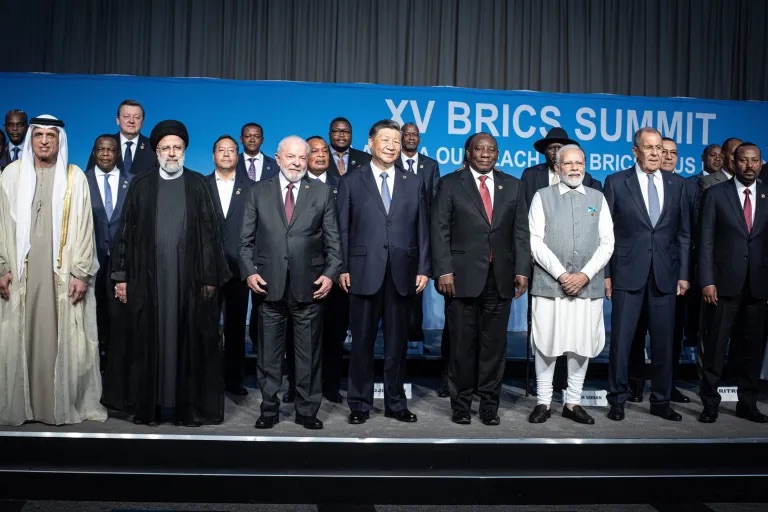
Photo credit: PER-ANDERS PETTERSSON/GETTY IMAGES

© 2025 Zakariyas James. First shared here at theruminationcompilation.wordpress.com.
When Trees Bear Witness

Give it some time, the trees will start listening to you. A device once used only to track growth rates is now the seed of something else, a quiet grafting of the forest into the cloud. 

Dendrometers (used to measure the growth of trees and other plants by monitoring changes in diameter) have gotten a recent boost in applicability for more than just forest management teams. Thus far, they’ve allowed forest managers to cut down site visits needed to gather data on tree growth and carbon capture rates, but because of a recent innovation, much more is possible and I want to paint a picture for you. 

As per usual, what begins as a gesture to efficiency, a nod to preservation, may warp into something far more insidious.

The company Treemetrics, working alongside the European Space Agency, created sensors that link through wide-area networks and satellites, feeding streams of data into a platform called Forest HQ. If your tree is growing, Forest HQ knows. The forest becomes an extension of the cloud, feeding numbers related to diameter growth, height, location—change of all sorts. So, the forest is no longer a place. It is a feed. The company calls this project the Internet of Trees.

The logic is seductive: better measurement equals better care. Carbon accounting strengthens climate response. Carbon credits for the cap-and-trade markets gain more authenticity. But inside that necessity lies a governance architecture: every tree, instrumented; every growth curve, visible; every beat of the forest, rearranged as data. A swarm of data waiting to be further monetized or weaponized—unfortunately, humans do one or the other. Often both. 

I know what I will soon describe may seem altogether far fetched, but it does not take much imagination to see the scope widen in the way I expect given the right amount of time.

The slope is not hard to imagine. Already, forests are wired with listening devices meant to detect chainsaws, trucks and any other prohibited criteria. Artificial intelligence runs on-site, flagging the sounds of illegal logging before they reach the cloud. It is admittedly clever, even noble. But anything involving criminalization soon collapses into categories: nuance is stripped, anomalies are flagged, people are reduced to signals. 

We’ve seen this arc before. The Global Positioning System was once sold as a gift for navigation: finding your way home, never getting lost. Now it’s the backbone of precision strikes and geofencing. Closed-circuit television cameras were rolled out for “public safety.” Now they’re stitched together in networks that can track a face across an entire city and can even recognize your gait amongst a crowd. Social media began as a way to connect with friends and now it’s a sprawling apparatus of profiling, targeted persuasion and behavioral nudging.

Each began as benevolent. Each hardened into control.

For a good number of technologies, the arc of applicability tends to bend toward something darker. Monetized until meaningless or weaponized against anyone not in control of the weapon. 

What begins as protection of ecology can just as easily become the monitoring of people. A hiker’s footsteps, a group of protestor’s chants; any human activity can be parsed as anomaly, pinged to headquarters. With the right contracts, the forest becomes surveillance infrastructure, camouflaged in green.

What if Forest HQ evolves from tracking growth to performing guard duty? What if the forest ceases to be wild and becomes a grid, mapping bodies as much as making bark? 

Conveniently, this year a viral post showcased a new service from XFinity that uses WiFi signals to detect motion in your home, “without relying on sensors or cameras.” The technology has existed for years, but only now is it being pitched as household convenience. Tracking once reserved for homes and offices will soon extend to the wilderness.

You can opt into this service, which routers and WiFi connected objects around you don’t give the option to opt out?

This shift matters not only technologically but culturally. What happens when forests are no longer trusted as wild refuges, but feared as watchtowers? What happens to the human imagination when trees are not symbols of mystery or sanctuary, but extensions of a monitoring state? Jokes about birds not being real will lose their humor. Children will hesitate or outright refuse to climb a tree.

Surveillance always arrives dressed as care. It comes with drones, dashboards and dragnet data streams in the name of stewardship and security. But benevolence, left unexamined, can harden into coercion. The trees will stop watching silently; they start reflecting, transmitting, bearing witness.

And so the question lingers: at what point does monitoring, however noble its pitch, become policing? 

Throughout our history, the wild was once where we went to disappear. Now it has the potential to be where we are found most easily. 


For more reading on how technological advancement affects our interaction with nature and cultivated products, see The Products of a New Environment.

© 2025 Zakariyas James. First shared here at theruminationcompilation.wordpress.com.

The Human Appetite for Metals and the Cost Incurred

Metals are more than just commodities, they exist as the scaffolding of corporate and societal appetite itself. Central banks hoard gold, nations fight over lithium and entire industries rise or fall depending on nickel supply chains. Upon their discovery and recognition as more than something in the earth, they had been survival tools, currencies, monuments, weapons, talismans et cetera; now they have become “green” lifelines. To follow metals through history is to trace how human desire, how our appetites, change shape but never lessen in weight and how we’ve entwined ourselves with them eternally.

The Hunger that Shapes Worlds

From the first hammered copper tool to the record bulk purchases of gold by central banks these last two years, human history has been driven by a desire involving metal.
While the metals we’ve wrought don’t hold intrinsic power, they ultimately reflect what societies hunger for: security, wealth, prestige, immortality. Each era and advancement of our metal use fulfilled this multifaceted appetite in a new way, yet each fulfillment left depletion, waste or disillusionment in its wake. While we improved our craftsmanship, mining and smelting, our satiation of the appetites didn’t improve, only the appetite itself. This pattern repeats across millennia with limited deviation: desire drives extraction from the earth, extraction feeds consumption and all that’s left is something that might shine for a while; altogether, only certainly can we say a hole in the ground is what remains. Trace this thread and you trace humanity itself: the mines we’ve riddled the earth with are the greatest testament to our appetite for more.

“Wealth consists not in having great possessions, but in having few wants.” — Epictetus

Copper, Bronze and the Weight of Survival

Copper and bronze emerged from necessity: sharper tools, stronger weapons, more productive farms, each proper meals to satiate the hunger our ancestors had for change and growth. Iron scaled our early appetite of secured growth, making war easier to wage and ultimately creating the first empires that stretched across continents. Empires rose on metal ripped from the very grounds they claimed; the lands our ancestors desired enough to kill for were in like kind stripped of resources as quickly as they were gazed upon. This hunger for dominance and security demanded such action and accompanied an unfounded belief that the two metals guaranteed the fulfillment of these desires as they unlocked new weapons and tools of agriculture.
Thus was the advent of a simple truth: the more we consume to secure ourselves, the faster the world erodes around us. From Bronze Age city-states to Roman legions, metals carried both civilization and destruction, a paradox that echoes in every era of human ambition.

“If you would conquer the world, first conquer yourself.” — Seneca

Coins and the Illusion of Security

When appetite shifted from survival to wealth, metals became symbols, not tools. Gold and silver promised stability, denoted status, solidified lines between beggar and chooser and consolidated power. Primarily power, that for the first time, that could be exerted without force yet had the capacity to create force by way of financing military might.
But power built on trust must always outrun the hunger it feeds, otherwise the hunger leads to cannibalism. Coins became less about the weight of their metal and more about the faith they carried. Once rulers discovered that stamped images and state decree could anchor belief as firmly as silver itself, debasement was inevitable. Rome did not hollow its coins and diminish the purity of them because it lacked imagination, but because its appetite for expansion exceeded its mines and temporarily staved off their people from eating the nation from the inside. Soldiers had to be paid, wars had to be financed and marble cities had to rise, so silver content shrank as promises swelled. Swelled until the money men figured out the greatest trick of all time, printing paper called money. Fiat currency was less of an invention than it was a confession: the earth could no longer yield enough metal to sustain the ambitions placed upon it. By detaching paper from gold and silver, states learned to mint appetite itself. Debt became the hidden ore of civilization, mined not from the ground but from tomorrow’s labor. Fractional reserve banking enshrined the process, multiplying desire by lending what did not yet exist.
Modern economies are thus propped up on this cycle: appetite creating credit, credit enabling appetite, each pretending to be backed by something more tangible than belief. Each coin, each bill, each ledger entry is a mirror of our urge to claim security and our long winded attempt at quantifying the appetite that drives it all. Metals, once tangible bastions of strength, became metaphors for ambition. Even in the process of detaching mass finance from metals, states opted to use nickel, which resembles silver to the untrained eye, instead of silver in monetary supply to convince the masses the metals were still around, that their appetite for more would still be met.
Rome’s problem was never the weight of its silver, but the weight of its hunger. The more it acquired, the more it needed; the more it consumed, the less it could restrain itself. Coins lost their substance because restraint lost its place; this Roman problem still exists and we inherited it.

“The things we love tell us what we are.” — Thomas Aquinas

Monuments of Desire and Ambition

Identity and legacy find their most visible expression in monuments, statues and icons. Gold leaf in Notre-Dame, copper on the Statue of Liberty, the iron of the Eiffel Tower: these are metals forged not to plow fields or mint coins, not for security or domination. Our use of metal had already addressed these things to a sufficient degree and the appetite we share shifted again: awe, impress and endure. The innumerable golden crosses, icons, and talismans scattered across the globe likewise functioned as declarations: this land is consecrated, this people belong to this god, this ruler has favor beyond the mortal, this symbol is synonymous with truth. Monuments are depictions of our craving to be remembered, to assert permanence in a world that refuses to grant it.
Yet permanence is the grandest illusion. Cathedrals burn, towers rust, statues are toppled and smelted into new emblems of power and declaration. The appetite then is less about survival or wealth than it is the craving for recognition, identity and symbolic immortality. We spend metal as though it could buy eternity and ignore the debt it exacts from the earth and ourselves, for the unrestrained appetite is truly a debt cycle in essence, potentially the worst there is. That our appetite allows us to stomach the price for any level of satiation, great or small, reveals its magnitude more than any monument ever could. Nothing can compare.

“All the works of mortals are destined to perish; only desire itself is endless.” — Seneca

Steel, Aluminum and the Facade of Progress

Industrialization morphed the appetite endurance and inspiration into speed, mass production and convenience. Steel carved railroads and skyscrapers; aluminum and nickel flowed into aircraft, appliances and war machines. Metals no longer just secured empires, they manufactured an entirely new pace of life. Admittedly, the first time we as a species realized copper and bronze availed sedentary societies and seasonal repetition, this was too the case but the comparison is pale and dismisses the state of leisure. Convenience became its own form of conquest, and with it, our appetite found a new dimension: the craving for effortlessness and essentially endless rest.
The machines we built did not merely serve us; they reshaped us. Factories and assembly lines gave rise to gadgets that promised ease but also ensnared attention. The circuits of modernity (televisions, smartphones, computers) are only the latest refinements of the same metallic hunger. Appetite, once satisfied by empire or monument, now found sustenance in the pocket and the screen. Even to the point of mental impact, the hunger for expedited content, contentment and contact has become so pervasive it is nearing levels of cannibalism at it obviously eats away at society in many ways today.
So, the gleam of progress is still two-sided as an ancient coin. On the obverse, we depict advancement, connectedness unparalleled and growth. On the reverse, beneath the polished facades lay pollution, gutted mines, battlefields littered with steel and aluminum and economies mortgaged and over-leveraged to feed the machinery our appetites demand. Thus, the hunger persists.

“Men have become the tools of their tools.” — Henry David Thoreau

Lithium Dreams and the Morality of Metals

The modern appetite, having already tasted of security, self-expression, leisure and longevity, now drapes itself in morality. Lithium, cobalt and silver (among other metals) are cast as instruments of redemption, promising a “green” future both for ourselves and for the planet. For the first time in history, our appetite presents itself not as selfish consumption but as virtuous stewardship. Yet what does stewardship mean when it is measured in gigafactories, strip mines and subsidies? What does it mean when mass adoptions of green tech demands mining at levels exceeding the norm?
Beneath this moral cloak lies the familiar cycle, only more globalized and more disguised. Child labor in cobalt mines, rivers poisoned in lithium basins, profits absorbed by the very manufacturers and kickback-enriched policymakers who prescribe these “solutions” are the overlooked and ignored foundation of our new ethics. We consume now not only for comfort or survival but for the absolution of guilt. The battery, the solar panel, the wind turbine all carry a subtext: I am not to blame.
But appetite, even moralized, does not change its nature. The so-called green revolution risks repeating history at high speed with a twist: appetite creating carbon credits to excuse pollution, carbon credits enabling appetite, over and over. So still, the hunger intensifies. Stewardship itself becomes a performance, one whose costs are obscured by urgency, by moral pressure and by our own willingness to believe that appetite can finally be reconciled with virtue and carbon credit scores. That the appetite won’t eventually envelop the planets and stars we’ve looked to throughout the ages. But it will. There’s only so much metal on this earth and only so many lands to rip apart.

“Man is not worried by real problems so much as by his imagined anxieties about real problems.” — Epictetus

The Tarnish of Tomorrow

Metals endure. They rust, they corrode, they are melted down and reshaped, but they do not vanish. So too with our appetite. Truly, are you full? Copper, bronze, silver, steel, lithium—each metal has been refashioned by successive generations and each time it has carried the same urge: to secure, to impress, to progress. This appetite has never rested; it has only found new vessels, new tastes, new forms of fulfillment.
Tomorrow, our mining may stretch beyond the Earth itself. Whether it be asteroids, moons, or distant planets, our appetite will follow the ore, carrying the same patterns we have engraved into metal for millennia: desire fueling extraction, extraction sustaining consumption, the consequences deferred or displaced. The residues of our ambition (scrap, debt, pollution, human toil and environmental destruction) will travel with us, folded into the architecture of other worlds.
If we cannot imagine restraint now, the cycle will repeat, not just on Earth but wherever we take our hunger. Metals will endure. Appetite will endure. Surely, the record of our desires, written in ore and dust alike, will be the first legacy we leave among the stars.

“It is not the man who has too little, but the man who craves more, that is poor.” — Seneca

Understanding the human appetite for metals echoes the points in An Ounce of Silver and More than an Ounce of Delusion

© 2025 Zakariyas James. First shared here at theruminationcompilation.wordpress.com.
An Ounce of Silver & More than An Ounce of Delusion

[Update – October 2025: When this piece was first published in July 2025, silver traded at $38.32 per ounce. As of this update, it sits near $51.60 — a 34% increase in less than four months. Every dollar rise in silver’s spot price compounds the already-underestimated cost of “green” manufacturing, storage, and infrastructure. The same scarcity dynamics I described below are now playing out in real time.]

There’s something ironic in how silver doesn’t match the weight it now carries, even when labeled on bullion.

It’s the best conductor of electricity, it’s antimicrobial and for thousands of years it acted as a monetary metal. For centuries it has been ornamental or a tool of commerce or consumption (think silverware) and now it finds itself increasingly involved in the infrastructure of a repeatedly promised future: solar panels, electric vehicles, grid storage systems, and the increasingly complicated web of “green” innovation spurred on by Sustainability Development Goals created by the U.N.

Excited conversations on TV and other blog posts discuss these technologies as if they’re incorporeal though. Guaranteed but incorporeal. As if solar energy arrives by virtue of political will or increased taxation, that EVs emerge from factories every quarter to appease shareholders and to respond to inevitable increases in consumer acceptance.

“People will want EVs when the range per full charge surpasses ICE gas mileage!”

But silver is physical. It is mined, refined, shipped, spent. However, there is only so much of it and fiscally speaking, only so much that it can be used on before the next thing that requires it is just too expensive.


Paper or Physical?

The silver market is quiet in the way illusions are quiet.

Prices have remained strangely stagnant; even as demand rises from every direction, prices have been relatively flat. Silver is only up about 94% in the last 4-5 years, even amidst the obvious increase in solar panel production & EVs all over.

But there’s a clear reason: most of the silver traded in financial markets isn’t silver at all. It’s “paper silver”—contracts, ETFs, and other abstractions that represent claims on silver rather than silver itself.

This paper silver is stacked and restacked, layered so thick that for every ounce of physical metal, there are about 300 paper claims for every physical ounce. These instruments are cheap and convenient. They give the appearance of liquidity. They help manufacture downward pressure on a metal that is worth more each and every day that governments push the green future they’ve committed to with Sustainability Development Goals.

But try to build a solar panel with an ETF. Try to wire a battery with a futures contract. Buy a paper claim for a 1,000 ounces of silver and try to claim ownership; it’s a bit more convoluted & difficult than you’d think.

But that’s because markets pretend there is abundance when the mines quietly say otherwise.


Domestic Dependence

The U.S. mines very little silver on the global scale.

Most of it comes as a byproduct—scraped from zinc, lead or copper operations already past their prime. Mexico, Peru, and China dominate the supply chain.

Still, federal and state initiatives in the U.S. continue pushing solar incentives, EV mandates, and infrastructure investments without asking the most basic question: is there enough material to meet these goals?

Independence in energy policy without independence in materials is not independence at all. It is an illusion with a timer or an attempt at convincing the public that independence exists at all. How can each nation experience independence in a global economy attempting to deal with a global problem like environmental protection?


The Math That Isn’t Discussed

There are roughly 260 million licensed drivers in the United States. If half of them eventually drive electric—an optimistic yet increasingly standardized projection—that’s 130 million EVs.

Each EV contains roughly 25 to 50 grams of silver. Taking the midpoint:

130,000,000 × 40g = 5.2 billion grams of silver
= 167 million troy ounces

That’s one-fifth of the entire global silver production in a year (~800 Million ounces) just for U.S. EVs.

Now consider rooftops. There are around 82 million owner-occupied homes in the U.S. Maybe 60% are viable for solar. That’s 49 million rooftops.

Each home installation uses about 700 grams of silver, on average:

49,000,000 × 700g = 34.3 billion grams of silver
= 1.1 billion troy ounces

That’s more than all the silver the world mines in a year, just for U.S. homes. We expect this for all the nations involved in international agreements like the Paris Climate Accords and the 2050-centered plans from the U.N. so these figures throw a lot of things into question.

This doesn’t cover batteries, none of the redundancy systems, commercial arrays, or military contracts. No export demand. No global population growth. Just drivers and rooftops. Already unfeasible. This doesn’t even cover the actual dollar cost of simply buying the necessary amount of silver.

At the time of writing, silver is trading hands at $38.32 USD.

So that 167 million Troy ounces needed for just the vehicles? That’s just shy of $6.4 billion and that’s a figure expected to be paid in part by us, the consumer, upfront and more than likely down the road through taxpayer funded subsidies to accelerate EV adoption.

(There’s about an average of 62 ounces of pure Lithium in an EV battery; at $1.93 an ounce for refined lithium, it’s obvious the real price constraint will eventually be silver.)

The 1.1 billion Troy ounces needed for the solar panels? That’s about $42 billion, another cost we can attribute to the federal deficit and consumer spending.

These are not “if” numbers. These are baseline assumptions. The kind that policy was supposed to be built on.


Technology Without Materials

We’ve been taught to think of green energy as a software problem. That with the right code, the right algorithm, the right policy tweak, we can unlock a clean, efficient, endlessly scaling future.

But materials don’t scale like software.

Silver is not a “tech solution.” It is a finite, mined resource that lives in geological time. Once it’s pulled from the ground, used in a panel or circuit, it is largely unrecoverable. There is no efficient way to recycle the trace amounts embedded in electronics or laminated into photovoltaic cells.

So while the software runs smoother every year, the hardware gets scarcer. Especially now that Costco is selling silver to the masses; it’s estimated they’ve already sold anywhere from 20-30 million Troy ounces of silver since January of 2024.

Industry is now competing with citizens of nations dealing with currency devaluation and governments with bad budgeting in its blood.

One of those 10 ozt PAMP Suisse bars from Costco doesn’t even equal a full solar panel; it’s just enough to finish making about 7 EV batteries though!

Quiet Disappearances

If silver were priced according to its utility—its indispensability to the green transition—its value would be multiples higher. But that would disrupt the illusion. It would wake the markets. It might even force a reckoning with how we plan, and who gets access to these technologies when scarcity arrives. (On another note, it would also break a couple banks since there’s a large short position affecting silver price discovery but that’s a whole other story you should read up on elsewhere.)

So the system does what it’s good at. It mutes the signal.

Silver’s price is managed, its physical demand obscured by the over-issuance of paper derivatives. Meanwhile, physical silver disappears—not in vaults, but into solder points, busbars, and circuitry. Into machinery that will work until it breaks and be too costly to recover when it does.

This is not theoretical. It is measurable. It is ongoing. It is irreversible on any policy-relevant timeline.


The Consequences of True Price

Here’s the part no one likes to say out loud:

If silver ever reaches a price that reflects its real utility and real scarcity, millions of people will be priced out of vehicle ownership—permanently. This can especially said with certainty for any jurisdictions that mandate EV adoption by way of phasing out ICEs or increasing daily taxation for driving an ICE vehicle like London does already.

But not because of a shortage of cars. Because of the materials required to build them. If silver doubles, triples, or reaches the kind of price discovery that gold once saw, the cost to manufacture electric vehicles and solar panels will skyrocket. That cost won’t land on corporations. It’ll land on people.

The very people these transitions were supposed to serve.

Middle-income households. Rural drivers. Lower-tier homeowners trying to insulate themselves from rising energy bills. They’ll be handed a clean-energy future they can’t afford to participate in.


Not Fragile Like Glass—Fragile Like a Lie

This isn’t just about silver.

It’s about what happens when we shift from one form of dependency to another and pretend the second is progress. Fossil fuels were finite and demonized for being dirty. But critical metals are finite, dirty until refined and polished; will they be demonized or will we make a beast out of the burden of allocation for these green dreams?

Silver is not the only material with a bottleneck. But it may be the first one to snap and it has reason to be called the most important material in the effort to advance green technology adoption across the U.S. and the other nations party to the U.N. climate goals.

And when it does, we’ll realize we didn’t build a transition. We built a fantasy. One that is clean on the surface, fragile underneath, just waiting for the first real demand to break it.

What we’re probably heading towards is a two-tier society built upon who has precious metals & who doesn’t.

Sounds sort of like we’re regressing to a world of kings and peasants doesn’t it?


When this piece was first written, I estimated the silver cost of producing 167 million EVs using $38.32/ozt spot price. At today’s $51.60, the same calculation jumps from roughly $6.4 billion to $8.6 billion, a reminder that “sustainability” priced in fiat ignores the finite nature of the materials that make it possible.


For more content related to silver, I’d recommend the Bald Guy Money YouTube channel, David Jensen’s Substack and Maneco64 on YouTube as well. These 3 individuals have the best grasp on why silver is probably one of the most interesting metals, it’s got conspiracy, history, importance for the future, it’s got it all.

© 2025 Zakariyas James. First shared here at theruminationcompilation.wordpress.com.

Something to share

Last year, I spoke at a city council meeting in Vista, California where the focus was on the “General Plan”. This “General Plan” is Vista’s version of California state’s “Climate Action Plan”. Since 2011, California law has mandated that every city have a General Plan, but only recently have cities started hosting meetings and workshops to involve community members in discussing what citizens want in the plan and marginally clarifying what citizens should expect the plan’s fruition to really look like.

For context, prior to the meeting, I prepared 3 questions to ask the city officials regarding the General Plan & provided each a copy of the questions to follow along as I spoke. Admittedly, I didn’t expect anything other than outright dismissal of my questions but I was extremely wrong. I got a response I need to share with you.

Before I do that, I want to separately address any potential readers based on geography:

⁃ Citizens of Vista, if possible, start going to the meetings for the General Plan & listen to what’s coming. I know it’s hard to carve out time with all that life sends our way but if you have any level of concern for future of the city (or your place in the city) show up to one of these specific meetings & listen to the plan they have in mind for the city, bearing fully in mind what Commissioner Looney says from 6:30-9:42 in the video below.

⁃ Citizens elsewhere, google whatever state you live in along with the words “climate action plan”. If your state has has one, check & see if a law was passed requiring the city you live in to adopt a climate action plan (CAP) or general plan as well. Since 33 states already have, I’d almost bet on it, so if it happens to be so, I suggest watching the clip below & asking yourself “is what Commissioner Looney says from 6:30-9:42 going on in my city too?”

Sorry this is a long video (by today’s standards) but I wanted to show every city member’s response unedited.


If anyone wants to watch the entirety of the meeting:

Thank you for your time, I value it tremendously.

© 2024 Zakariyas James. First shared here at theruminationcompilation.wordpress.com.

Mamagotchis & Digital Dependents

As of late, the discussions of fertility rates, bodily autonomy/agency & general adolescent care increasingly center around philosophical assertions as to the pertinence of proposed legislation or outright purely economic statements pointing to losses & gains.

On June 17th, 2022, the World Economic Forum stated, “[f]or the last 70 years, fertility rates have decreased worldwide, with a total 50% decline.” This was only a few months after Elon Musk tweeted (in May of this year) a WSJ article about US birth rates declining; since then, as though everyone’s been putting their minds (and other things) to it, a flurry of seemingly reactionary events have taken place. On June 18th the CDC approved COVID-19 vaccination for children who are at least 6 months old, legislative action took place in the form of the Roe v Wade overturn scenario on June 24th & only a handful of days prior to writing this, scientists in Israel announced a breakthrough in medical research & experimentation: the “synthetic embryo” which “bypassed the need for sperm, eggs and fertilisation”. Even at the Oregon Health & Science University, artifical eggs devoid of genetic material are being manipulated:

"If successful, they plan to then fertilize those eggs with sperm and grow the resulting embryos in the lab for five or six days to see if they develop normally." If the technique proves to be safe, the creation of artificial human eggs could one day be used to treat infertility and even enable same-sex couples to have genetically related children.”

I won’t even get into the chimeric sperm part of that article – it makes me think of “The Island of Dr. Moreau” a bit more than I’d like to, even if it is a great film.

Further along the list of issues I don’t like to mentally tackle are those where I’d be expected to correctly ascertain “what it is to be human” or what sort of legislation a nation would need in place when technologies like the aforementioned are on the cusp of large-scale/common application.

Wesley J. Smith said in his article:

“If the “entity” — let’s call it — develops like a natural embryo and has nearly identical genetic properties, why would it be considered something other than bona fide human life? After all, a cloned human embryo doesn’t involve the use of sperm but is as fully human as its counterpart that comes into being through fertilization. Just because sperm and egg are not involved would not necessarily make the resulting entity less human. What should matter is the nature of the thing itself, however brought into existence. Just calling something “synthetic” doesn’t make it so. And the burden of proof in this regard should fall on the scientists to demonstrate that the process would not create an organism before they are given carte blanche.”

It eloquently encapsulates the gravity of the situation; hopefully, it also explains why, in this paper, I will not claim to know where to begin in these matters of adjudicating the rights & rewards of another entity.

What I’d rather do is discuss our technological dependence since the advent of agriculture & surmise as to what lengths we could go in this digital world to achieve the goals of procreation, stewardship & social longevity.

Back then…

It is no mystery to those fortunate in their education that agriculture was the first technological advancement of our species. While the use of tools is considered a benchmark of evolution, it was the shift from meek hunter-gatherers (kept in check with the games of chance & fate, always on the hunt with their breakable tools) to stewards of the earth (with a voracious appetite but a tolerance for sitting around) that set us on a path towards further discovery & social evolutions.

Chief amongst the agricultural innovations in 7000 BC was alcohol; everlasting in it’s application to societal affairs, micro & macro, alcohol is a testament to the human predisposition to be technologically dependent. This is not to say every human dead & alive has imbibed, nor contrarily, that there’s no such thing as an alcoholic since we’re fated to be dependent on this ancient technological advancement; this is to point to the fact that the discovery of fermentation has been utilized in our times of joy, reception of sacrament & stifling of sorrows. Most, if not, all of the emotions that humans have developed, deepened & attempted to describe to each other has involved alcohol in some way as we’ve been further socialized with one another.

After certain technologies, like fermentation & animal husbandry, become familiarized & fully integrated into the social fabrics we’ve knit over the millennia, it is near impossible to regulate or outright restrict their applications. Historically speaking, the US government’s 19th amendment is a perfect place in “recent” history to point to for an example of a glaring dependence on a technology familiarized & fully integrated into social order. After 13 years of prohibiting the production & consumption of alcohol during a Protestant movement in the 1920’s, the American people said “I need a drink.” Comparatively, in Islam, alcohol is scripturally prohibited but even though there’s around 50 majority-Muslim countries, only 14 enforce this rule in a theocratic manner.

Certain technological advancements have become so integrated that it seems they’ll be here to stay.

May 14th, 1932 in New York

Today…

Juvenile in the scope of all advancements made thus far, social media platforms are becoming the next dependency. Sure, one could lackadaisically point to the temper tantrum a child throws in response to an authority figure taking away a tablet & call that the sign of dependence but that more closely resembles anger attributed to loss of control. Up to a certain age, a child is simply viewing the tech as a toy & something interesting – half of the kids playing around on mom’s & dad’s phone have hardly any idea what they’re doing or what they’re seeing, they’re just having fun. It isn’t until one is around the teen years that the dependency begins to develop.

Teenagers & adults are better points to assess the progressive dependence on technology that sustains social networking; in the former, there are entire campaigns focused on bringing attention to the addictive nature of social media in a developing mind, studies on the correlation between social media use & teen suicide rates & lately there are proposals by governments to ban teen access to certain apps & limit most that fall under the label of “social media”. In the latter, social media is where most adults find their news, where most of the political rhetoric is being created & utilized & where an increasing number of adults are producing income or at least attempting to.

At this point, the activity on social media reminds me of various games like “The Sims”, numerous “Sid Meier’s Civilization” titles, BitLife & others in the sense that social media has become a false reality wherein the user attempts to affect other entities in a digital plane. Role playing games where one is able to customize their avatar to a high degree also come to mind whenever the idea of “curating” a profile & it’s content comes up in discussion; MMORPGs are comparable to social media in so many ways honestly but the concept of expressing the self in a digital fashion is the primary focus.

Tomorrow…

Social media, across the board, allows anything from anonymity to almost completely unfettered self-expression; some users create entire personas that solely exist online & a relatively fresh example is that of “Lil Miquela” – an avatar created by L.A. based company Brud. Lil Miquela has a few songs on Spotify, 3 million ardent fans & followers on Instagram & has spurred on a slow race between other companies to make their own versions of these advanced avatars.

Some want to create avatars of brand-new, never-before-seen “people”. Some want to create more advanced avatars of ourselves, much like the bitmoji stuff I find a bit creepy. I personally can’t wait to see the creation of the first “digital dependent”.

As a kid, one of my favorite shows was called “Digimon: Digital Monsters”; there’s a slew of games based on the series but the prevailing theme is that, there exists, in a digital world accessible by our modern day devices, digital monsters we can befriend, battle with & help evolve as we nurture it like a pet. Released right after the original Tamagatchi’s, Digimon simply took the “digital egg” concept a bit further which led to Pokémon introducing their own egg-aspect to the games & anime just a year later.

In most of these iterations, the player would simply walk with the egg or provide it care in some form. In Pokémon Go, the mobile app, players still do this walking but it is now tracked with GPS & motion sensors in our mobile devices. The same devices responsible for the rapid onset of targeted advertisement, rampant mass surveillance & public documentation of conspicuous consumption, aka flexing on social media.

In due time, thanks to the rampant & often unchecked state of data collection we exist in, the companies working on those digital avatars will proposition the people:

Provide us your consumer data & your health data & we’ll create an online representation of what your child would look & act like! For a yearly subscription, we’ll use our AI to evolve the level of interaction & appearance that mirrors actual human cognitive development. Available to couples, individuals, corporations & communities our digital denizens will be an extension of you!

Already so absorbed with cultivating & curating our own profiles, I can see a future wherein companies appeal to our nature to nurture & desire to create by offering to “assist us” in creating “offspring with an off-switch” & it going over extremely well. The idea of “digital resurrection”, holographic models of dead individuals, has already been introduced to the public through events like the Tupac hologram from 2012, Robert Kardashian “showing up” at Kim’s birthday party in 2020 & now Amazon’s working on it’s Alexa technology to “let people turn their dead loved ones’ voices into digital assistants”.

There’s plenty of apps where you & another person can upload photos of yourselves & see an AI generated example of what your offspring would look like; there’s fertility clinics that offer couples the ability to predetermine the eye color of their coming child; in due time, companies will exist that provide all this & more, for the right price, of course.

Though what is the price for even further mixing the digital plane & the physical? For attempting to curate a persona in a space of manufactured members of society?

Remember that line Wesley wrote?

“Just because sperm and egg are not involved would not necessarily make the resulting entity less human. What should matter is the nature of the thing itself, however brought into existence. Just calling something “synthetic” doesn’t make it so.”

I believe we’re on the cusp of having to deal with these issues, whether we want to or not. The level of dependence on technology thus far has not peaked or begun to plateau & accordingly we must expect progressive integration of human activities involving creation, description & everything in between on the digital plane. We’re not going to be able to ban social media & the technologies of mass communication much like we weren’t able to ban the manufacture of alcohol, so will we see something play out that feels almost surreal as watching an obviously fake avatar take selfies in an obviously real place? Or will we simply accept the advanced integration of the human experience in the digital plane until that’s all there is?

Thanks for reading.

P.S. the digital dependents are already on the way:

https://www.kait8.com/2022/08/21/capitol-records-signs-first-ai-virtual-rapper-fn-meka/

Works Cited

Alvarez, P., 2022. What does the global decline of the fertility rate look like?. [online] World Economic Forum. Available at: <https://www.weforum.org/agenda/2022/06/global-decline-of-fertility-rates-visualised/&gt; [Accessed 9 August 2022].

Sample, I., 2022. Scientists create world’s first ‘synthetic embryos’. [online] The Guardian. Available at: <https://www.theguardian.com/science/2022/aug/03/scientists-create-worlds-first-synthetic-embryos&gt; [Accessed 9 August 2022].

Bailey, R., 2022. Researchers create artificial eggs, chimeric sperm and synthetic embryos. [online] Reason.com. Available at: <https://reason.com/2022/08/05/researchers-create-artificial-eggs-chimeric-sperm-and-synthetic-embryos/&gt; [Accessed 9 August 2022].

Smith, W., 2022. About Those ‘Synthetic Embryos’ | National Review. [online] National Review. Available at: <https://www.nationalreview.com/corner/about-those-synthetic-embryos/&gt; [Accessed 9 August 2022].

Hern, A., 2022. Amazon’s Alexa could turn dead loved ones’ voices into digital assistant. [online] The Guardian. Available at: <https://www.theguardian.com/technology/2022/jun/23/amazon-alexa-could-turn-dead-loved-ones-digital-assistant&gt; [Accessed 18 August 2022].

Photo credit:

https://unsplash.com/photos/unlm6Fxxvjw?utm_source=unsplash&utm_medium=referral&utm_content=creditShareLink

Homage, 2022. [image] Available at: <https://www.homage.com/blogs/news/28550593-we-want-beer-the-parade-to-end-prohibition&gt; [Accessed 18 August 2022].

© 2022 Zakariyas James. First shared here at theruminationcompilation.wordpress.com.

Virtues in a Virtual Reality

I believe, we as modern humans, exist in a virtual reality based upon codes of rulers & the minds of a million writers, dead & alive. Through the use of the written word & other innovations, we have created a “scripted” reality where things begin in the mind & eventually become reality, if allowed by regulatory powers of an ancient, yet ever evolving code.

Academically speaking, a malleable collection of qualities set us apart from the other fauna of Earth:

⁃ abstract thinking

⁃ blade technology

⁃ creating & working with fire

⁃ dancing

⁃ making music

⁃ symbolic behaviors like art or ornamentation.

The malleability arises out of occasional dissenting opinions on theories like the Upper Paleolithic Revolution on either the basis that it is anthropocentric at the foundation & thereby flawed due to examples like the “Stone Age Chimps” or criticized as inherently dismissive of archeological sites across the Middle East & Africa & thereby flawed in relation to timeline construction.

Once one watches enough of those David Attenborough nature documentaries, it becomes clear a few species provide examples of conscious application of musicality, dancing during mating rituals & exhibiting traits of observable grief over death like seen in elephants. To a degree, I agree the consensus is flawed but primarily by simply overlooking the magick of that is the written word.

The first technological advancement that truly separated us from the rest of nature & reality itself was the written word. Though the vocalized form of communication we possess is impactful, for the nature of this post, consider the fact that even though I’m not aware of the exact structure of the language my two cats employ between each other – I am aware it exists solely by observation of their interactions. That said, they possess no ability to transcribe & place ideologies nor information outside of themselves in a physical form for other members of their species – this is where humans are distinctly different & where the focus of this piece lies.

Much like other animals that exist in systems wherein large populations of the species can coexist by self-determined structure (matriarchal bees & ants, lion pride hierarchy, etc) humans have had some form of communication available to them that allowed a level of societal structure. Flimsy as it was, it was/is there.

Summarily, prior to the advent of technologies that accelerate the means of communication, communication itself was solely a tool employed to determine the course of public affairs & sustain order.

The first level by which humans can surpass this simple function is through psychological time travel & plane-jumping – a true culmination of the powers of abstract thinking & language exemplified by the written word. Across the globe we see examples of cultures that in varying degrees live in ways that dismiss time as a concept or overall concern; regardless, they still have social order & essentially confirm the prior statement regarding communication as a function for public affairs. Where there is no consideration of time, a language will not exist around time & this is a necessary aspect of the first level.

As humans began to transcribe ideations from their psyche onto the walls of caves & mountainsides, we were scratching at the surface of the virtual reality. Through art & lexical lacerations in runic & hieroglyphic form, our ancestors were practicing how to properly transcend their personas & perspectives across time & space. Consensual determinations of symbolic choices over generations gave rise to inherited meaning & understanding that exists outside of the present moment – early on we were writing a code for our personas to exist in a fixed virtual plane where our sentiments & ideologies would be catalogued in ways that support maximum fungibility. Not only for self-expression but the continuous regimentation of social order throughout time.

The basis of this premise lies in the assertion that written language was a necessity for continuity of social order by way of coded law & epitomized by the discoveries of the Codes of Ur-Nammu & Hammurabi, two social contracts between masters, free folk & slaves all more or less based around “if, then” statements. These were the first examples of humanity using the written word to design the future & transcend time itself; over time itself, the codified laws would evolve to meet the needs of the preferred social order or limit specific actions in a social setting.

Thousands of years after the reign & coded structures of Sumerian & Mesopotamian design that still solely attempted to sustain order, further coding developed by the Roman counterparts in the gradual formation of the “res publica” (the republic) introduced a new concept that exists in a reimagined fashion today in countries across the globe: the virtue & virtual man.

In 509 BC, the last king of Rome lost power & out of this vacuum of control eventually came the “Conflict of the Orders” – a political bout between the upper class & the lower class in regards to political equality. One of the first lasting outcomes of this conflict was the creation of the “Laws of the Twelve Tables” in 449 BC which was essentially a formalized documentation of the rights & the duties of the citizens of Rome in the public & private spaces of life posted in the town centers for all to read. In the 60 years between the end of a kingdom & the creation of a republic, ideations of public good & the correlated self began to swirl amongst the populous giving birth to the Latin word “virtus”, the root of both virtue & virtual.

Virtus applies solely to one’s behavior in the public sphere as it relates to political action & the public good; private matters, in Roman society in the context of the republic, had no bearing on one’s social standing & was not a space where one could rise through the ranks of society with conscious efforts. Bearing in mind the basis of all social order thus far in society was economic in nature given all codes related to property rights related to land & slavery or varying allowances afforded by a master class, the concept of virtus was revolutionary & magical all at once. It implied that merit determines the value of an individual, not their heredity; their social standing would be a reflection of their public services or lack thereof & that with enough public conformity to the legalized standards of right, one could achieve a greater status in the public realm.

Ages ago, ideal individuals were imagined & described through engravings on varying mediums; following the proliferation of these virtues, such individuals began to exist in the physical realm. As I mentioned in a long-winded manner throughout “Ramparts & Revolution”, many of the qualities we inherit from our ancestors are remnants of coded determinations of what an amicable member of society is & what our roles/limitations are within the society. The original authors & philosophers that promulgated the concepts of public good & elevated social order may be dead & gone but they are immortalized by their success in time-traveling & plane-jumping as millions still adhere to their written words.

In this realm where ancient code dictates current & future actions & ultimately the nature of our social existence, the authors themselves are the original “avatars” in this virtual reality – they are the first “profiles”. From the base models they described in the manuscripts pertaining to the proper person in relation to politics, we find the framework for not only politicians but all common folk in the scripted reality known as political theater.

With the innovation of mass printing & the gradual expansion of conscious members of the virtuous framework called “the law”, a level even further separated from reality was established by transporting ideologies & codices outside of their original space & time; by removing the need for a centralized space of reception originally required by the likes of Ancient Rome, the “forum” of political discourse is equally tangible & intangible, ultimately blurring the lines between public & private.

Through this degradation of perceived parameters between private & political spaces, a variety of imaginary & borderline disingenuous avenues of political discourse are made available to both common folk & the presiding political parties.

The original, probably the most impactful yet least defined, is the form of doublespeak; by intentionally providing the possibility of misinterpretation on the listener’s end, fraudulent activity is excused & oftentimes conflated with near-successful or fully successful attempts at gaining or maintaining virtue through false honesty or shifting of blame. Though more often utilized by governing bodies or entities within, citizens can parrot talking points or expand upon them at will in their own areas of influence. Through this creation of near-truth, another layer of virtual existence is added to the coded world we already live in.

Another tactic often employed to maintain a public perception of obvious effort to positively impact the public good is the action of donation or charity. In US history, the first observable form of charity as a tactic to maintain social standing was in reaction to the public opinion in 1889-1892 regarding the South Fork Fishing and Hunting Club, comprised of over 50 wealthy steel, coal & railroad investors/owners like Andrew Carnegie (owner of Carnegie Steel). On May 31st of 1889, a pre-existing public dam that was purchased & hastily redesigned solely for the construction of a private lake resort for the South Fork Club broke & resulted in the deaths of over 2,200 people & property damage of about $17 million (today that’s over half a billion). The dam itself was built by members of the community as they were employed under the monopoly (or “vertically integrated” as the doublspeakers would say) Andrew Carnegie created through Carnegie Steel; to brush aside this obvious conflict of interest & evidence of guilt in legal proceedings that would happen in 1892 (you should research why it was postponed on your own), Andrew Carnegie visited Johnstown on November 28th, 1889 & donated $54,000. Following the donation, Carnegie created multiple foundations, spread philosophical concepts related to philanthropy through self-authored books in libraries he built across New England & sold his companies in 1901 to J.P. Morgan, the business mogul of hell who affects American lives to this day, even in death.

Following Carnegie’s efforts to shape public opinion in light of wrongdoing using an interplay of legal tender (written money) & the mass media news networks, variations of this tactic described with examples of “greenwashing”, charities outed as tax-havens, etc began to appear with increasing regularity. Today, the tactic is essentially overused as public opinion is now wary of this avenue due to the propensity of tax-free groups being tied to laundering operations or other morally questionable events.

Finally, the most recent, innovative & interactive tactic lies with virtue signaling; clearly defined as: “the action or practice of publicly expressing opinions or sentiments intended to demonstrate one’s good character or the moral correctness of one’s position on a particular issue” virtue signaling, in my opinion, is the culmination of the written word, doublespeak & the attempt to create charity through commentary to elevate one’s social standing in our coded virtual reality. This is not to say that virtue signaling is the highest level of altered communication in a fabricated system, although some may have made or may eventually make this argument, I’m not aware of such stances nor do I share them.

Though as novel as the concept & action of virtue signaling is, I will admit that the veracity & overall impact of the tactic may evolve & progress either naturally or by design, especially considering it is built upon the framework of digital social media.

I often wonder, given the fact that humanity exists in this state of temporal haziness regarding predetermined valuations of the self & the group, if technology progresses to a point where digital reality is indistinguishable from physical reality, will there be a clashing of digital computer code, ancient legal code & the human lexicon?

Will there be a new level of falsifying & reshaping reality with the spoken & elaborately written word?

Will there be a transparency afforded to the masses for the first time in a situation where cognition & computation intersect & interact on a level we can’t even comprehend at the moment?

Will the concept of virtues, individuality & public good shift to more synthetic attributes as technology & humanity meld into one or will the concepts themselves be completely re-coded?

We all repetitively state that time doesn’t stand still, yet the written word, the essence of a writer, steps outside of this rule & imparts upon readers tales of old, potential futures, present guidelines & creates rules of its own. This act of writing with the intention of transcending space & time is what sets us apart from all other publicly observable beings – the magicks of time-travel & teleportation are available to those fortunate to be literate; those in control of the nature of political discourse are able to simply shape reality by “spelling it out” in coded law. Ultimately, the laws passed under the cover of the night by governing bodies & international committees without public input are the actual occult & dark magicks of the world, the statements & actions thereafter are the added illusions & extra spells to control & contort reality.

Truly, this is why the greatest obsession of any tyrant is the free person’s mind; if they can’t physically restrain or restrict, the next best & admittedly preferred option from the onset of any fear & terror campaign is mental subversion & control.

Be wary of the words you see on the screens & be critical of the means by which a party seeks to achieve your public appreciation. Write with intent & rest assured that even after you begin your eternal rest, an aspect of your self remains in the written world that exists outside of celestial space-time. As a member of the public, it is our duty to determine what are the true values & virtues needed for the public good, not the corporations or some currently prevailing party; should we forfeit the ability & the right to help shape the predetermined best qualities of a citizen of the earth & digital planes we create hereafter, we will be subject to coded terms set by rulers in a virtual reality forevermore.

Thanks for reading

Works cited:

Gibbons, A., 2022. The Chimpanzee Stone Age. [online] Science.org. Available at: <https://www.science.org/content/article/chimpanzee-stone-age&gt; [Accessed 31 July 2022].

Parker, L., 2022. Rare Video Shows Elephants ‘Mourning’ Matriarch’s Death. [online] Animals. Available at: <https://www.nationalgeographic.com/animals/article/elephants-mourning-video-animal-grief&gt; [Accessed 31 July 2022].

Mantri, V., 2022. Cultures Without The Concept Of Time – Wanderlust. [online] Oss.adm.ntu.edu.sg. Available at: <https://oss.adm.ntu.edu.sg/vishaka1/cultures-without-the-concept-of-time/&gt; [Accessed 31 July 2022].

Gormandy Wright, M., 2022. Examples of Doublespeak. [online] Examples.yourdictionary.com. Available at: <https://examples.yourdictionary.com/examples-of-doublespeak.html&gt; [Accessed 31 July 2022].

Photo cred: Photo by Markus Spiske: https://www.pexels.com/photo/green-and-white-line-illustration-225769/

© 2022 Zakariyas James. First shared here at theruminationcompilation.wordpress.com.

Market Forces: Foreign Factors & Domestic Actors

Do you see it yet?

Assumptions aside, before progressing any further into this text, I’d recommend reading my post, “Environments & Requirements” – it serves as a backdrop for this discussion of ambiguous terminology employed by myself & others of far greater influence.

Admittedly, I was extremely reductive in my total description of the dissenting Justice’s vague reference to “market forces” that economically enacted the moderation sought to be legislatively achieved through the Clean Power Plan of 2015. I was pressed for time in a number of ways & opted to employ a tone as cryptic as the parties involved & for that I apologize.

Across the United States of America & most nations across the globe, contractually binding agreements focused on the years 2025, 2030 & 2050 are actively being implemented & exercised in ways that, more often than not, circumnavigates a nations domestic legislation & overtly neglects public opinion.

Nonetheless, we’re all pressed for time.

By a design I hope to properly explain henceforth, these contracts are primarily fulfilled through utilization of actors in two distinct groupings:

• individual members of domestic governments on the local or national level, party to, or at the very least aware of the contract & beholden to it’s terms. Throughout this text, we’ll refer to them as “domestic actors”.
• individual members of corporations & non-government organizations party to, or at the very least aware of the contract & beholden to it’s terms. Throughout this text, we’ll refer to them as “foreign factors”. (The video I have linked at the end of “Environments & Requirements” is a documented example of the second scenario.)

This aforementioned contract, oftentimes discussed as though singular in nature, is actually a consortium of contracts contingent upon an original that essentially grows through these compartmentalized amendments.

In 1992, the United Nations Framework Convention on Climate Change, described as a treaty of nations, was the foundation of the Conference of the Parties (COP) & the Convention on Biological Diversity (CBD), the latter being an international contract signed at the Earth Summit in Rio de Janeiro, Brazil, on June 5, 1992 and entered into force at the end of 1993. A majority of the 196 parties signed the contract immediately or soon after; the rest signed later in the early 2000’s with the latest being the nation of Andorra on February 4th, 2015. As simply as it is, nations involved are the Conference of the Parties.

The contract created by the CBD is the foundation of a number of other contracts & compartmentalized sub-organizations – for the sake of time & clarity, I’ll be focusing on overall elements & intermittently addressing specifics that will best discuss the “market forces” alluded to all too often.

The degree of obligation parties to the contract are subject to are clearly stated in Article 5:

Each Contracting Party shall, as far as possible and as appropriate, cooperate with other Contracting Parties, directly or, where appropriate, through competent international organizations, in respect of areas beyond national jurisdiction and on other matters of mutual interest, for the conservation and sustainable use of biological diversity.

As well as Article 10:

Each Contracting Party shall, as far as possible and as appropriate:
(a) Integrate consideration of the conservation and sustainable use of biological resources into national decision-making;
(e) Encourage cooperation between its governmental authorities and its private sector in developing methods for sustainable use of biological resources.

Frequently, the competent international organizations are subgroups that have been delegated authorities vested by these two Articles – entities like the Wildlife Project, Cities With Nature, & the financial arm of the CBD, the Global Environment Facility, in charge of about $5.33 billion from government & corporate investments, all stem from the contract itself while various organizations like ICLEI (the International Council for Local Environmental Initiatives, the subject of the linked video) are granted jurisdiction & provided impetus by way of the CBD contract.

Furthermore, through manufactured fragmentation of the UNCCC into the aforementioned subgroups & others I’ve opted to forego in the interest of time, individual members from each of the original UNCCC subgroups bestow upon each other & new subgroups a false sense of authority in the eyes of a subnational government & the general public. This inorganic networking founded upon disingenuous representation serves as a way to also build rapport with a subnational government, often the focus of these UNCCC subgroups, through a multitude of domestic actors.

From the state level to the federal level, most nations have members of government party to the contract by association with one, if not more, of the UNCCC subgroups. By my estimate however, there are more members of commerce in leadership positions party to the contract considering the private sector is where the implementation of the carbon credit cap-and-trade system began.

In your own time, pay attention to the prevalence of corporate commitments to sustainability efforts related to the years 2025, 2030 & 2050; it is more than likely that the board of directors, in part or full, are aware of the CBD contract, specifically Article 11:

Each Contracting Party shall, as far as possible and as appropriate, adopt economically and socially sound measures that act as incentives for the conservation and sustainable use of components of biological diversity.

In no clearer terms, this is the foundation of the cap-and-trade system in relation to carbon emissions & other economic sustainability tools like Sustainable Aviation Fuel being spearhead by Shell Corp & Boeing. The actions taken by corporate interests & universities that mirror the SDGs set forth by the UNCCC are in summation the market forces the Justices briefly mentioned – the individuals working in government (e.g. mayors, city council members, directors/chancellors of state universities) while also representing these extrajudicial entities are the domestic actors.

For a few examples, here in the United States of America, since 06/21/22 the point of contact (domestic actor) between the GEF & the U.S. Department of the Treasury is Ms. Abigail Mary Demopulos who has worked as an economist for the Department since 2004, as far as public record states.

For a more local example, Scott Tess is a Sustainability & Resilience Officer at the City of Urbana, Illinois (a noted Cities With Nature city member) who contributed to the 2020 Illinois Climate Action Plan (iCAP), created by the Institute for Sustainability, Energy, and Environment (iSEE) at the University of Illinois on the Urbana-Champaign campus. iSEE gets most of its funding from students through increased costs of attendance & an organization called the University Climate Change Coalition (UC3) who seek “to scale up climate actions by both state and non-state actors to accelerate the implementation of the Paris Agreement and the 2030 Agenda” across the United States, Mexico & Canada. Both the Paris Agreement & the 2030 Agenda are creations of the UNCCC & CBD. (I’ll be doing a few posts on the Precision Consumer aspects of the 2030 Agenda in due time.)

If one hyper-focuses on the iCAP objectives (or any of the other versions at USA state universities), it is clear that they essentially copied the framework of essentially every other UNCCC-derived economic climate plan:

Objective 2.2.1: Improve efficiency of space use by minimizing the square footage per person and updating the Space Policy in the Campus Administrative Manual (CAM) by FY23.
Objective 3.3: Establish an Electric Vehicle Task Force to identify key goals for supporting the use of electric vehicles on and off campus by FY22.
Objective 8.1: Develop a coordinated urban bio- diversity master plan by FY24 to make the Champaign, Urbana, Savoy, and campus metro area a model for biodiversity.

In light of this exceedingly shrouded information, to what degree, if at all, can you be certain that your representatives in government are observing only the constitutional laws of your nation? To what degree are markets truly free?

Again, I’d like to apologize for my preference to discuss these matters from an American/North American standpoint – please do not misconstrue omissions of other nations as indications of absence of this schematic, to reiterate, all nations of the globe are party to the contract as of 2015; from that point forward, all nations were essentially operating in a form of lockstep that is founded upon external influence & market manipulation by way of self-imposed fossil fuel/carbon emission restrictions well before advent of constitutionally observed legislation & incentivized programs for entities that opt to follow the 2030 Agenda.

Essentially, since 1992, even prior depending on the length of research of done, the events & the lifestyles of 2025, 2030 & 2050, regardless of the country, were being planned for precise results. Predetermined forms of economics & reimagined realities await us; in just 3 years from now, our lives will begin to bear greater resemblance across national borders & social groups as our restrictions become unified under a global framework centered around carbon emissions.

Over the next few weeks, I hope to discuss this concept of market forces in further detail & with more focused points of discussion; this post itself, I imagine, has a bit too many links for most readers & still has a bit of ambiguity plaguing it, thus we’ll be returning to this topic numerous times.

In the meantime, research your local entities – determine their unspoken goals & decide for yourself if they are the same goals you & yours seek to achieve.

Feel free to contact me if you have any questions or anecdotes regarding this text.

Thanks for reading.

Photo credit: https://globalforestcoalition.org/who-makes-decisions-at-the-cbd-the-increasing-power-of-business-in-biodiversity-protection/

© 2022 Zakariyas James. First shared here at theruminationcompilation.wordpress.com.