Mamagotchis & Digital Dependents

As of late, the discussions of fertility rates, bodily autonomy/agency & general adolescent care increasingly center around philosophical assertions as to the pertinence of proposed legislation or outright purely economic statements pointing to losses & gains.

On June 17th, 2022, the World Economic Forum stated, “[f]or the last 70 years, fertility rates have decreased worldwide, with a total 50% decline.” This was only a few months after Elon Musk tweeted (in May of this year) a WSJ article about US birth rates declining; since then, as though everyone’s been putting their minds (and other things) to it, a flurry of seemingly reactionary events have taken place. On June 18th the CDC approved COVID-19 vaccination for children who are at least 6 months old, legislative action took place in the form of the Roe v Wade overturn scenario on June 24th & only a handful of days prior to writing this, scientists in Israel announced a breakthrough in medical research & experimentation: the “synthetic embryo” which “bypassed the need for sperm, eggs and fertilisation”. Even at the Oregon Health & Science University, artifical eggs devoid of genetic material are being manipulated:

"If successful, they plan to then fertilize those eggs with sperm and grow the resulting embryos in the lab for five or six days to see if they develop normally." If the technique proves to be safe, the creation of artificial human eggs could one day be used to treat infertility and even enable same-sex couples to have genetically related children.”

I won’t even get into the chimeric sperm part of that article – it makes me think of “The Island of Dr. Moreau” a bit more than I’d like to, even if it is a great film.

Further along the list of issues I don’t like to mentally tackle are those where I’d be expected to correctly ascertain “what it is to be human” or what sort of legislation a nation would need in place when technologies like the aforementioned are on the cusp of large-scale/common application.

Wesley J. Smith said in his article:

“If the “entity” — let’s call it — develops like a natural embryo and has nearly identical genetic properties, why would it be considered something other than bona fide human life? After all, a cloned human embryo doesn’t involve the use of sperm but is as fully human as its counterpart that comes into being through fertilization. Just because sperm and egg are not involved would not necessarily make the resulting entity less human. What should matter is the nature of the thing itself, however brought into existence. Just calling something “synthetic” doesn’t make it so. And the burden of proof in this regard should fall on the scientists to demonstrate that the process would not create an organism before they are given carte blanche.”

It eloquently encapsulates the gravity of the situation; hopefully, it also explains why, in this paper, I will not claim to know where to begin in these matters of adjudicating the rights & rewards of another entity.

What I’d rather do is discuss our technological dependence since the advent of agriculture & surmise as to what lengths we could go in this digital world to achieve the goals of procreation, stewardship & social longevity.

Back then…

It is no mystery to those fortunate in their education that agriculture was the first technological advancement of our species. While the use of tools is considered a benchmark of evolution, it was the shift from meek hunter-gatherers (kept in check with the games of chance & fate, always on the hunt with their breakable tools) to stewards of the earth (with a voracious appetite but a tolerance for sitting around) that set us on a path towards further discovery & social evolutions.

Chief amongst the agricultural innovations in 7000 BC was alcohol; everlasting in it’s application to societal affairs, micro & macro, alcohol is a testament to the human predisposition to be technologically dependent. This is not to say every human dead & alive has imbibed, nor contrarily, that there’s no such thing as an alcoholic since we’re fated to be dependent on this ancient technological advancement; this is to point to the fact that the discovery of fermentation has been utilized in our times of joy, reception of sacrament & stifling of sorrows. Most, if not, all of the emotions that humans have developed, deepened & attempted to describe to each other has involved alcohol in some way as we’ve been further socialized with one another.

After certain technologies, like fermentation & animal husbandry, become familiarized & fully integrated into the social fabrics we’ve knit over the millennia, it is near impossible to regulate or outright restrict their applications. Historically speaking, the US government’s 19th amendment is a perfect place in “recent” history to point to for an example of a glaring dependence on a technology familiarized & fully integrated into social order. After 13 years of prohibiting the production & consumption of alcohol during a Protestant movement in the 1920’s, the American people said “I need a drink.” Comparatively, in Islam, alcohol is scripturally prohibited but even though there’s around 50 majority-Muslim countries, only 14 enforce this rule in a theocratic manner.

Certain technological advancements have become so integrated that it seems they’ll be here to stay.
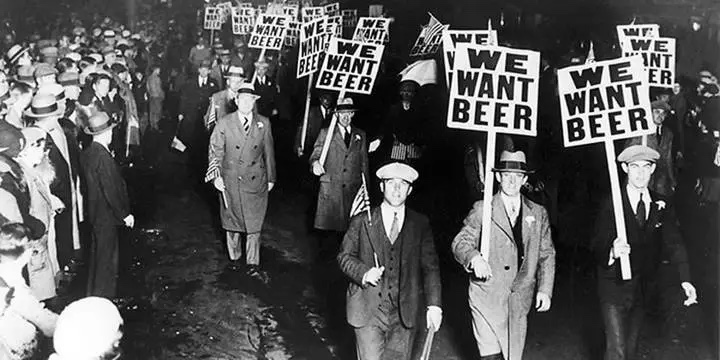
May 14th, 1932 in New York

Today…

Juvenile in the scope of all advancements made thus far, social media platforms are becoming the next dependency. Sure, one could lackadaisically point to the temper tantrum a child throws in response to an authority figure taking away a tablet & call that the sign of dependence but that more closely resembles anger attributed to loss of control. Up to a certain age, a child is simply viewing the tech as a toy & something interesting – half of the kids playing around on mom’s & dad’s phone have hardly any idea what they’re doing or what they’re seeing, they’re just having fun. It isn’t until one is around the teen years that the dependency begins to develop.

Teenagers & adults are better points to assess the progressive dependence on technology that sustains social networking; in the former, there are entire campaigns focused on bringing attention to the addictive nature of social media in a developing mind, studies on the correlation between social media use & teen suicide rates & lately there are proposals by governments to ban teen access to certain apps & limit most that fall under the label of “social media”. In the latter, social media is where most adults find their news, where most of the political rhetoric is being created & utilized & where an increasing number of adults are producing income or at least attempting to.

At this point, the activity on social media reminds me of various games like “The Sims”, numerous “Sid Meier’s Civilization” titles, BitLife & others in the sense that social media has become a false reality wherein the user attempts to affect other entities in a digital plane. Role playing games where one is able to customize their avatar to a high degree also come to mind whenever the idea of “curating” a profile & it’s content comes up in discussion; MMORPGs are comparable to social media in so many ways honestly but the concept of expressing the self in a digital fashion is the primary focus.

Tomorrow…

Social media, across the board, allows anything from anonymity to almost completely unfettered self-expression; some users create entire personas that solely exist online & a relatively fresh example is that of “Lil Miquela” – an avatar created by L.A. based company Brud. Lil Miquela has a few songs on Spotify, 3 million ardent fans & followers on Instagram & has spurred on a slow race between other companies to make their own versions of these advanced avatars.

Some want to create avatars of brand-new, never-before-seen “people”. Some want to create more advanced avatars of ourselves, much like the bitmoji stuff I find a bit creepy. I personally can’t wait to see the creation of the first “digital dependent”.

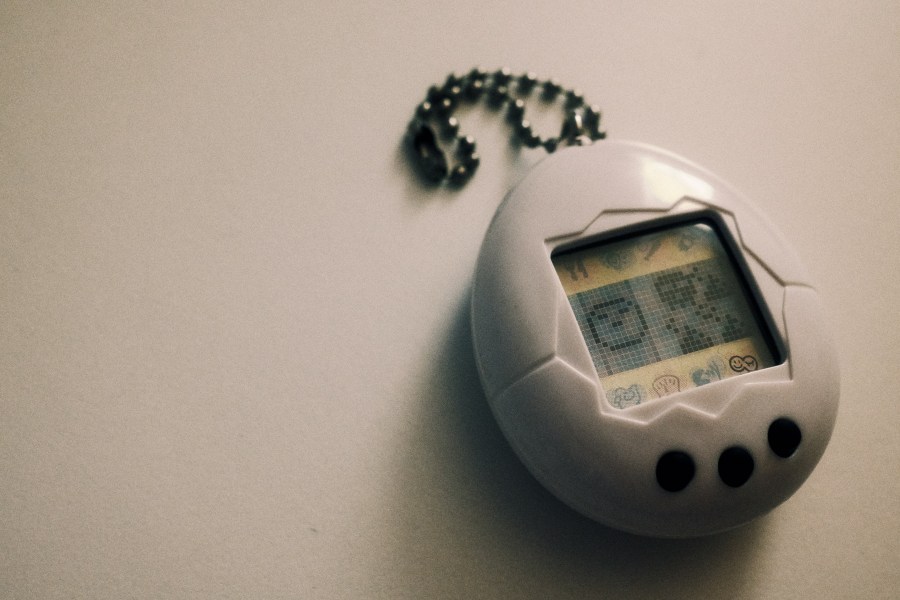
As a kid, one of my favorite shows was called “Digimon: Digital Monsters”; there’s a slew of games based on the series but the prevailing theme is that, there exists, in a digital world accessible by our modern day devices, digital monsters we can befriend, battle with & help evolve as we nurture it like a pet. Released right after the original Tamagatchi’s, Digimon simply took the “digital egg” concept a bit further which led to Pokémon introducing their own egg-aspect to the games & anime just a year later.

In most of these iterations, the player would simply walk with the egg or provide it care in some form. In Pokémon Go, the mobile app, players still do this walking but it is now tracked with GPS & motion sensors in our mobile devices. The same devices responsible for the rapid onset of targeted advertisement, rampant mass surveillance & public documentation of conspicuous consumption, aka flexing on social media.

In due time, thanks to the rampant & often unchecked state of data collection we exist in, the companies working on those digital avatars will proposition the people:

Provide us your consumer data & your health data & we’ll create an online representation of what your child would look & act like! For a yearly subscription, we’ll use our AI to evolve the level of interaction & appearance that mirrors actual human cognitive development. Available to couples, individuals, corporations & communities our digital denizens will be an extension of you!

Already so absorbed with cultivating & curating our own profiles, I can see a future wherein companies appeal to our nature to nurture & desire to create by offering to “assist us” in creating “offspring with an off-switch” & it going over extremely well. The idea of “digital resurrection”, holographic models of dead individuals, has already been introduced to the public through events like the Tupac hologram from 2012, Robert Kardashian “showing up” at Kim’s birthday party in 2020 & now Amazon’s working on it’s Alexa technology to “let people turn their dead loved ones’ voices into digital assistants”.

There’s plenty of apps where you & another person can upload photos of yourselves & see an AI generated example of what your offspring would look like; there’s fertility clinics that offer couples the ability to predetermine the eye color of their coming child; in due time, companies will exist that provide all this & more, for the right price, of course.

Though what is the price for even further mixing the digital plane & the physical? For attempting to curate a persona in a space of manufactured members of society?

Remember that line Wesley wrote?

“Just because sperm and egg are not involved would not necessarily make the resulting entity less human. What should matter is the nature of the thing itself, however brought into existence. Just calling something “synthetic” doesn’t make it so.”

I believe we’re on the cusp of having to deal with these issues, whether we want to or not. The level of dependence on technology thus far has not peaked or begun to plateau & accordingly we must expect progressive integration of human activities involving creation, description & everything in between on the digital plane. We’re not going to be able to ban social media & the technologies of mass communication much like we weren’t able to ban the manufacture of alcohol, so will we see something play out that feels almost surreal as watching an obviously fake avatar take selfies in an obviously real place? Or will we simply accept the advanced integration of the human experience in the digital plane until that’s all there is?

Thanks for reading.

P.S. the digital dependents are already on the way:

https://www.kait8.com/2022/08/21/capitol-records-signs-first-ai-virtual-rapper-fn-meka/

Works Cited

Alvarez, P., 2022. What does the global decline of the fertility rate look like?. [online] World Economic Forum. Available at: <https://www.weforum.org/agenda/2022/06/global-decline-of-fertility-rates-visualised/&gt; [Accessed 9 August 2022].

Sample, I., 2022. Scientists create world’s first ‘synthetic embryos’. [online] The Guardian. Available at: <https://www.theguardian.com/science/2022/aug/03/scientists-create-worlds-first-synthetic-embryos&gt; [Accessed 9 August 2022].

Bailey, R., 2022. Researchers create artificial eggs, chimeric sperm and synthetic embryos. [online] Reason.com. Available at: <https://reason.com/2022/08/05/researchers-create-artificial-eggs-chimeric-sperm-and-synthetic-embryos/&gt; [Accessed 9 August 2022].

Smith, W., 2022. About Those ‘Synthetic Embryos’ | National Review. [online] National Review. Available at: <https://www.nationalreview.com/corner/about-those-synthetic-embryos/&gt; [Accessed 9 August 2022].

Hern, A., 2022. Amazon’s Alexa could turn dead loved ones’ voices into digital assistant. [online] The Guardian. Available at: <https://www.theguardian.com/technology/2022/jun/23/amazon-alexa-could-turn-dead-loved-ones-digital-assistant&gt; [Accessed 18 August 2022].

Photo credit:

https://unsplash.com/photos/unlm6Fxxvjw?utm_source=unsplash&utm_medium=referral&utm_content=creditShareLink

Homage, 2022. [image] Available at: <https://www.homage.com/blogs/news/28550593-we-want-beer-the-parade-to-end-prohibition&gt; [Accessed 18 August 2022].

© 2022 Zakariyas James. First shared here at theruminationcompilation.wordpress.com.

The Products of a New Environment

Are you certain that you’ll reap what you’ve sown?

For the moment, I seek to address those in the southwestern portion of the United States of America & ask those reading from elsewhere to keep an open mind & an open eye. We’re just about halfway into our summer season but we’re nowhere near close to beginning the actual battles that’ll come in respect to water rights & land rights for those in the southwest & eventually the entire nation.

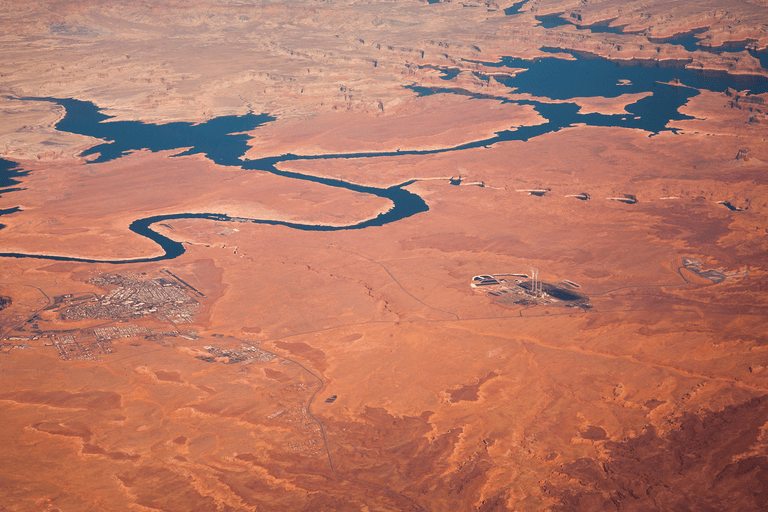
As most are aware, more than a few bodies of water & rivers they connect to are depleting at exigent rates like Lake Powell, Lake Mead & the Colorado River Basin. To note, the “U.S. Bureau of Reclamation officials gave all seven states until August 15 to create a plan to save between 2 million and 4 million acre-feet of water. If they fail, the federal government will take control and impose its own cuts as water use exceeds supply and an ongoing megadrought continues to sap water from the Colorado River.” To clarify, the seven states in question are Arizona, California, Colorado, Nevada, New Mexico, Utah & Wyoming – by August 15th, nearly 40 million people will be subject to regulations & contractual agreements they’ll probably be hearing about for the first time.

Though one could dive deeper into the legal acumen involving water use, I will not be doing that here. I am admittedly more concerned with the present nature of genetic ownership in regards to gardening & farming – I find the issue to be a bit more murky than Leak Mead is at the moment & I believe predetermined agreements between corporations & legislative bodies will exacerbate any water issue regardless of civilian conservation efforts going forward.

Are you certain the things you’ve grown are things you own?

To illustrate the point of a future scuffle regarding “right to grow”, one must only look to existing laws that provide precedent for such an incident.

In a Nature Biotechnology paper from 2015, four authors found that,

“Nonetheless, with the data that can readily be gleaned publicly, our analysis of mapped and referenced patent sequences across the three crop genomes revealed DuPont and its affiliates as the holder of the largest collection of gene patents. It holds more gene patents than Monsanto or the rest of the US industry—including small and medium biotech companies and governmental research institutes and universities—put together (Fig. 1).
Uniquely in the United States, plants and their products can be protected by patents and by other IP mechanisms at the same time. Plant varieties can be protected by a specific plant patent under the Plant Patent Act of 1930 for asexually reproducible plants; by a plant variety protection (PVP) certificate under the Plant Variety Protection Act of 1970 for sexually reproducible plants or tuber-propagated plant varieties; or, since 1985, by utility patents.
Because several types of protection can be granted at the same time—for example, either a plant patent or a PVP certificate with a utility patent—and exclusive rights extend for 20 years, any IP right holder on any of the crops can in principle benefit not only by enforcing their IP rights but also by holding off competition in the market and potentially delaying innovation on certain technologies, especially when the granted rights are under utility patents. Utility patents have a broader scope, including protection on the plant itself, its diverse uses, its progenies and the method used to produce it, and they have an impact on follow-on innovations.”

In summation, bioengineered materials are property, in some way, of corporations that produced them. This fact itself is what lies at the core of most debates around commercial agriculture practices & genetically modified organism (GMOs) as “the biotech industry argues that genetic engineering can be used to create “nature-identical,” non-GMO products. This false claim supports the development of new GMOs in the food supply while side-stepping the current definition of bioengineering and avoiding BE disclosure. Without transparent and reliable GMO labeling, Americans are kept in the dark about what goes into their food” & who really owns it.

The Invasion of the Garden Snatchers

The commercial aspect of gardening, rife with rebranding & business-to-business marketing schemes like any other discernible industry has notably unique moments wherein legislation concerning biological conservation can be tweaked or outright ignored.

While most Californians by now are aware of the issue of the moderately invasive nature of the Eucalyptus globulus (Tasmanian Blue Gum) & the impact it has on soil erosion & fueling fires, certain corporations that operate in the southwest are tactically circumnavigating subnational & national legislation meant to curb the sale of invasive species & they’re becoming increasingly bold in their endeavors.

In all honesty, I work for a large nursery that supplies plants to a number of states & I thoroughly enjoy my job so I won’t be disclosing business practices I can directly speak to that correlate here. Sorry Too Short, this is the one time I don’t want to blow the whistle. That said, I will do my best to display the matter as a basic schematic so as to allow application to any business that potentially falls under the model to be properly scrutinized in a like manner.

Linked here are the 6 agencies overseeing the invasive species list; if you live in California, look at one of the lists the next time you go shopping at a store that has a garden center. For the past year & change that I’ve worked in the industry, a number of the listed plants have been available for purchase & the number of invasive species being sold on the market is growing.

Through genetically manipulating invasive species, commercial growers are able to market the plants as “new varieties” or “regional friendly” – no determinations, to my knowledge, are required by legislation to assess the nature of hybridized or genetically modified plant varieties in regards to local impact on the environments where these lab-produced plants are introduced & established. As the Non-GMO group put it in their blog post, “nothing in nature exists in a vacuum, and it is unnatural to assume that it would.” So it could be said that these lab-produced edible & non-edible plants on the market are potentially as detrimental as the organisms they are based on, unfortunately only time & focused attention will tell.

At the present time, companies like SDG&E are facilitating programs wherein “qualifying SDG&E customers can receive a $35 rebate for planting or potting a 1- or 5-gallon tree/plant species.”

Specifically, under the “native trees” category, the Black Willow is native to the East Coast of the US, not the Southwest; furthermore, the other two Willow species listed are more commonly found in wetlands as their root systems take so much water that is advised not to plant them near septic tanks or drainage fields. Intriguing choices to say the absolute least, though when you look to the “regionally-friendly” trees & see the number of invasive species, it doesn’t seem to matter much anymore. Either SDG&E is misinformed or they’re willing to let the public stay misinformed about the future cost of those $35 since it’s all for “local biodiversity, improving air quality, and sequestering carbon.”

That “sequestering carbon” bit is how a lot of these GMO trees are being pushed on the market & into the ground lately & why the Lorax is one of my favorite films of all time.

Artificial Trees & Grasslands Please

Mass sapling-planting campaigns are nothing new; most of anyone who could read this is probably aware of at least 1-3 moments wherein a company or country just threw a bunch of saplings in the ground. My mothers homeland just went crazy with the idea last year & planted 350 million of them.

Without a doubt, the only certainty at all, is that the most interesting & equally terrifying campaigns are the ones that involve the interplay between genetically modified trees & the cap-and-trade carbon-credit scheme.

MasterCard, a proponent of the cap-and-trade scheme, has a credit card called Aspiration: Zero Carbon Footprint where they “plant a tree every time you make a purchase—and let you round up to plant one too. Using this card just once a day can plant enough trees that, once grown, will counteract your daily negative carbon footprint (unless you’re a real gas-guzzler). Spend daily with Zero to neutralize your footprint and earn up to 1% cash back. Use your rewards to plant more trees or receive a statement credit.”

Call me crazy whatever way suits you, merely afford me a bit more of your time if you’ve yet to read Part 3 of “The Volumes on Vitality” specifically the section on utility tokens.

The “statement credit” Zero Card is vaguely proposing in lieu of planting more trees is rather reminiscent of the utility token FreeWater quickly mentioned on their own site & digital advertisements, along with carbon credits as a whole. Aspirations’ “join us in our mission to plant 125 Million trees by 2030” remark on their website, coupled with the self-implementation of a carbon-credit schematic makes it clear they are probably aware of one of the contracts I mentioned in the blog post that precedes this one. Good old “market forces”!

Another company, Living Carbon, genetically modifies trees in a way that causes “modified poplar trees [to] store up to 53% more carbon than control trees.” In the interview for the article, the CEO Maddie Hall said, “if we were to double the acreage that we have today up until 2030, we would be able to actually plant enough trees to remove 1.66% of global emissions in 2021.” I can’t wait to see how many companies try to buy these GMO trees, then reason to the government & relevant regulating bodies that the trees in question warrant greater carbon capture credit values than purchases of regular trees.

It’s odd though – there is a respectable amount of science regarding carbon capture practices that point out that grass is more of a reliable carbon sink than trees for two reasons: grass grows faster & grass stores the carbon in the soil unlike trees that store carbon in their wood above soil. The carbon above the soil line is pure fuel in the event of a forest fire & hardly the safer choice considering a sizable portion of the US is in a drought & is expected to remain so for the foreseeable future. All this considered, we have a stark prevalence of tree planting campaigns across the globe & across the market & water restrictions across the Southwest that directly impact civilian grass lawn upkeep. It seems as though not all things are considered equally, I should say.

Due in large part to the unequal use of water from the Colorado River Basin, one can see exactly what it looks like when water is continuously taken from one environment & used/left in another. The canopy alongside the canal that exists now is a testament to what Lake Mead will look like (check out 12:16-17:08) in due time, should the water levels continue to recede at the rate they have as shown in the beginning of the video.

But as a whole, what will our collective future be like in regards to water rights & land rights? I often wonder, did the people who wrote the film adaptation of the Lorax just get oddly lucky in retrospect or were they prematurely portraying a theoretical situation where GMO trees modified to capture increased levels of carbon replace natural trees in a system where carbon credits & debits become commonplace across the globe?

Will we prevail through this unifying struggle or will we communally fail, leaving behind only remnants of our attempts to simply survive, much like the Hohokam people who long ago built the canals that the city of Phoenix, Arizona finds inspiration from today?

I don’t imagine these compounding issues can be swept under the rug – we’re talking about the earth itself, where can we sweep it? There needs to be better application of the best practices available to every region afflicted with constrained access to the basics of life, greater attention paid to the outcome of our efforts & actual transparency between civilian, regulator & market. The cool thing is, the civilian is the foundation of the coupled latter & Dr. Seuss said it well enough, “Unless someone like you cares a whole awful lot, nothing is going to get better. It’s not.”

This is not to say we all need to memorize the list of invasive species & self-impose restrictions; on the contrary, in a world where the morality of consumption is debated & designed by market forces & legislation that can oftentimes be overreaching (hello & goodbye 18th amendment) we, the consumer, must become pickier & demand more of the persons seeking to make off with our hard earned money. We must work to see our own requirements met, soon, before there comes a time, for some maybe August 15th, when the only requirements met are those set outside of our control.

Thanks for reading.


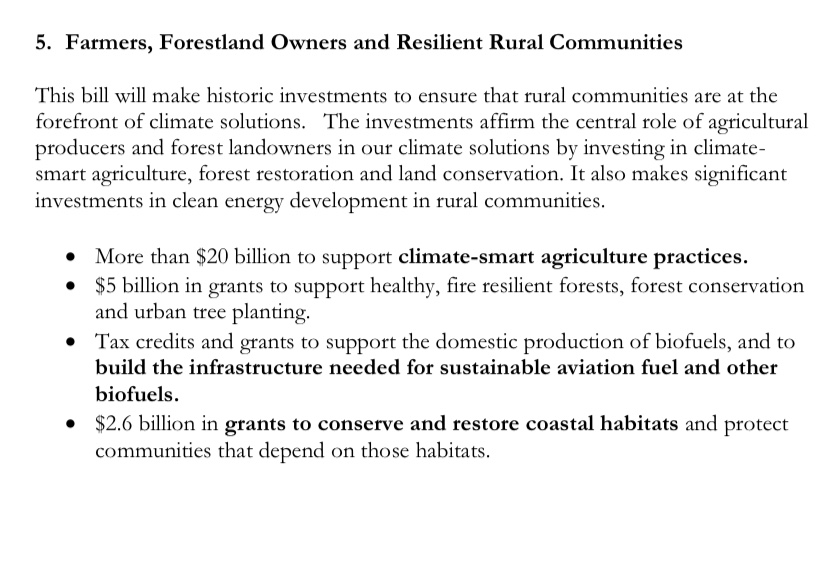
P.S. look at Point 5 of the Summary of the Energy Security and Climate Change Investments in the Inflation Reduction Act of 2022:

SDG&E is salivating I bet

And when you find another 20 minutes of your time affordable to this post, watch this video on the pipeline being built for carbon capture:


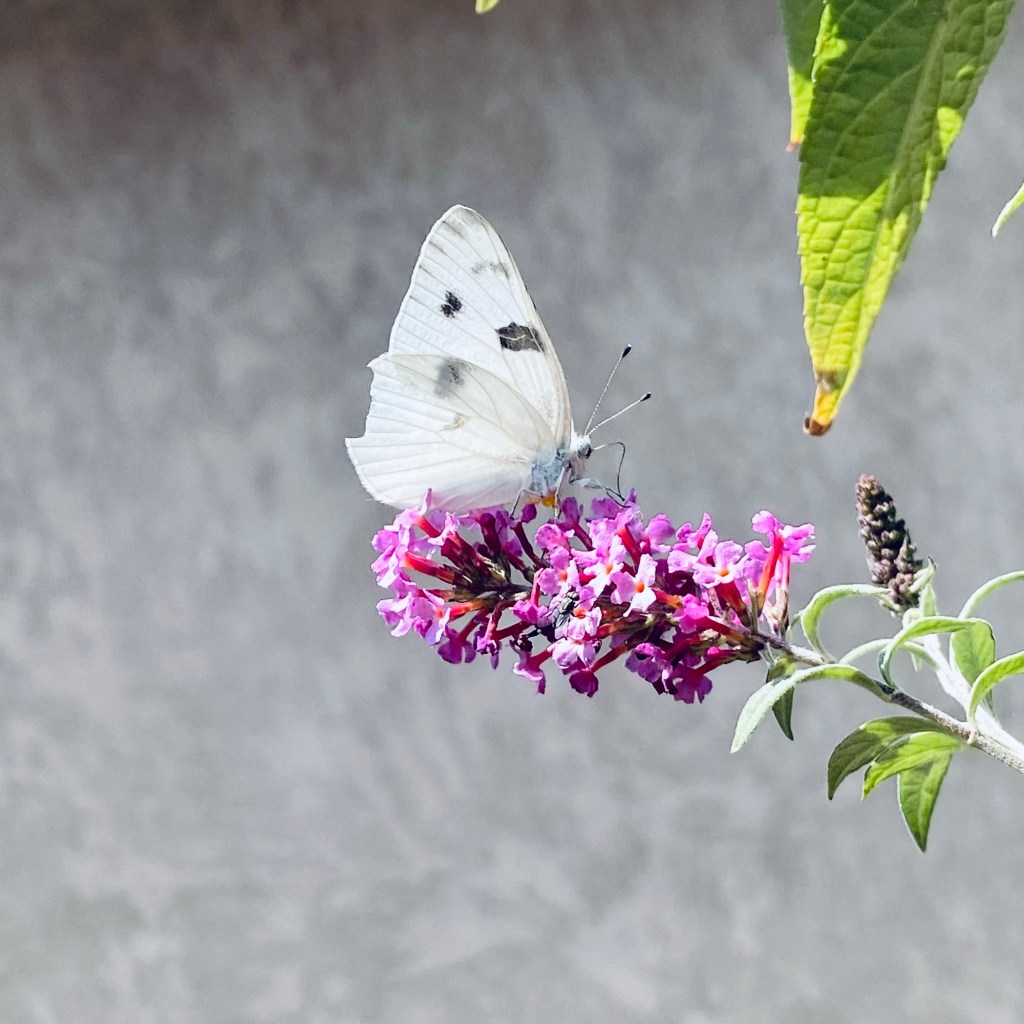
And to cap it all off, a nice photo I snapped of a moth on my balcony enjoying the pollen of a buddleja davidii.


Works Cited:

Swanson, Conrad. “As Critical Deadline Nears, Only Half of a Plan to Save Colorado River Water Has Been Proposed.” The Denver Post, The Denver Post, 22 July 2022, https://www.denverpost.com/2022/07/22/colorado-river-drought-plan-water-arizona-california/.

Jefferson, O., Köllhofer, D., Ehrich, T. et al. The ownership question of plant gene and genome intellectual properties. Nat Biotechnol 33, 1138–1143 (2015). https://doi.org/10.1038/nbt.3393

Non-Gmo Project. “What Is Bioengineered Food? .” The Non-GMO Project – Everyone Deserves an Informed Choice, 8 Sept. 2021, https://www.nongmoproject.org/blog/what-is-bioengineered-food/.

“National Invasive Species Resource Center.” Resource Search | National Invasive Species Information Center, https://www.invasivespeciesinfo.gov/resources/search?f%5B0%5D=location%3A90&amp;f%5B1%5D=subject%3A268.

“Community Tree Rebate Program – SDGE.” SDG&amp;E Community Tree Rebate Program for Residential Customers, SDG&amp;E, https://www.sdge.com/sites/default/files/15897_sdge_treerebate_fs.04.pdf.

“Ethiopia Plants More than 350 Million Trees in 12 Hours.” AFR100, https://afr100.org/content/ethiopia-plants-more-350-million-trees-12-hours.

“Green Credit Card: Carbon-Neutral &amp; Eco-Friendly.” Aspiration, Aspiration Partners, Inc., https://www.aspiration.com/credit.

Kerlin, Katherine E. “Grasslands More Reliable Carbon Sink than Trees.” UC Davis, 25 Oct. 2021, https://climatechange.ucdavis.edu/climate/news/grasslands-more-reliable-carbon-sink-than-trees.

Millison, Andrew. “The Canal That Accidentally Grew a Forest in the Arizona Desert.” Andrew Millison, YouTube, 29 Nov. 2021, https://m.youtube.com/watch?v=jf8usAesJvo.

“Lake Mead Drought Update!!! Lowest It’s Ever Been!!!” SinCity Outdoors, YouTube, 20 July 2022, https://m.youtube.com/watch?v=3Azy88IiVqU.

© 2022 Zakariyas James. First shared here at theruminationcompilation.wordpress.com.
The Volumes on Vitality: Part Three

Platforms of Mobility

Even the Rain

Growing up, I’d heard that someday there would be water wars. Conflicts centered around physical domination of a resource that is already depleting or diminishing in value/utility. I’d heard this from immediate family members, those I’d randomly encounter over the course of a day & the a few forms of content available on the web like this NPR piece from a while back that’s always stuck in my mind.

Though I accept this unfortunate possibility of nations warring over waterways & dams, I often wonder to myself, “what’ll lead up to that? What will the economics of water look like over the course of my lifetime & further on?”

Along the way, going through life with these random thoughts, I’ve come across tidbits of innovation & determinations that I believe paint an abstract picture of what the economics of & around water could look like.

At the moment, the CME Group, the largest financial derivatives exchange in the world, has been offering futures contracts where the underlying asset is water since December of 2020 when California’s entire water market was valued at $1.1 billion. The speculated water spans “across the five largest and most actively traded regions in California. Water entitlement transactions from the surface water market and four adjudicated groundwater basins-the Central Basin, the Chino Basin, the Main San Gabriel Basin, and the Mojave Basin Alto Subarea are included in the index.”

As far as California goes, around 65%, give or take seasonal changes, of the surface water available is in Northern California, hence the mentioning of the basins in the NQH20 index. Most of that water is pumped from the north to south or transported by other means; the rest of the water needed in the south is pumped from groundwater basins regulated by the Sustainable Groundwater Management Act of 2014 & other legislative actions.

To do a bit more in depth research & also try my hand at trading the NQH20 contracts, I contacted the CME Group & one of their registered brokers to open an account but was told I do not possess the capital required to participate in the market. I guess I should cry a river & then trade futures on that supply of water.

In all seriousness, not just because my humor lacks refinement by any standard of the word, I bring this up to echo the sentiment Pedro Arrojo Agudo made when he said, “water is increasingly being treated as a mere commodity and even as a financial asset, undermining the human rights to safe drinking water and sanitation and the sustainability of the environment.” at the UN General Assembly on October 20th, 2021. If I myself, a “middle-class” citizen, can’t access the potential profits from a water market, what sort of hope or outlook should I hold for my future financial status & the mobility of my money? Will it stretch worse in a world where water prices are speculated on by those who won’t even drink that exact water? Or will those gains “trickle down” too & it’ll all be okay?

About a week ago or so, my fiancé brought to my attention a startup company called FreeWater based in Austin, Texas that markets aluminum bottles & paper-based cartons of “free” water “paid for by ads that are printed directly onto eco-friendly cans and cartons. Ten cents per beverage is donated to charity.”

The 10¢ per beverage is donated to WellAware a non-profit based out of Austin, Texas as well that “fund[s] and implement[s] lasting clean water systems to drive development and empower communities in East Africa.” After a bout of equal parts boredom & being nosey, I perused their IRS audits from 2017 & 2020 & noticed the non-profit WellAware, pays a for-profit company called WellBeyond, which is owned by the same individual, also based in Austin, for “project consulting and execution services for the Organization’s program services in Kenya” to the tune of “$237,460 in paid expenditures and $124,823 of in-kind contributions and expenses,” in 2020.

Through pessimistic lenses critical of foreign conglomerates granted unilateral rights of a resource or location, I look at this “free water” scenario as a possible foundational step towards a future where the 1999-2000 water wars of Cochabamba, Bolivia are replayed with new characters. The protests over the wells & water costs inspired a film called (in English) “Even the Rain” that I saw some years ago now; as summer is upon & droughts continue, various scenes from the film cross my mind as of late, especially so when I think of the creeping normalization of water as a commodity.

FreeWater, in their FAQ section, says they’ll be launching “a new type of utility tokens called the FreeWater token.” Ignoring the application of a currency not scrutinized by external securities aspect (hello crypto), I’ve sat wondering how many energy resources will someday have respective “utility tokens” created by large conglomerates; I eventually wonder, will there be tokens or other company-based credit systems for electricity too? Mastercard already has a card in Sweden with a company based there that “not only helps users track and measure CO2 emissions associated with their purchases, but also puts a limit to the climate impact of their spending with a carbon footprint limit.”

Hear me out, I’m not saying blockchain currencies won’t be a part of the future with my jab earlier towards cryptocurrencies in a general way. Earlier this week, Shell Corp., American Express Global Business Travel & Accenture announced a joint partnership to create a company called Avelia Solutions, that facilitates a “blockchain powered book-and-claim solution that provides you with fully traceable environmental attributes of SAF (sustainable aviation fuel) to help decarbonise your air travel.” I see these continued applications of blockchain pay systems & corporate tokens to be indicative of the fact that they’ll be the norm at some point.

As far as innovation besides blockchain tokens & the like goes, technology related to water & other liquids necessitates further discussion on the levels of access & uses of water.

Over the last decade & change, the desalination industry has made improvements in technology & production costs to combat the decreasing level of access of freshwater, researchers at the University of Colorado Boulder have developed a method using microbes to clean both organic contaminants and salts from hydraulic fracturing wastewater, while producing renewable energy & countless other examples can be given but my favorite comes from even further back in time: MagnetoHydrodynamics (MHD).

Popularized by a few Tom Clancy books, MHD systems can be found discussed & funded at length by parties like the US Dep of Energy’s National Energy Technology Laboratory, NASA & the HIT-SI lab, part of the William E. Boeing Department of Aeronautics & Astronautics at the University of Washington.

I’d wager, if this technology that utilizes water as a fuel component becomes widespread with multiple applications (as far vehicles go) water will become even more scarce but truly live up to its designation of “platform of mobility”. In a way, it’s like we might go from ancient, disconnected seafaring peoples that eventually learned flight to evolving into spacefaring peoples that will use water as much as our ancestors did before us, maybe even more.

In my mind there’s a war between all these thoughts; possibility versus possibility, only settled by time passed. Hopefully, we enter a future ultimately lacking in strife that is abundant with the needed resources for us all to equally enjoy the gift of life. I hope we all someday look at a glass completely full, instead of bicker about the determined or perceived volume.

Thanks for reading.

P.S. leave a comment! Tell me of your goals, expectations, concerns for 2022; I hope to create an area where it can all be hashed out.

P.P.S. are there water restrictions where you live too?

Links to ponder:

https://www.newyorker.com/news/letter-from-the-southwest/the-water-wars-come-to-the-suburbs

Added on 8/16/22:

https://www.washingtonpost.com/climate-environment/2022/08/16/colorado-river-bureau-of-reclamation/

© 2022 Zakariyas James. First shared here at theruminationcompilation.wordpress.com.