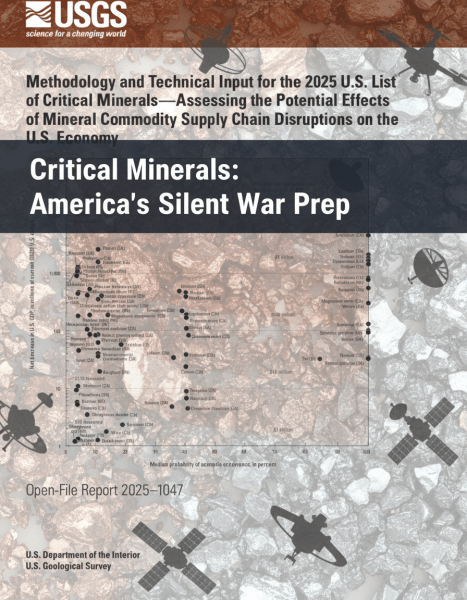
When the U.S. Geological Survey (USGS) updates its critical minerals list, the headlines barely notice. It reads like administrative trivia: a few minerals added, others removed, technical notes buried in appendices. But the 2025 draft list, now including copper, silver, lead, potash, silicon and rhenium, is not trivia. It is a tell.
These are not just “resources.” They are the circuitry, fuel and substrates of distance warfare: drones, satellites, AI servers, hypersonic craft and cyber networks. Naming them “critical” is not geology; it is policy. It signals that Washington intends to underwrite, secure (and if necessary) militarize the supply chains for tomorrow’s conflicts.
If history is the guide we expect it to be, we understand such lists are never neutral. Before WWII, Washington catalogued strategic materials like chromium, manganese and nickel as tanks and planes would have remained sketches without these metals. The Cold War stockpiles of uranium, titanium and rare earths told their own story of nuclear escalation and aerospace competition. Whenever governments build inventories of earth and ore, war usually follows.
Copper
Copper has long been civilization’s wire. Today it is the bloodstream of unmanned systems. Every drone swarm, every electronic countermeasure, every power-hungry radar dome requires copper’s conductive veins. The Pentagon’s own electrification push (from hybrid tactical vehicles to expeditionary battlefield grids) makes copper as strategically indispensable as oil once was.
The USGS data shows about two-thirds of copper production comes from private multinationals, while state firms like Chile’s Codelco anchor the rest. In war, that’s a chokepoint: private profit and public sovereignty tugging against U.S. demand. The federal “critical” designation is the mechanism for resolving that tug, by aligning private output with military need.
Silver
Silver is the mineral of precision. Its conductivity makes it indispensable in the circuitry of surveillance satellites, the sensors on drone wings, the guidance modules of missiles. It’s also the mirror of the heavens: silver-coated panels and optics sharpen the eyes of space-based reconnaissance.
Mexico’s silver (highlighted in USGS modeling as a $435 million GDP risk in the event of disruption) is more than jewelry export. It is the fragile tether of America’s electronic warfare capacity. If WWII needed steel and oil, the drone wars of the 21st century will need silver: it’s in every chip, every reflective surface, every sensor that makes remote systems function in real time.
Lead
Lead sounds archaic, a relic of musket balls. But logistics never sheds old tools. Lead-acid batteries remain the workhorse of backup power, rugged vehicles and forward-deployed comms units. They start engines in the desert, stabilize grids in the field and keep lights burning when lithium-ion fails under cold or cost.
China dominates production, with “private” firms bound to state direction. By putting lead on the list, the U.S. acknowledges what the generals already know: battles are won not just with drones and code but with batteries that still crank when newer chemistries fail in the field or fail the budget.
Potash
Food is logistics. Napoleon’s armies starved; Hitler’s armies sought Ukrainian wheat; America’s mobilization in WWII required fertilizer to keep farms feeding troops and allies. Potash, as a primary input to fertilizer, is not about crops alone, it is about sustaining human capital in war.
With Belarus, Russia and Canada holding the export reins, potash is geopolitically entangled. Its presence on the USGS list signals that Washington understands a modern war economy will not only hinge on missiles and AI but on whether its population (and allied populations) can eat under blockade or disruption.
Silicon
If copper is circulation, silicon is cognition. It is the substrate of AI, the backbone of cybersecurity, the etched brain of every satellite, drone and digital fortress. Without silicon wafers, there are no chips; without chips, there is no digital battlefield.
China’s industrial policy has made it the center of silicon refining. That means the U.S. must either subsidize domestic fabs or militarize semiconductor flows (hello Intel). By declaring silicon “critical,” the federal government isn’t just protecting consumer supply. It is announcing that AI warfighting, drone autonomy and orbital cybersecurity are national defense priorities and that silicon will be commandeered to feed them.
Rhenium
Rhenium is the most esoteric of the six, but perhaps the most militarily revealing. Added to nickel-based superalloys, it allows turbine blades to withstand searing temperatures. Without rhenium, high-performance jet engines melt; without those engines, fighter jets, hypersonics and reconnaissance craft can’t fly.
In WWII, nickel and chromium were critical because they made steel tanks roll and engines run. In the Cold War, titanium allowed spy planes to reach the stratosphere. Today, rhenium plays that role. Its scarcity (less than 10 metric tons globally in 2024) mostly recovered as a byproduct of copper mining makes it a perfect “tell.” It is not industry that demands it at scale; it is the Air Force.
The Historical Echo
Every mobilization has its list. The National Defense Stockpile Act of 1939 quietly laid the groundwork for industrial war, identifying which resources would decide victory or defeat. The Cold War Defense Production Act extended the logic, aligning corporate supply with strategic need. Each list is both an inventory and a prophecy.
The DoD Industrial Capabilities Report underscores the stakes: vulnerabilities in minerals like copper, silicon, silver, rhenium, and lead are national security threats. Adversary control or disruption of these materials would undermine warfighting readiness and the Pentagon already treats this as an operational, not just economic, issue. The USGS 2025 draft list is therefore more than academic: it is the civilian-facing reflection of a military strategy that assumes scarcity could decide battles.
Stimulus or Inevitable Conflict?
The genius of bureaucratic language is that it conceals what it reveals. The report never says “we are preparing for remote wars and orbital conflict” on page one. It doesn’t have to. The list itself is the confession.
By designating these minerals as “critical,” the federal government is signaling that two possibilities are on the table:
- War as Stimulus: Subsidies, stockpiles and corporate alignment redirect production into a defense-driven growth cycle. The late 1930s provide a historical parallel: FDR’s pre-WWII rearmament quietly built the arsenal of democracy while simultaneously pulling America out of the Depression. Factories humming with war contracts were both shield and lifeline.
- War as Expectation: The alternative is grimmer: Washington is preparing for conflict because it expects it: whether in orbital control, cyber escalation, or contested supply chains. Just as FDR’s military buildup acknowledged looming global confrontation, today’s mineral maneuvering may be a recognition that certain conflicts are unavoidable.
Either way, these minerals are no longer neutral commodities. They are instruments of war planning. Copper wires it. Silver refines it. Lead powers it. Potash sustains it. Silicon thinks for it. Rhenium lifts it into the sky.
This is structural war prep: either as a lever for economic revival or as preparation for a fight the state believes it cannot avoid.
Works Cited
1. Nassar, Nedal T., et al. Methodology and Technical Input for the 2025 U.S. List of Critical Minerals—Assessing the Potential Effects of Mineral Commodity Supply Chain Disruptions on the U.S. Economy. U.S. Geological Survey Open-File Report 2025–1047. Reston, VA: U.S. Geological Survey, August 25, 2025.
2. U.S. Geological Survey. “Department of the Interior Releases Draft 2025 List of Critical Minerals.” USGS News Release. U.S. Department of the Interior, August 2025.
3. U.S. Geological Survey. Mineral Commodity Summaries 2025 (ver. 1.2, March 2025): 212 p. U.S. Geological Survey.
4. Bloomberg News. “US Agency Proposes Including Copper, Potash in Critical Minerals.” Bloomberg, August 2025.
5. U.S. Department of Defense. Annual Industrial Capabilities Report to Congress. Office of the Under Secretary of Defense for Acquisition and Sustainment, January 2024.
© 2025 Zakariyas James. First shared here at theruminationcompilation.wordpress.com.
 The Rumination Compilation