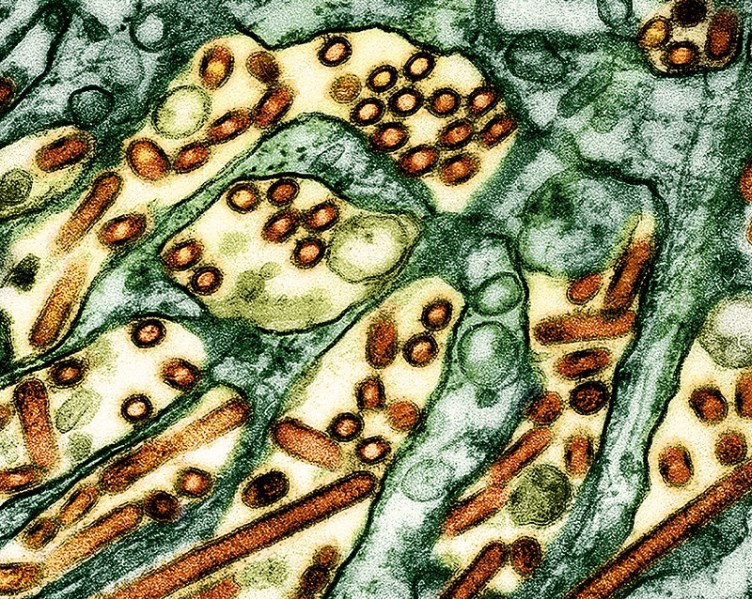
From the wetlands of Asia to the frozen coasts of Antarctica, from the farms of Europe to the forests of North America, H5N1 is moving quietly yet relentlessly. Once called “bird flu,” this virus has slipped through the cracks of public attention, expanding its reach across species and continents. It is no longer just a disease of birds: it is a cross-species contagion, touching goats, pigs, seals, sea lions, cats, cows and numerous other wild mammals.
Yet despite this, media coverage is fragmented and human awareness is uneven. H5N1 is everywhere, but our gaze often stops at borders, political lines, or convenient news cycles. The virus does not respect such boundaries. Its spread is a mirror to our selective attention.
A Global Cast of Hosts
Consider the reach of this virus. Across the globe, new species are being documented with infection and the list is become extensive to say the least (FAO, 2025). In Europe, swans, wild geese, poultry and even foxes and martens have been infected (ECDC, 2025). North America has seen seals, sea lions, wild birds, domestic cats, cows, raccoons and skunks (USDA, 2025). South America reports penguins, sea lions, gulls and other marine mammals. Swine are the historical step before human transmission but because of the amount of mammalian hosts thus far, it could be anything from cattle to sea lions that lead to a mutation that’ll cause the jump (Nature, 2025).
From Antarctic penguins to goats in Asia, from big cats in American sanctuaries to backyard poultry across the globe, the virus leaps in ways that are both biological and symbolic. It reminds us that human, animal and environmental health are never separate; they are threads in a single, tangled web.
The Global Eye: How States Track (or don’t track) Bird Flu
Even as H5N1 spreads across species and continents, the ways in which governments observe it diverge sharply. Some countries maintain strict, systematic surveillance; others glance occasionally; some have turned away entirely.
United States: Federal oversight has receded. The Centers for Disease Control and Prevention treats H5N1 updates as a subset of routine influenza data (CDC, 2025). Voluntary testing programs in dairy herds draw participation from just a tiny fraction of farms. The state’s gaze has shifted elsewhere, leaving large gaps in knowledge.
China: Poultry markets and farms are disinfected daily, weekly, and monthly in a meticulously enforced rhythm (ScienceDirect, 2025). Every bird cough, every unusual death is a signal in a network designed to catch the virus before it leaps.
Europe: Coordinated regionally, member states report any case within 24 hours. A sick bird in Spain triggers alerts across the continent (ECDC, 2025).
India: Reactive measures, like the temporary closure of the National Zoological Park in Delhi after two painted storks died, illustrate intervention that follows tragedy rather than anticipation (Times of India, 2025).
Across the globe, this spectrum of vigilance (from obsessive monitoring to passive observation to deliberate neglect) illustrates the human choices behind surveillance. The virus moves indiscriminately, but our attention is selective. And selective attention, in a pandemic of interspecies proportion, is a choice with consequences.
The most recent iteration of government action related to H5N1 is quite literally a polar opposite of the U.S. approach: The Korea Center for Disease Control and Prevention conducts a national diagnostic test practice mock training for animal influenza human infection (KCDCP, 2025).
A Reflection on Our Relationship with the Wild
H5N1’s march across species and continents forces a question: how do we relate to the wild when it can suddenly turn contagious? When a virus moves from birds to goats to marine mammals, when pets and livestock are implicated, the boundary between nature and human society blurs.
As with other technologies or threats, the unintended consequences unfold over time. The virus is impartial; we are not. Our awareness is shaped by policy, economics and media attention. What we choose to track, or not track, determines not just who gets sick, but who notices, who acts and who survives.
And so the question lingers: if a virus can hop continents and species, why do our eyes remain shut? When does selective monitoring become neglect, when does the world’s quiet whisper demand that we finally listen?
Closing Reflection
H5N1 is not just a threat to poultry or wildlife; it is a mirror of our attention, our governance, our relationship to the planet. The wild was once where humans went to disappear; now it is a place where contagion can travel undetected, where the boundaries between species and borders blur.
We can ignore it, as some states do. We can track obsessively, as others do. But no matter where the virus moves, it challenges every human assumption about control, safety, and care. And perhaps the greatest question is not whether we can stop it, but whether we are paying attention in time.
For further reading on how lobby groups are influencing the U.S. decision to ignore H5N1, see Bird Flu & The Great Disappearing Act.
References / Further Reading
- CDC, 2025 – Global Summary of Recent Human Cases of H5N1 Bird Flu
- USDA, 2025 – Detections of Highly Pathogenic Avian Influenza in Mammals
- ECDC, 2025 – Avian Influenza Overview
- WOAH, 2025 – Avian Influenza
- Nature, 2025 – The Global H5N1 Influenza Panzootic in Mammals
- Times of India, 2025 – Bird Flu Deaths in Delhi Zoo
- FAO, 2025 – Bird & Mammal Species Affected by H5Nx
- KCDCP, 2025 – The Korea Center for Disease Control and Prevention conducts a national diagnostic test practice mock training for animal influenza human infection
Photo credit: NIAID
© 2025 Zakariyas James. First shared here at theruminationcompilation.wordpress.com.

 The Rumination Compilation