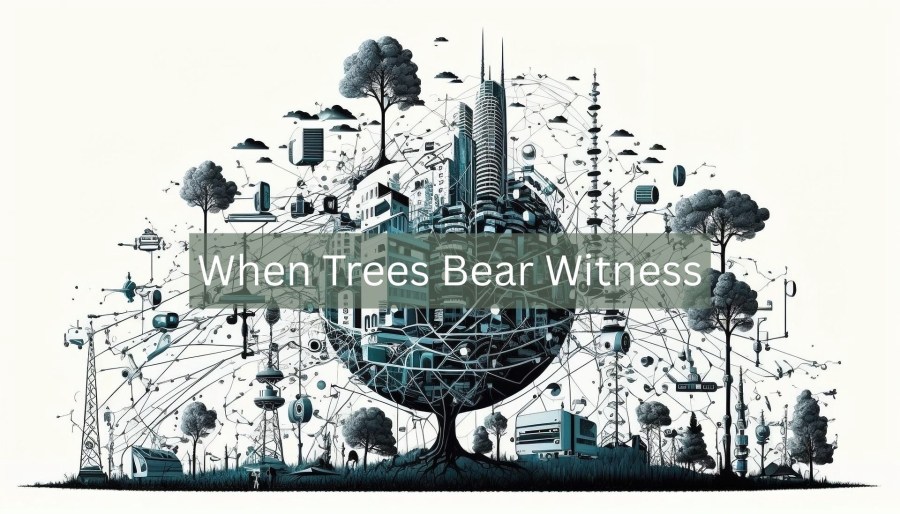
Give it some time, the trees will start listening to you. A device once used only to track growth rates is now the seed of something else, a quiet grafting of the forest into the cloud.
Dendrometers (used to measure the growth of trees and other plants by monitoring changes in diameter) have gotten a recent boost in applicability for more than just forest management teams. Thus far, they’ve allowed forest managers to cut down site visits needed to gather data on tree growth and carbon capture rates, but because of a recent innovation, much more is possible and I want to paint a picture for you.
As per usual, what begins as a gesture to efficiency, a nod to preservation, may warp into something far more insidious.
The company Treemetrics, working alongside the European Space Agency, created sensors that link through wide-area networks and satellites, feeding streams of data into a platform called Forest HQ. If your tree is growing, Forest HQ knows. The forest becomes an extension of the cloud, feeding numbers related to diameter growth, height, location—change of all sorts. So, the forest is no longer a place. It is a feed. The company calls this project the Internet of Trees.
The logic is seductive: better measurement equals better care. Carbon accounting strengthens climate response. Carbon credits for the cap-and-trade markets gain more authenticity. But inside that necessity lies a governance architecture: every tree, instrumented; every growth curve, visible; every beat of the forest, rearranged as data. A swarm of data waiting to be further monetized or weaponized—unfortunately, humans do one or the other. Often both.
I know what I will soon describe may seem altogether far fetched, but it does not take much imagination to see the scope widen in the way I expect given the right amount of time.
The slope is not hard to imagine. Already, forests are wired with listening devices meant to detect chainsaws, trucks and any other prohibited criteria. Artificial intelligence runs on-site, flagging the sounds of illegal logging before they reach the cloud. It is admittedly clever, even noble. But anything involving criminalization soon collapses into categories: nuance is stripped, anomalies are flagged, people are reduced to signals.
We’ve seen this arc before. The Global Positioning System was once sold as a gift for navigation: finding your way home, never getting lost. Now it’s the backbone of precision strikes and geofencing. Closed-circuit television cameras were rolled out for “public safety.” Now they’re stitched together in networks that can track a face across an entire city and can even recognize your gait amongst a crowd. Social media began as a way to connect with friends and now it’s a sprawling apparatus of profiling, targeted persuasion and behavioral nudging.
Each began as benevolent. Each hardened into control.
For a good number of technologies, the arc of applicability tends to bend toward something darker. Monetized until meaningless or weaponized against anyone not in control of the weapon.
What begins as protection of ecology can just as easily become the monitoring of people. A hiker’s footsteps, a group of protestor’s chants; any human activity can be parsed as anomaly, pinged to headquarters. With the right contracts, the forest becomes surveillance infrastructure, camouflaged in green.
What if Forest HQ evolves from tracking growth to performing guard duty? What if the forest ceases to be wild and becomes a grid, mapping bodies as much as making bark?
Conveniently, this year a viral post showcased a new service from XFinity that uses WiFi signals to detect motion in your home, “without relying on sensors or cameras.” The technology has existed for years, but only now is it being pitched as household convenience. Tracking once reserved for homes and offices will soon extend to the wilderness.

This shift matters not only technologically but culturally. What happens when forests are no longer trusted as wild refuges, but feared as watchtowers? What happens to the human imagination when trees are not symbols of mystery or sanctuary, but extensions of a monitoring state? Jokes about birds not being real will lose their humor. Children will hesitate or outright refuse to climb a tree.
Surveillance always arrives dressed as care. It comes with drones, dashboards and dragnet data streams in the name of stewardship and security. But benevolence, left unexamined, can harden into coercion. The trees will stop watching silently; they start reflecting, transmitting, bearing witness.
And so the question lingers: at what point does monitoring, however noble its pitch, become policing?
Throughout our history, the wild was once where we went to disappear. Now it has the potential to be where we are found most easily.
For more reading on how technological advancement affects our interaction with nature and cultivated products, see The Products of a New Environment.
© 2025 Zakariyas James. First shared here at theruminationcompilation.wordpress.com.
 The Rumination Compilation