
America’s Warpath Towards Corporate Control

Do you feel it shifting yet?
It is subtle, but unmistakable. The United States is stepping beyond ordinary economic support, slipping into direct ownership of private enterprise. Owning ten percent of Intel is not a bailout, it’s a strategic maneuver.
The Intel chip foundry, powering every drone, missile system, satellite and cyber-defense operation is now partially tethered to Washington. This is the war economy coming alive again.
Let us walk this through.
(Cue the Battle Hymn of the Republic)

Intel as the New Arsenal

On August 22, 2025, the administration converted federal CHIPS Act grants into a ten-percent equity stake in Intel. The stake carries no voting rights, yet it signals Intel’s further integration into the national defense apparatus; chips are now synonymous with weapons.
While the government claims this move will not interfere with day-to-day operations, history shows that ownership (even without governance) aligns strategic interests with influence.
Consider SkyWater Technology, a U.S.-based semiconductor foundry specializing in radiation-hardened chips for high-altitude craft and satellites. With deep collaborations with the Defense Advanced Research Projects Agency, it stands as the only American-owned pure-play foundry of its kind, making it a likely candidate for future government equity. If Intel is the visible fortress of U.S. semiconductor capacity, SkyWater may be the shadow arsenal woven into defense.
This is not mere industrial policy, it is war economy logistics; the state is embedding itself into the supply chains critical for military readiness.

A Repeating Playbook

In both World Wars, the U.S. government nationalized railroads, seized control of the telephone system and created the Defense Plant Corporation to build and lease munitions factories. These assets were returned or privatized in peacetime and the pattern has been repeated: wartime central planning, privatization in peace. Today, semiconductors are the new artillery; Intel’s stake could be the new assembly line.
Likewise, the Department of Defense’s $400 million investment in MP Materials, the only significant rare-earth mining company in the U.S., mimics wartime strategy: securing magnet supply chains for guidance systems, drones and missiles.

What Industries Are Next?

Semiconductors were just the opening salvo. The war economy model is poised to extend into:
• Rare-earth elements and strategic metals: MP Materials already shows the model.
• Battery minerals such as lithium, graphite, and cobalt: critical for advanced munitions and energy systems.
• Oil and natural gas infrastructure: needed to sustain fleets, aircraft, and command centers.
• Advanced manufacturing for aerospace, hypersonics, and AI systems.

Silver’s Role in Military Tech and Munitions

Silver is indispensable in modern warfare for its superior conductivity and reliability. It features prominently in military electronics from radar and guidance systems to circuit boards.
• Conservative estimates put cruise missiles silver usage at about 15 per missile.
• Defense contractors manufacture silver-zinc batteries for missile families such as Patriot, Tomahawk, Hellfire, THAAD, and JDAM to power guidance, telemetry and control systems.
This demand makes silver a strategic resource and yet supply remains volatile. It is likely to become a target for government safeguarding or supply-chain oversight. If not from a military perspective, the government may involve themselves in the industry solely to manipulate cost of acquiring the metal for all industrial use.

U.S.–Ukraine Minerals Partnership

On April 30, 2025, the United States and Ukraine signed a landmark minerals agreement establishing a United States–Ukraine Reconstruction Investment Fund, equally managed by both governments. Ukraine retains ownership of its subsoil and resources, while 50 percent of new project revenues (across rare earths, lithium, titanium, uranium, graphite, oil, and gas) will flow into the fund. U.S. military aid counts as contributions and there are no debt provisions on past aid.
Ukraine’s parliament has since ratified the deal, envisioned as both a reconstruction and strategic investment vehicle. However, actual economic benefits are projected to take a decade or more due to damaged infrastructure, outdated geological data, and active conflict zones as many resource-rich areas remain under Russian control.

Strategic State War Economics

This is not European-style dirigiste planning in peacetime, it is America preparing its economy for conflict. From railroads and refineries to rare-earth mines, semiconductor fabs, critical minerals and silver-dependent munitions. The pattern is clear: when the United States identifies a threat, it turns not merely to regulation or subsidies but to ownership and control.

Ownership as Armament

America is once again rewiring capitalism for conflict. The Intel stake may feel disconcerting because it is not a standard industrial policy, it is war economy policy.
Will this be temporary, like past wartime interventions, or permanent like the Tennessee Valley Authority? That is the question.

In some respects, these recent developments from our government resembles a form of economic warfare conducted in the open but rarely acknowledged as such. The factories, the mineral rights, the intellectual property, they have all become fields of contest rather than fields of commerce. A document that circulated decades ago, Silent Weapons for Quiet Wars, framed the notion that a population could be subdued not by force of arms but by systems of policy, scarcity and control. Ignoring whether it should be viewed as allegory or leaked strategy, the thesis lingers: today’s corporate stakeholdings and mineral seizures may not be silent weapons in the literal sense but they echo the idea that war has shifted into quieter, more pervasive forms. If the weapon is silent and the war is quiet, how would we recognize we are even at war at all?


For more insight as to how likely it is the U.S. is prepping for a major conflict, see Critical Minerals: The Silent Tell of a War Economy.

© 2025 Zakariyas James. First shared here at theruminationcompilation.wordpress.com.
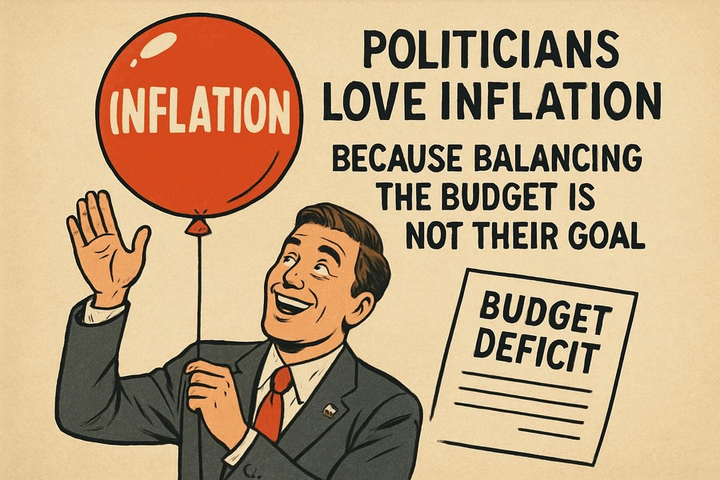
Shadow Inflation & the Price of Freedom

You’re not losing your mind, you’re losing your purchasing power.

Everything from groceries to rent to basic utilities has crept into unaffordable territory, but somehow the government insists inflation is around 3.3%. To most of us, that number feels like a punchline with no setup.

ShadowStats, which calculates inflation using methods from before the 1980s CPI revisions, suggests it’s actually over 9%. That sounds far more in line with what you feel in your bones and your wallet, doesn’t it?

The difference isn’t just mathematical, it’s philosophical. It determines whether you believe our society is slowly progressing or quietly deteriorating.

And at the center of that delusion sits the green tech movement: an ideal pushed by agreements between supranational organizations and state governments, built on commodities like silver, which ironically is one of the few tangible lifeboats left in an era of untethered money, misrepresented data, and unsustainable goals.


CPI: The Numbers Game That Makes Poverty Look Like Progress

In the early 1980s, the U.S. government began quietly redefining inflation. It didn’t look good on paper to say retirees needed 10% annual increases in Social Security checks. It looked even worse for Treasury bondholders expecting “real” returns.

So instead of wrestling inflation down, policymakers redefined how it was measured.

They introduced terms like:

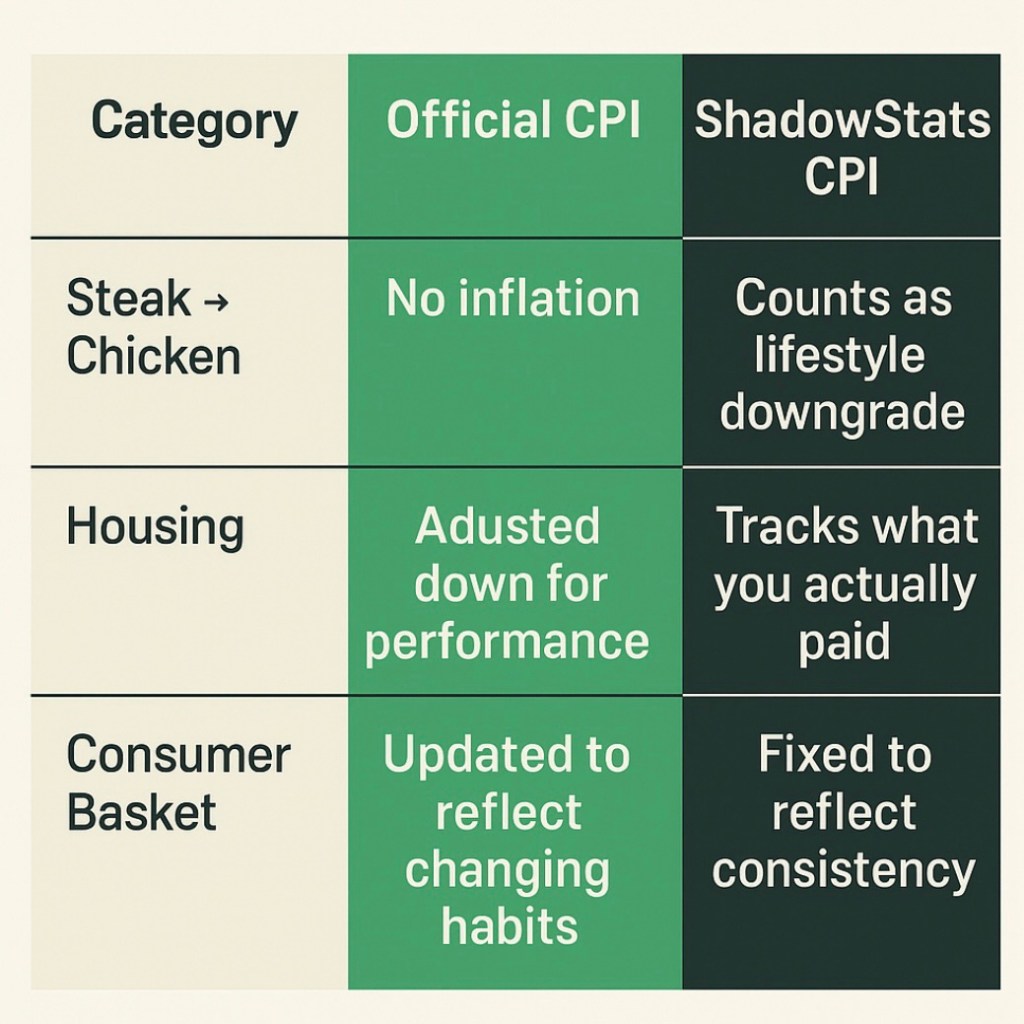
  • Substitution: If steak gets too expensive, CPI assumes you switch to chicken. Inflation problem solved.
  • Hedonic adjustment: If your laptop is twice as fast, they say you’re paying less for it—even if it cost you more dollars (source, second bullet point).
  • Owner’s Equivalent Rent (OER): Instead of tracking what you pay in housing, they estimate what your home might rent for, based on surveys. (Crazy isn’t it?)

These methods were sold as ways to make CPI “more accurate,” but what they really did was make inflation more palatable to policymakers and debt managers. They also did it to make sure you and I kept racking up debt and consuming more each quarter.

Official inflation numbers rely on mechanisms that hide the erosion of lifestyle:

These adjustments treat your survival adaptations like buying cheaper food, delaying car repairs, moving back in with family, etc as market choices rather than signs of stress.

You’re not living worse, they say you’re just living differently.

Here’s what the former Fed Chairman Alan Greenspan said in 1995:

“If you are measuring the cost of living, you must measure the cost of maintaining a constant standard of living. If you substitute chicken for beef, you are not maintaining the same standard.”(https://www.nytimes.com/1995/12/04/us/inflation-gauge-may-be-too-high-experts-say.html)

The BLS has been doing the opposite for decades.


Green Tech: The Utopian Offramp Built on Industrial Scarcity

Enter the Sustainable Development Goals and the “just transition” to a greener future. Electric vehicles. Wind turbines. Solar panels. Battery storage. Carbon offsets. All tied to the years 2030 and 2050 as I’ve outlined in more than a few posts on this blog.

The problem? Every one of these systems relies heavily on silver, a finite, mined metal with growing industrial scarcity. According to the Silver Institute, solar panel production alone is expected to account for over 25% of annual silver demand by the end of this decade.

The price of silver has risen 43% year-to-date as of July 2025. Gold is up roughly 22%. Compare that to:

2025 YTD Return

NASDAQ +15%

S&P 500 +10%

DJIA +5.5%

So let’s check the math. If inflation is only 3.3% (official CPI), then those stock market gains look decent. But if ShadowStats is right, and inflation is closer to 9%, then:

  • The Dow Jones is posting a negative real return.
  • The S&P 500 is barely breaking even.
  • Even the NASDAQ, with its AI hype and tech surge, is only modestly positive in real terms.
  • Only silver and gold are delivering substantial real returns after adjusting for actual inflation.

This is the moment where you realize: only one entity will be paying for the widespread retrofitting and implementation of all this green tech that needs silver and it’s you. Either through willing compliance or taxation by the government so they can buy it with your wages and make you use it.


Hedonics, Hopium, and the Silver Choke Point

The CPI tells you that your phone is getting cheaper, even if you spent more on it, because it has better specs (source, first bullet point).

The ESG movement tells you your energy is getting cleaner, even if your utility bills are rising, because it’s coming from renewables.

But here’s what they don’t tell you:

  • Silver is irreplaceable in high-efficiency solar, circuit boards, EV contacts, and grid storage.
  • No large-scale replacement exists.
  • We are burning through reserves faster than we are discovering new viable deposits.

That means the very commodity needed to “fix” the future is becoming more expensive, even in inflation-adjusted terms. And that creates a dilemma no policy paper can solve.


Silver: The Honest Asset in a Dishonest System

In a world where official CPI is engineered to deflate your sense of decline, silver doesn’t lie.

  • It doesn’t get adjusted for quality.
  • It doesn’t get substituted.
  • It doesn’t get hedonicized.

It just reflects what a scarce, in-demand physical asset actually costs in a world of paper promises and underpriced labor.

And unlike fiat currencies or ESG credits, silver is outside the system. That’s why central banks don’t talk about it, and why retail investors who understand its utility in both monetary protection and energy transition are quietly accumulating at Costco before getting a hot dog and soda.


The Fatal Irony of Sustainable Progress

We are trying to build a green future using a grey metal whose supply cannot scale with our policy ambition. The Sustainable Development Goals require a miracle of material availability that simply doesn’t exist.

If silver prices are outpacing even ShadowStats’ inflation, then the affordability of the clean tech utopia vanishes on arrival. And if real inflation is devouring your market returns, then the dream of using “compound growth” to escape stagnation is mathematically dead.


Compliance or Sovereignty: There Is No Third Option

If you’re not holding assets that outpace real inflation (like silver or gold or the next randomly pumping stock) then you’re not preserving wealth. You’re slowly converting it into obedience.

Because what happens when your savings can’t keep up?

  • You’ll be offered government rebates for heat pumps.
  • Carbon credits for commuting less.
  • EV mandates.
  • Sustainability scorecards tied to your bank account (like that Aspire card I mentioned a few posts ago).
  • Access granted in exchange for compliance.

If you can’t buy your way out of the system, you’ll be forced to conform to it.

Green tech won’t be a lifestyle choice. It will be a behavioral requirement coded into policy, enforced by banks, and justified by a CPI that says “everything’s fine.”


Final Thought: Scarcity Isn’t the Problem—It’s the Lie

ShadowStats reveals how far we’ve drifted from price reality. Silver shows how tangible scarcity still has economic weight, how truth leaks out where it can’t be hedged.

And if you’re still counting on index funds and CPI-adjusted retirement accounts to protect you, ask yourself:

What happens when the growth you’re chasing is just inflation in disguise?

Silver isn’t just a hedge. It’s a mirror. And the reflection it shows is too uncomfortable for mainstream narratives to tolerate.

© 2025 Zakariyas James. First shared here at theruminationcompilation.wordpress.com.
An Ounce of Silver & More than An Ounce of Delusion

[Update – October 2025: When this piece was first published in July 2025, silver traded at $38.32 per ounce. As of this update, it sits near $51.60 — a 34% increase in less than four months. Every dollar rise in silver’s spot price compounds the already-underestimated cost of “green” manufacturing, storage, and infrastructure. The same scarcity dynamics I described below are now playing out in real time.]

There’s something ironic in how silver doesn’t match the weight it now carries, even when labeled on bullion.

It’s the best conductor of electricity, it’s antimicrobial and for thousands of years it acted as a monetary metal. For centuries it has been ornamental or a tool of commerce or consumption (think silverware) and now it finds itself increasingly involved in the infrastructure of a repeatedly promised future: solar panels, electric vehicles, grid storage systems, and the increasingly complicated web of “green” innovation spurred on by Sustainability Development Goals created by the U.N.

Excited conversations on TV and other blog posts discuss these technologies as if they’re incorporeal though. Guaranteed but incorporeal. As if solar energy arrives by virtue of political will or increased taxation, that EVs emerge from factories every quarter to appease shareholders and to respond to inevitable increases in consumer acceptance.

“People will want EVs when the range per full charge surpasses ICE gas mileage!”

But silver is physical. It is mined, refined, shipped, spent. However, there is only so much of it and fiscally speaking, only so much that it can be used on before the next thing that requires it is just too expensive.


Paper or Physical?

The silver market is quiet in the way illusions are quiet.

Prices have remained strangely stagnant; even as demand rises from every direction, prices have been relatively flat. Silver is only up about 94% in the last 4-5 years, even amidst the obvious increase in solar panel production & EVs all over.

But there’s a clear reason: most of the silver traded in financial markets isn’t silver at all. It’s “paper silver”—contracts, ETFs, and other abstractions that represent claims on silver rather than silver itself.

This paper silver is stacked and restacked, layered so thick that for every ounce of physical metal, there are about 300 paper claims for every physical ounce. These instruments are cheap and convenient. They give the appearance of liquidity. They help manufacture downward pressure on a metal that is worth more each and every day that governments push the green future they’ve committed to with Sustainability Development Goals.

But try to build a solar panel with an ETF. Try to wire a battery with a futures contract. Buy a paper claim for a 1,000 ounces of silver and try to claim ownership; it’s a bit more convoluted & difficult than you’d think.

But that’s because markets pretend there is abundance when the mines quietly say otherwise.


Domestic Dependence

The U.S. mines very little silver on the global scale.

Most of it comes as a byproduct—scraped from zinc, lead or copper operations already past their prime. Mexico, Peru, and China dominate the supply chain.

Still, federal and state initiatives in the U.S. continue pushing solar incentives, EV mandates, and infrastructure investments without asking the most basic question: is there enough material to meet these goals?

Independence in energy policy without independence in materials is not independence at all. It is an illusion with a timer or an attempt at convincing the public that independence exists at all. How can each nation experience independence in a global economy attempting to deal with a global problem like environmental protection?


The Math That Isn’t Discussed

There are roughly 260 million licensed drivers in the United States. If half of them eventually drive electric—an optimistic yet increasingly standardized projection—that’s 130 million EVs.

Each EV contains roughly 25 to 50 grams of silver. Taking the midpoint:

130,000,000 × 40g = 5.2 billion grams of silver
= 167 million troy ounces

That’s one-fifth of the entire global silver production in a year (~800 Million ounces) just for U.S. EVs.

Now consider rooftops. There are around 82 million owner-occupied homes in the U.S. Maybe 60% are viable for solar. That’s 49 million rooftops.

Each home installation uses about 700 grams of silver, on average:

49,000,000 × 700g = 34.3 billion grams of silver
= 1.1 billion troy ounces

That’s more than all the silver the world mines in a year, just for U.S. homes. We expect this for all the nations involved in international agreements like the Paris Climate Accords and the 2050-centered plans from the U.N. so these figures throw a lot of things into question.

This doesn’t cover batteries, none of the redundancy systems, commercial arrays, or military contracts. No export demand. No global population growth. Just drivers and rooftops. Already unfeasible. This doesn’t even cover the actual dollar cost of simply buying the necessary amount of silver.

At the time of writing, silver is trading hands at $38.32 USD.

So that 167 million Troy ounces needed for just the vehicles? That’s just shy of $6.4 billion and that’s a figure expected to be paid in part by us, the consumer, upfront and more than likely down the road through taxpayer funded subsidies to accelerate EV adoption.

(There’s about an average of 62 ounces of pure Lithium in an EV battery; at $1.93 an ounce for refined lithium, it’s obvious the real price constraint will eventually be silver.)

The 1.1 billion Troy ounces needed for the solar panels? That’s about $42 billion, another cost we can attribute to the federal deficit and consumer spending.

These are not “if” numbers. These are baseline assumptions. The kind that policy was supposed to be built on.


Technology Without Materials

We’ve been taught to think of green energy as a software problem. That with the right code, the right algorithm, the right policy tweak, we can unlock a clean, efficient, endlessly scaling future.

But materials don’t scale like software.

Silver is not a “tech solution.” It is a finite, mined resource that lives in geological time. Once it’s pulled from the ground, used in a panel or circuit, it is largely unrecoverable. There is no efficient way to recycle the trace amounts embedded in electronics or laminated into photovoltaic cells.

So while the software runs smoother every year, the hardware gets scarcer. Especially now that Costco is selling silver to the masses; it’s estimated they’ve already sold anywhere from 20-30 million Troy ounces of silver since January of 2024.

Industry is now competing with citizens of nations dealing with currency devaluation and governments with bad budgeting in its blood.

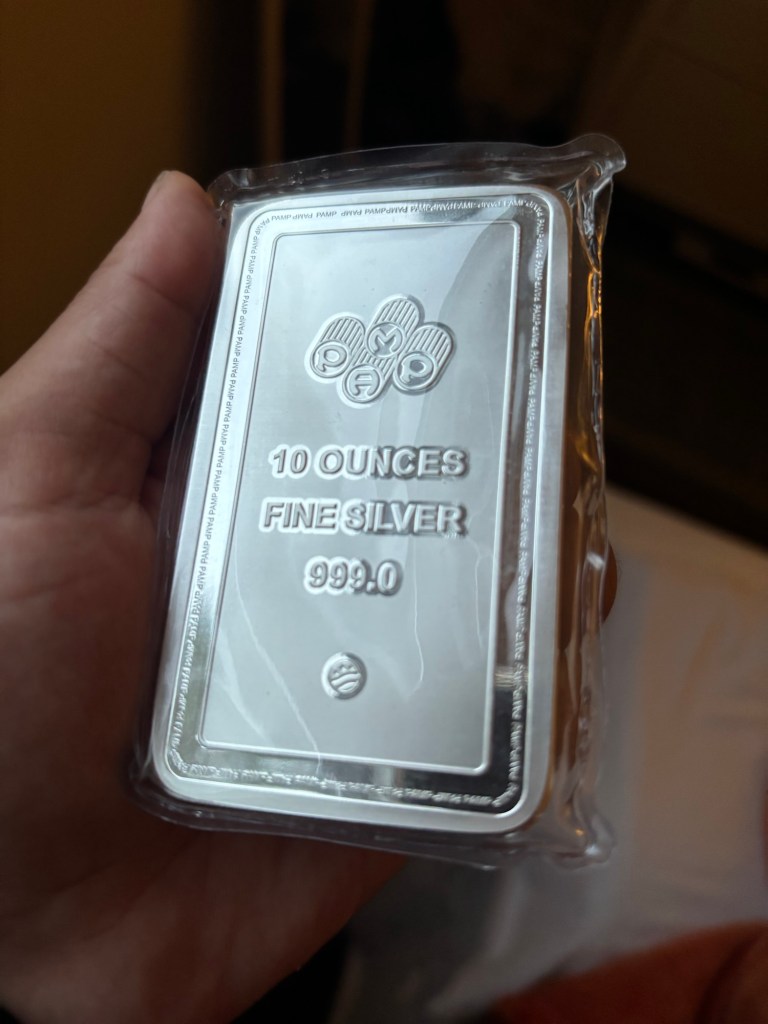
One of those 10 ozt PAMP Suisse bars from Costco doesn’t even equal a full solar panel; it’s just enough to finish making about 7 EV batteries though!

Quiet Disappearances

If silver were priced according to its utility—its indispensability to the green transition—its value would be multiples higher. But that would disrupt the illusion. It would wake the markets. It might even force a reckoning with how we plan, and who gets access to these technologies when scarcity arrives. (On another note, it would also break a couple banks since there’s a large short position affecting silver price discovery but that’s a whole other story you should read up on elsewhere.)

So the system does what it’s good at. It mutes the signal.

Silver’s price is managed, its physical demand obscured by the over-issuance of paper derivatives. Meanwhile, physical silver disappears—not in vaults, but into solder points, busbars, and circuitry. Into machinery that will work until it breaks and be too costly to recover when it does.

This is not theoretical. It is measurable. It is ongoing. It is irreversible on any policy-relevant timeline.


The Consequences of True Price

Here’s the part no one likes to say out loud:

If silver ever reaches a price that reflects its real utility and real scarcity, millions of people will be priced out of vehicle ownership—permanently. This can especially said with certainty for any jurisdictions that mandate EV adoption by way of phasing out ICEs or increasing daily taxation for driving an ICE vehicle like London does already.

But not because of a shortage of cars. Because of the materials required to build them. If silver doubles, triples, or reaches the kind of price discovery that gold once saw, the cost to manufacture electric vehicles and solar panels will skyrocket. That cost won’t land on corporations. It’ll land on people.

The very people these transitions were supposed to serve.

Middle-income households. Rural drivers. Lower-tier homeowners trying to insulate themselves from rising energy bills. They’ll be handed a clean-energy future they can’t afford to participate in.


Not Fragile Like Glass—Fragile Like a Lie

This isn’t just about silver.

It’s about what happens when we shift from one form of dependency to another and pretend the second is progress. Fossil fuels were finite and demonized for being dirty. But critical metals are finite, dirty until refined and polished; will they be demonized or will we make a beast out of the burden of allocation for these green dreams?

Silver is not the only material with a bottleneck. But it may be the first one to snap and it has reason to be called the most important material in the effort to advance green technology adoption across the U.S. and the other nations party to the U.N. climate goals.

And when it does, we’ll realize we didn’t build a transition. We built a fantasy. One that is clean on the surface, fragile underneath, just waiting for the first real demand to break it.

What we’re probably heading towards is a two-tier society built upon who has precious metals & who doesn’t.

Sounds sort of like we’re regressing to a world of kings and peasants doesn’t it?


When this piece was first written, I estimated the silver cost of producing 167 million EVs using $38.32/ozt spot price. At today’s $51.60, the same calculation jumps from roughly $6.4 billion to $8.6 billion, a reminder that “sustainability” priced in fiat ignores the finite nature of the materials that make it possible.


For more content related to silver, I’d recommend the Bald Guy Money YouTube channel, David Jensen’s Substack and Maneco64 on YouTube as well. These 3 individuals have the best grasp on why silver is probably one of the most interesting metals, it’s got conspiracy, history, importance for the future, it’s got it all.

© 2025 Zakariyas James. First shared here at theruminationcompilation.wordpress.com.

Something to share

Last year, I spoke at a city council meeting in Vista, California where the focus was on the “General Plan”. This “General Plan” is Vista’s version of California state’s “Climate Action Plan”. Since 2011, California law has mandated that every city have a General Plan, but only recently have cities started hosting meetings and workshops to involve community members in discussing what citizens want in the plan and marginally clarifying what citizens should expect the plan’s fruition to really look like.

For context, prior to the meeting, I prepared 3 questions to ask the city officials regarding the General Plan & provided each a copy of the questions to follow along as I spoke. Admittedly, I didn’t expect anything other than outright dismissal of my questions but I was extremely wrong. I got a response I need to share with you.

Before I do that, I want to separately address any potential readers based on geography:

⁃ Citizens of Vista, if possible, start going to the meetings for the General Plan & listen to what’s coming. I know it’s hard to carve out time with all that life sends our way but if you have any level of concern for future of the city (or your place in the city) show up to one of these specific meetings & listen to the plan they have in mind for the city, bearing fully in mind what Commissioner Looney says from 6:30-9:42 in the video below.

⁃ Citizens elsewhere, google whatever state you live in along with the words “climate action plan”. If your state has has one, check & see if a law was passed requiring the city you live in to adopt a climate action plan (CAP) or general plan as well. Since 33 states already have, I’d almost bet on it, so if it happens to be so, I suggest watching the clip below & asking yourself “is what Commissioner Looney says from 6:30-9:42 going on in my city too?”

Sorry this is a long video (by today’s standards) but I wanted to show every city member’s response unedited.


If anyone wants to watch the entirety of the meeting:

Thank you for your time, I value it tremendously.

© 2024 Zakariyas James. First shared here at theruminationcompilation.wordpress.com.
Analyzing the City of San Diego Climate Action Plan

A friend of mine sent me a DM over the weekend, an Instagram post about bikes.

The City of Los Angeles on August 8th will regard the public repair, sale & distribution of bicycles as “chop shops”, legally defined as: three or more bicycles;— a bicycle frame with the gear cables or brake cables cut;— two or more bicycles with missing parts;— five or more bicycle parts.

On the surface & even from a distance this new ordinance seems fickle, overreaching, unnecessary or long overdue – the opinions vary as greatly as the personalities & cultures of California itself.

Unbeknownst to most, this new ordinance is a sign of the times to come. An indication of the veracity with which the governing bodies & authorities are willing to display in their endeavor to see predetermined plans finally implemented across the populous.

Just this past week, the neighboring City of San Diego enacted their own legislative frameworks regarding bikes too! Mayor Todd Gloria, members of SANDAG & affiliated organizations presented the 2022 edition of the Climate Action Plan, even though only weeks prior, what was reported to be over 4,000 citizens expressed discontent & preferences requesting the withdrawal of the plan altogether.

Without a doubt, a majority of the citizenry’s dissatisfaction with the proposed Climate Action Plan stems from public awareness of the plan’s origins itself; the goals of conscious stewardship & leveraging local abilities are not foreign to the citizenry of San Diego but the citizenry do not wish to yield agency & authority to international conglomerates & contractual agreements they are hardly party to. For clarification, as stated on pages 32 & 33 of the updated 2022 draft, “[t]he ICLEI Community-wide Protocol methodology was utilized for determining the City’s science-based fair share CAP goal for this program which is described in more detail in Appendix C.”

For those that have already read my post, “Environments & Requirements”, you may skip this video from a 2009 city council meeting in San Carlos, CA showing council members ignoring the words of the citizenry & implementing an ICLEI-derived plan. For those now coming across this site, I’d recommend watching & comparing the disregard of the San Carlos council members to the disregard of our politicians today as far climate legislation is concerned.

The folks seen in 2009 & the folks seen last week are of like mind: they simply wish to oversee their lands themselves; they uniformly wish to see the lands & its resources benefit the locals to the greatest degree. The politicians seen in 2009 & today are the same: they wish to see their plans fulfilled, no matter the cost as increased taxes will foot the bill.

Proposed taxes & suggested economic frameworks of San Diego’s 2022 version of CAP range from gallon per capita water limits, an increase in funding for tree rebate programs I covered a bit in “The Products of a New Environment” & transportation ordinances that all relate to a 2050 plan the City of San Diego has been pushing since at least 2010 involving…you guessed it: bikes. If you look to page 56 of the 2022 CAP, under Strategy 3: Mobility and Land Use, you see the City’s obsession with bikes & disdain for internal combustion engine vehicles at once:

“Shifting away from a car-centric transportation system starts with a loading priority for our roadways, prioritizing and protecting the most vulnerable modes such as walking and biking, and enhancing public transit for improved efficiency and performance. The loading priority concludes with shared, commercial, and personal electric vehicles, underscoring a commitment to the full transition of all vehicles from combustion engines and fossil fuels. The City will reduce vehicle miles traveled (VMT) for trips through transportation infrastructure and technology improvements, transportation demand management (TDM) programs, and land use changes.”

It should be noted that this 2022 plan is simply a foundation for the 2050 plan titled “Riding to 2050: The San Diego Regional Bicycle Plan” but there are a number of proposed actions relating to Greenhouse Gas (GHG) emissions & other climate issues that will be enacted along the way as 2035 is a mid-point target year from now to 2050. Among the myriad of proposals to curb GHG emissions, one of marked interest is found in the 2022 edition of the CAP on page 69:

1) Reduce GHG emissions and water use of total beef, pork, chicken, turkey and dairy purchases by 20%.
2) Increase local, healthy, and sustainable foods to 20% of total food purchases prioritizing locally sourced, valued workforce and animal welfare.

Interestingly enough, in the entire CAP document, only one page is devoted to “Measure 5.3: Local Water Supply” & simply discusses the aforementioned gallon per capita limit; in one week the Federal government is going to impose water restrictions on 40 million people due to the state of the Colorado River basin, yet the City of San Diego has apparently nothing to say on the matter.

At the moment, the City of San Diego is primarily focused on regulator technology & economic frameworks that will advance the 2050 plan. In all fairness, San Diego has been this way since it entertained ICLEI & other entities; in the 2010 version of “Riding to 2050: The San Diego Regional Bicycle Plan”, published while Jerry Sanders was Mayor, on page 49, “encouragement programs” are proposed as an economic method of enticing, to some perspectives coercing, citizens & businesses into participating in these programs where ride-sharing & biking are the preferred forms of transportation.

An excerpt on these programs:

Encouragement programs are generally characterized by their focus on encouraging people to bicycle more frequently, particularly for transportation. Encouragement programs increase the propensity for bicycle trips by providing incentives, recognition, or services that make bicycling a more convenient transportation mode. The following encouragement programs are recommended for implementation in the region and described in more detail in the remainder of the section:
⁃ Bike Sharing Program
⁃ Pilot Smart Trips Program
⁃ Employer Incentive Programs
⁃ Bicycle Friendly Community Designation
⁃ San Diego Region Bike Map
⁃ Identification and Way-finding Signage
⁃ University-base Bike Orientation

In the version published in 2011, the concept of ride-share programs is expanded & marginally defined a bite more with examples like the Guaranteed Ride Home Program (which I had no clue existed until today) & iCommute, a vanpool program with a subsidy of $400 per month per vanpool. By 2015, under the direction of then Mayor Kevin L. Faulconer, the ride-share programs expanded into a contract with DecoBike but ended in 2019 after the City of San Diego claimed a breach of contract occurred on the companies end – though this is disputed by DecoBike.

In terms of high occupancy transportation, all versions of the climate plans advocate for electric vehicle fleets; the most common form is tied to K-12 & collegiate school bus programs. This past July, a San Diego based company, Nuvve Holding Corp., announced a joint venture with San Diego Gas & Electric where eight electric school buses in the Cajon Valley Union School District will connect to the grid & serve as a pilot program for the next five years, not only for state-wide school transportation use but also for the federal Build Back Better plan as Nuvve Holding Corp. announced a Memorandum of Understanding with the US Department of Energy some time ago regarding V2G & V2X technology.

An often overlooked aspect of the V2X technology that appeals to governing bodies is the “connected vehicle” nexus & data mining capabilities thereof. In these evolving iterations of climate plans related to the years 2025, 2030 & 2050, digital details are a prerequisite of all vehicles that will be on the road for a consortium of reasons that summarily present as regulatory technology. In early plans, connected vehicles simply refers to vehicles capable of emitting wireless data vehicle-to-vehicle & vehicle-to-infrastructure so as to aid in the flow of traffic; as we’ve seen with newer plans & in European counterparts, intelligent speed limits, excessive tracking & the aforementioned prioritization of biking civilians are the culmination of these mandated advances in vehicle technology.

I have yet to address the cost of all these mandated applications of higher-end vehicle-to-everything technologies; I’ve considered making a whole post on the expected costs incurred for civilians in the wake of these subnational & national mandates stemming from international contractual agreements but I’ll simply point out that the average all-electric bus costs $400,000 & in the Inflation Reduction Act of 2022, eligible “clean” vans, SUVs & pickup trucks qualify for a rebate of $80,000 upon purchase & other vehicles for $55,000. I really can’t imagine how much these all vehicles will cost in total but if the rebates are already close to some people’s yearly income, I can imagine most will not be buying these vehicles, unless on an already strained credit line.

So, I guess we’ll all bike to work, right?

But what if your bike breaks down & you live in a city like Los Angeles where you can’t rely on your local handy-folk to lend a helping hand anymore because of a city ordinance? Guess you’ll pull out your card anyways & pay for a ride on an EV bus, rent a ride-share bike or pay for a ride on the rail transit system.

From what I can gather, the Guaranteed Ride Home Program only covers three rides per year; seems like baseball, three strikes & we’re left outside.

Amazingly, the word “homeless” shows up only one time in the entire 2022 San Diego Climate Action Plan, whereas the word “bike” shows up 49 times. I wonder, if one is left outside, what is the plan, what are the options & allowances afforded by a City that can’t even type the word “homeless” more than once in a 238 page document?

Thanks for reading.


San Diego’s approach can be better understood in the context of global economic pressures outlined in Market Forces: Foreign Factors and Domestic Actors.


Works Cited:

Photo by Susanne Jutzeler, suju-foto from Pexels

Chou, E., 2022. Los Angeles City Council votes to ban bike repair entrepreneurs on public sidewalks – Daily News. [online] Dailynews.com. Available at: <https://www.dailynews.com/2022/06/21/los-angeles-city-council-votes-to-ban-bike-repair-entrepreneurs-on-public-sidewalks/&gt; [Accessed 7 August 2022].

Sandiego.gov. 2022. City of San Diego Climate Action Plan. [online] Available at: <https://www.sandiego.gov/sites/default/files/san_diegos_2022_climate_action_plan_0.pdf&gt; [Accessed 8 August 2022].

Sandag.org. 2010. Riding to 2050: The San Diego Regional Bicycle Plan. [online] Available at: <https://www.sandag.org/uploads/publicationid/publicationid_1674_14591.pdf&gt; [Accessed 8 August 2022].

(In case that link doesn’t work, try: https://www.sandiego.gov/sites/default/files/san_diegos_2022_climate_action_plan_0.pdf )

Sandag.org. 2011. 2050 Regional Transportation Plan. [online] Available at: <https://www.sandag.org/uploads/2050RTP/F2050rtp_all.pdf&gt; [Accessed 8 August 2022].

(In case that link doesn’t work, try: https://www.sdforward.com/pdfs/Final_PDFs/AppendixU16.pdf )

Sdgenews.com. 2022. SDG&E and Cajon Valley Union School District Flip the Switch on Region’s First Vehicle-to-Grid Project Featuring Local Electric School Buses Capable of Sending Power to the Grid | SDGE | San Diego Gas & Electric – News Center. [online] Available at: <https://www.sdgenews.com/article/sdge-and-cajon-valley-union-school-district-flip-switch-regions-first-vehicle-grid-project&gt; [Accessed 8 August 2022].

Documentcloud.org. 2022. Inflation Reduction Act of 2022. [online] Available at: <https://www.documentcloud.org/documents/22122281-inflation_reduction_act_of_2022&gt; [Accessed 8 August 2022].

© 2022 Zakariyas James. First shared here at theruminationcompilation.wordpress.com.

Virtues in a Virtual Reality

I believe, we as modern humans, exist in a virtual reality based upon codes of rulers & the minds of a million writers, dead & alive. Through the use of the written word & other innovations, we have created a “scripted” reality where things begin in the mind & eventually become reality, if allowed by regulatory powers of an ancient, yet ever evolving code.

Academically speaking, a malleable collection of qualities set us apart from the other fauna of Earth:

⁃ abstract thinking

⁃ blade technology

⁃ creating & working with fire

⁃ dancing

⁃ making music

⁃ symbolic behaviors like art or ornamentation.

The malleability arises out of occasional dissenting opinions on theories like the Upper Paleolithic Revolution on either the basis that it is anthropocentric at the foundation & thereby flawed due to examples like the “Stone Age Chimps” or criticized as inherently dismissive of archeological sites across the Middle East & Africa & thereby flawed in relation to timeline construction.

Once one watches enough of those David Attenborough nature documentaries, it becomes clear a few species provide examples of conscious application of musicality, dancing during mating rituals & exhibiting traits of observable grief over death like seen in elephants. To a degree, I agree the consensus is flawed but primarily by simply overlooking the magick of that is the written word.

The first technological advancement that truly separated us from the rest of nature & reality itself was the written word. Though the vocalized form of communication we possess is impactful, for the nature of this post, consider the fact that even though I’m not aware of the exact structure of the language my two cats employ between each other – I am aware it exists solely by observation of their interactions. That said, they possess no ability to transcribe & place ideologies nor information outside of themselves in a physical form for other members of their species – this is where humans are distinctly different & where the focus of this piece lies.

Much like other animals that exist in systems wherein large populations of the species can coexist by self-determined structure (matriarchal bees & ants, lion pride hierarchy, etc) humans have had some form of communication available to them that allowed a level of societal structure. Flimsy as it was, it was/is there.

Summarily, prior to the advent of technologies that accelerate the means of communication, communication itself was solely a tool employed to determine the course of public affairs & sustain order.

The first level by which humans can surpass this simple function is through psychological time travel & plane-jumping – a true culmination of the powers of abstract thinking & language exemplified by the written word. Across the globe we see examples of cultures that in varying degrees live in ways that dismiss time as a concept or overall concern; regardless, they still have social order & essentially confirm the prior statement regarding communication as a function for public affairs. Where there is no consideration of time, a language will not exist around time & this is a necessary aspect of the first level.

As humans began to transcribe ideations from their psyche onto the walls of caves & mountainsides, we were scratching at the surface of the virtual reality. Through art & lexical lacerations in runic & hieroglyphic form, our ancestors were practicing how to properly transcend their personas & perspectives across time & space. Consensual determinations of symbolic choices over generations gave rise to inherited meaning & understanding that exists outside of the present moment – early on we were writing a code for our personas to exist in a fixed virtual plane where our sentiments & ideologies would be catalogued in ways that support maximum fungibility. Not only for self-expression but the continuous regimentation of social order throughout time.

The basis of this premise lies in the assertion that written language was a necessity for continuity of social order by way of coded law & epitomized by the discoveries of the Codes of Ur-Nammu & Hammurabi, two social contracts between masters, free folk & slaves all more or less based around “if, then” statements. These were the first examples of humanity using the written word to design the future & transcend time itself; over time itself, the codified laws would evolve to meet the needs of the preferred social order or limit specific actions in a social setting.

Thousands of years after the reign & coded structures of Sumerian & Mesopotamian design that still solely attempted to sustain order, further coding developed by the Roman counterparts in the gradual formation of the “res publica” (the republic) introduced a new concept that exists in a reimagined fashion today in countries across the globe: the virtue & virtual man.

In 509 BC, the last king of Rome lost power & out of this vacuum of control eventually came the “Conflict of the Orders” – a political bout between the upper class & the lower class in regards to political equality. One of the first lasting outcomes of this conflict was the creation of the “Laws of the Twelve Tables” in 449 BC which was essentially a formalized documentation of the rights & the duties of the citizens of Rome in the public & private spaces of life posted in the town centers for all to read. In the 60 years between the end of a kingdom & the creation of a republic, ideations of public good & the correlated self began to swirl amongst the populous giving birth to the Latin word “virtus”, the root of both virtue & virtual.

Virtus applies solely to one’s behavior in the public sphere as it relates to political action & the public good; private matters, in Roman society in the context of the republic, had no bearing on one’s social standing & was not a space where one could rise through the ranks of society with conscious efforts. Bearing in mind the basis of all social order thus far in society was economic in nature given all codes related to property rights related to land & slavery or varying allowances afforded by a master class, the concept of virtus was revolutionary & magical all at once. It implied that merit determines the value of an individual, not their heredity; their social standing would be a reflection of their public services or lack thereof & that with enough public conformity to the legalized standards of right, one could achieve a greater status in the public realm.

Ages ago, ideal individuals were imagined & described through engravings on varying mediums; following the proliferation of these virtues, such individuals began to exist in the physical realm. As I mentioned in a long-winded manner throughout “Ramparts & Revolution”, many of the qualities we inherit from our ancestors are remnants of coded determinations of what an amicable member of society is & what our roles/limitations are within the society. The original authors & philosophers that promulgated the concepts of public good & elevated social order may be dead & gone but they are immortalized by their success in time-traveling & plane-jumping as millions still adhere to their written words.

In this realm where ancient code dictates current & future actions & ultimately the nature of our social existence, the authors themselves are the original “avatars” in this virtual reality – they are the first “profiles”. From the base models they described in the manuscripts pertaining to the proper person in relation to politics, we find the framework for not only politicians but all common folk in the scripted reality known as political theater.

With the innovation of mass printing & the gradual expansion of conscious members of the virtuous framework called “the law”, a level even further separated from reality was established by transporting ideologies & codices outside of their original space & time; by removing the need for a centralized space of reception originally required by the likes of Ancient Rome, the “forum” of political discourse is equally tangible & intangible, ultimately blurring the lines between public & private.

Through this degradation of perceived parameters between private & political spaces, a variety of imaginary & borderline disingenuous avenues of political discourse are made available to both common folk & the presiding political parties.

The original, probably the most impactful yet least defined, is the form of doublespeak; by intentionally providing the possibility of misinterpretation on the listener’s end, fraudulent activity is excused & oftentimes conflated with near-successful or fully successful attempts at gaining or maintaining virtue through false honesty or shifting of blame. Though more often utilized by governing bodies or entities within, citizens can parrot talking points or expand upon them at will in their own areas of influence. Through this creation of near-truth, another layer of virtual existence is added to the coded world we already live in.

Another tactic often employed to maintain a public perception of obvious effort to positively impact the public good is the action of donation or charity. In US history, the first observable form of charity as a tactic to maintain social standing was in reaction to the public opinion in 1889-1892 regarding the South Fork Fishing and Hunting Club, comprised of over 50 wealthy steel, coal & railroad investors/owners like Andrew Carnegie (owner of Carnegie Steel). On May 31st of 1889, a pre-existing public dam that was purchased & hastily redesigned solely for the construction of a private lake resort for the South Fork Club broke & resulted in the deaths of over 2,200 people & property damage of about $17 million (today that’s over half a billion). The dam itself was built by members of the community as they were employed under the monopoly (or “vertically integrated” as the doublspeakers would say) Andrew Carnegie created through Carnegie Steel; to brush aside this obvious conflict of interest & evidence of guilt in legal proceedings that would happen in 1892 (you should research why it was postponed on your own), Andrew Carnegie visited Johnstown on November 28th, 1889 & donated $54,000. Following the donation, Carnegie created multiple foundations, spread philosophical concepts related to philanthropy through self-authored books in libraries he built across New England & sold his companies in 1901 to J.P. Morgan, the business mogul of hell who affects American lives to this day, even in death.

Following Carnegie’s efforts to shape public opinion in light of wrongdoing using an interplay of legal tender (written money) & the mass media news networks, variations of this tactic described with examples of “greenwashing”, charities outed as tax-havens, etc began to appear with increasing regularity. Today, the tactic is essentially overused as public opinion is now wary of this avenue due to the propensity of tax-free groups being tied to laundering operations or other morally questionable events.

Finally, the most recent, innovative & interactive tactic lies with virtue signaling; clearly defined as: “the action or practice of publicly expressing opinions or sentiments intended to demonstrate one’s good character or the moral correctness of one’s position on a particular issue” virtue signaling, in my opinion, is the culmination of the written word, doublespeak & the attempt to create charity through commentary to elevate one’s social standing in our coded virtual reality. This is not to say that virtue signaling is the highest level of altered communication in a fabricated system, although some may have made or may eventually make this argument, I’m not aware of such stances nor do I share them.

Though as novel as the concept & action of virtue signaling is, I will admit that the veracity & overall impact of the tactic may evolve & progress either naturally or by design, especially considering it is built upon the framework of digital social media.

I often wonder, given the fact that humanity exists in this state of temporal haziness regarding predetermined valuations of the self & the group, if technology progresses to a point where digital reality is indistinguishable from physical reality, will there be a clashing of digital computer code, ancient legal code & the human lexicon?

Will there be a new level of falsifying & reshaping reality with the spoken & elaborately written word?

Will there be a transparency afforded to the masses for the first time in a situation where cognition & computation intersect & interact on a level we can’t even comprehend at the moment?

Will the concept of virtues, individuality & public good shift to more synthetic attributes as technology & humanity meld into one or will the concepts themselves be completely re-coded?

We all repetitively state that time doesn’t stand still, yet the written word, the essence of a writer, steps outside of this rule & imparts upon readers tales of old, potential futures, present guidelines & creates rules of its own. This act of writing with the intention of transcending space & time is what sets us apart from all other publicly observable beings – the magicks of time-travel & teleportation are available to those fortunate to be literate; those in control of the nature of political discourse are able to simply shape reality by “spelling it out” in coded law. Ultimately, the laws passed under the cover of the night by governing bodies & international committees without public input are the actual occult & dark magicks of the world, the statements & actions thereafter are the added illusions & extra spells to control & contort reality.

Truly, this is why the greatest obsession of any tyrant is the free person’s mind; if they can’t physically restrain or restrict, the next best & admittedly preferred option from the onset of any fear & terror campaign is mental subversion & control.

Be wary of the words you see on the screens & be critical of the means by which a party seeks to achieve your public appreciation. Write with intent & rest assured that even after you begin your eternal rest, an aspect of your self remains in the written world that exists outside of celestial space-time. As a member of the public, it is our duty to determine what are the true values & virtues needed for the public good, not the corporations or some currently prevailing party; should we forfeit the ability & the right to help shape the predetermined best qualities of a citizen of the earth & digital planes we create hereafter, we will be subject to coded terms set by rulers in a virtual reality forevermore.

Thanks for reading

Works cited:

Gibbons, A., 2022. The Chimpanzee Stone Age. [online] Science.org. Available at: <https://www.science.org/content/article/chimpanzee-stone-age&gt; [Accessed 31 July 2022].

Parker, L., 2022. Rare Video Shows Elephants ‘Mourning’ Matriarch’s Death. [online] Animals. Available at: <https://www.nationalgeographic.com/animals/article/elephants-mourning-video-animal-grief&gt; [Accessed 31 July 2022].

Mantri, V., 2022. Cultures Without The Concept Of Time – Wanderlust. [online] Oss.adm.ntu.edu.sg. Available at: <https://oss.adm.ntu.edu.sg/vishaka1/cultures-without-the-concept-of-time/&gt; [Accessed 31 July 2022].

Gormandy Wright, M., 2022. Examples of Doublespeak. [online] Examples.yourdictionary.com. Available at: <https://examples.yourdictionary.com/examples-of-doublespeak.html&gt; [Accessed 31 July 2022].

Photo cred: Photo by Markus Spiske: https://www.pexels.com/photo/green-and-white-line-illustration-225769/

© 2022 Zakariyas James. First shared here at theruminationcompilation.wordpress.com.

“Ramparts & Revolution”

Nature & nurture or design & downloads?

In the spirit of the times, I’d like to discuss revolution. Though it is one of the most human activities, in this instance, for the sake of clarity & successful generalized speculation, I’ll compare the human mind & spirit as general components of a computing system. In doing so, I hope to outline innate flaws & fortuitous features in the battle for freedom both physically & mentally.

The mind, agreed upon by addicts, philosophers & most high school football coaches, is the greatest obstacle. The body itself can be manipulated – broken to a point. Yet, the mind, the intangible byproduct of this intricate vessel, is moreso susceptible to manipulation & damage, oftentimes beyond repair.

I view the mind, individual & hive-kind, as systems in which necessary informations, or those that are time sensitive, are subject to the tendencies of a hard drive & a RAM drive.

Within this imagined “hard drive” lies the things we’ve patiently & earnestly considered; the information we hold of such high value that it lies stored in the back of the mind ready to be called at-will. This information spurs on the basic action we display with our body: if one truly believes “might is right” on this deep a level, their physical mannerisms & corporeal presentation will reflect in kind: athletic prowess, brute force, checked or unchecked ferocity. Contrarily, if a mindset values peace through inaction or “turning the other cheek” to a comparable degree, we see events like Thích Quảng Đức’s self-immolation where “as he burned he never moved a muscle, never uttered a sound, his outward composure in sharp contrast to the wailing people around him”.

The “basic truths” we all hold are inherited from older generations or our peers, oftentimes in close proximity. Stewardship, privacy, acknowledgment, control, freedom; there are a number of basic driving concepts, diverse as the number of lives one can lead. The energy of these concept stem from older generations (downloading, so to speak) but “update” as needed; 2,000 years ago, the same basic driving concepts existed but were in different stages of application – different times, different operating systems ie governments, prevailing social orders. Freedom today, in most nations, is vastly different than freedoms described centuries ago; privacy, by the day, diminishes in real life but creates more energy, more drive in some to achieve it (and for that we look to Julian Assange for our barely-living example). I see these “basic truths” as things we deeply appreciate across lifetimes, those things whose absence causes a depression of the energy in us all to do whatever we set a healthy & determined mind to. When a computer shuts off, the hard drive still holds all the pertinent information; we may fall asleep, but even in our dreams we are drawn to what we yearn for most & battle that which we fear the most.

This part of the mind is malleable but rather fixed as these inherited ideals, the downloaded desires are replicants, reiterations of past dreams; if they remained so for a millennia, they will probably remain so. The other side, the “RAM” parts, this is where the battle lies.

Here, in the hyperactive front of the mind, the Random Access Memory drive is where external coercion (stress) creates chaos. Comparatively, a RAM drive is the temporary storage space to the constant storage space of a hard drive; too much power is required to recall all information simultaneously, thus we have the limitations of awareness, focus & stress exemplified by the RAM drive.

This part of the mind exists in a state that initially resembles amnesia; upon further observation though, it is better described as the part of the mind directed & detailed by distraction & external commands.

External commands, the keystrokes that request specific files from the hard drive, are the stressors in life that cause us to hyper-fixate on an obstacle, a miscalculation. It’s in these moments we lose sight of the bigger picture; through the same electric shocks that trigger the mechanical response to have the RAM drive retrieve a specific file, we can view the “shocking” material on mainstream media as a mechanism by which the content creator seeks to retrieve a specific file, a specific reaction from the content consumer.

It’s possible, similarly, to frame these symbolic keystrokes in an authoritative light: as the tools of propaganda become more cutting-edge with the advancement of technology, the gradual human interfacing & censorship thereof online will only better serve to discuss the individual mind & the hive-mind as the computers of social order. Even as governments simply add legislation that illicit trigger reactions in any notable demographic under its authority, the correlation will suffice as misrepresentation on the governing scale can be jadedly termed as the moment the computer screen says “Error 404: File Not Found” as we’ve seen in the instances where FOIA requests are disgraced with black space.

The primary matter of this entire text is to analyze how this specific part of the mind, using a computing framework as lenses, disables revolution. In a sense, the remaining discussion requires a sustained recognition that those in power wish to stay in power; otherwise this ensuing text is for naught-a ruler indifferent to maintenance of power would not operate in the same ways, their hard drive is filled with different information.

The regimes of old, present & yet to be all have a persistent fixation upon the malleable nature of the RAM drive part of the mind where it concerns language & stress.

Moderation of public discourse by way of censorship is the foundation of this manipulation of the RAM drive. Through selection of approved key commands (talking points), those in control of information can either choose to outright “delete” sections of public sentiment & ideologies or saturate the available pool of information (noise) with state-sponsored sentiments & ideologies so the average citizen in the current & future generation inherits this information & essentially “copy & paste”s it until the original native information in the hard drives of the masses is replaced with the new.

Essentially, this would be described as integrative propaganda-that which the narrative controllers wish to see the citizenry slowly accept as reality & convince others of, to download & disseminate.

Agitative propaganda, that which seeks to place the RAM in overdrive, is most commonly found in instances that illicit emotional responses or those that compel an individual to act in an irregular way, or we’ll say “glitch”. In one fashion, narrative controllers can cause this agitation through information suppression; citizens kept in the dark through periods of strife become demoralized at the lack of actionable intel & eventually submit or commit violent acts in a disoriented manner incomparable to prior examples of the group or individuals demeanor-this is the hacking process in a human.

Soon, people will be singing “o’er the ramparts we watch,” & there will be varying meanings; some will imagine physical barriers between free speech, unencumbered travel & freedom of expression. Some will be imagining chat boards, blog sites & stages across the globe affected by double-speak & key commands, wondering what new ways they’ll be able to hack you & I & anyone plugged in, consciously or not.

Hold fast to what you’ve inherited but assess the source; changing our minds sometimes takes a considerable force. Countless campaigns continue attempting to convince future generations that the desires of the past should be left in the past, that they are barbaric due to antiquity. Should we continue down a path that allows the human mind to be manipulated as a computer, I fear our minds will be tormented & left as hollow receptacles of mandated iniquity.

Thanks for reading.

P.S. check out this art this guy I follow on Instagram made; I seriously love his content.

Check out his stuff!

© 2022 Zakariyas James. First shared here at theruminationcompilation.wordpress.com.