A friend of mine sent me a DM over the weekend, an Instagram post about bikes.
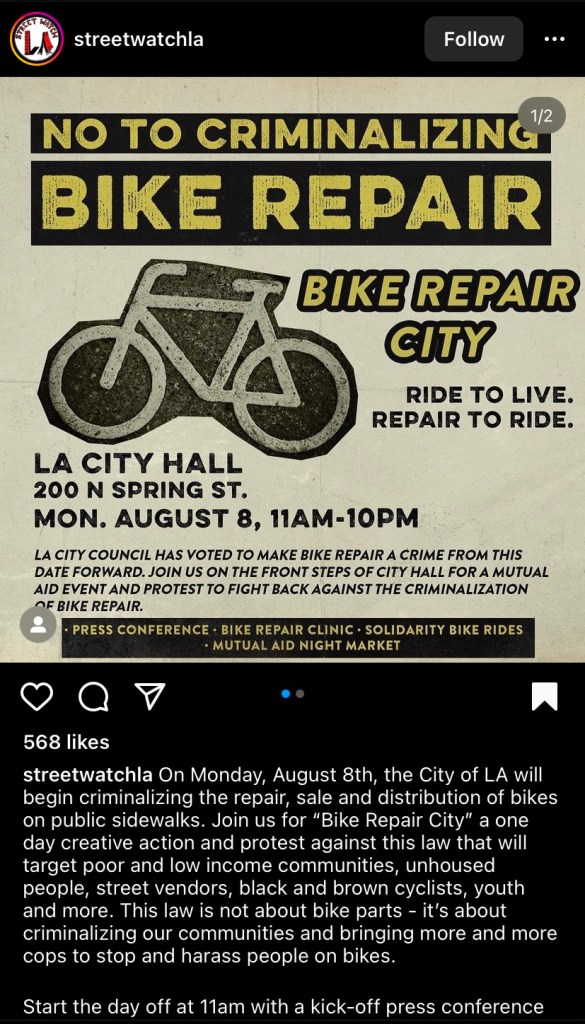
The City of Los Angeles on August 8th will regard the public repair, sale & distribution of bicycles as “chop shops”, legally defined as: three or more bicycles;— a bicycle frame with the gear cables or brake cables cut;— two or more bicycles with missing parts;— five or more bicycle parts.
On the surface & even from a distance this new ordinance seems fickle, overreaching, unnecessary or long overdue – the opinions vary as greatly as the personalities & cultures of California itself.
Unbeknownst to most, this new ordinance is a sign of the times to come. An indication of the veracity with which the governing bodies & authorities are willing to display in their endeavor to see predetermined plans finally implemented across the populous.
Just this past week, the neighboring City of San Diego enacted their own legislative frameworks regarding bikes too! Mayor Todd Gloria, members of SANDAG & affiliated organizations presented the 2022 edition of the Climate Action Plan, even though only weeks prior, what was reported to be over 4,000 citizens expressed discontent & preferences requesting the withdrawal of the plan altogether.
Without a doubt, a majority of the citizenry’s dissatisfaction with the proposed Climate Action Plan stems from public awareness of the plan’s origins itself; the goals of conscious stewardship & leveraging local abilities are not foreign to the citizenry of San Diego but the citizenry do not wish to yield agency & authority to international conglomerates & contractual agreements they are hardly party to. For clarification, as stated on pages 32 & 33 of the updated 2022 draft, “[t]he ICLEI Community-wide Protocol methodology was utilized for determining the City’s science-based fair share CAP goal for this program which is described in more detail in Appendix C.”
For those that have already read my post, “Environments & Requirements”, you may skip this video from a 2009 city council meeting in San Carlos, CA showing council members ignoring the words of the citizenry & implementing an ICLEI-derived plan. For those now coming across this site, I’d recommend watching & comparing the disregard of the San Carlos council members to the disregard of our politicians today as far climate legislation is concerned.
The folks seen in 2009 & the folks seen last week are of like mind: they simply wish to oversee their lands themselves; they uniformly wish to see the lands & its resources benefit the locals to the greatest degree. The politicians seen in 2009 & today are the same: they wish to see their plans fulfilled, no matter the cost as increased taxes will foot the bill.
Proposed taxes & suggested economic frameworks of San Diego’s 2022 version of CAP range from gallon per capita water limits, an increase in funding for tree rebate programs I covered a bit in “The Products of a New Environment” & transportation ordinances that all relate to a 2050 plan the City of San Diego has been pushing since at least 2010 involving…you guessed it: bikes. If you look to page 56 of the 2022 CAP, under Strategy 3: Mobility and Land Use, you see the City’s obsession with bikes & disdain for internal combustion engine vehicles at once:
“Shifting away from a car-centric transportation system starts with a loading priority for our roadways, prioritizing and protecting the most vulnerable modes such as walking and biking, and enhancing public transit for improved efficiency and performance. The loading priority concludes with shared, commercial, and personal electric vehicles, underscoring a commitment to the full transition of all vehicles from combustion engines and fossil fuels. The City will reduce vehicle miles traveled (VMT) for trips through transportation infrastructure and technology improvements, transportation demand management (TDM) programs, and land use changes.”
It should be noted that this 2022 plan is simply a foundation for the 2050 plan titled “Riding to 2050: The San Diego Regional Bicycle Plan” but there are a number of proposed actions relating to Greenhouse Gas (GHG) emissions & other climate issues that will be enacted along the way as 2035 is a mid-point target year from now to 2050. Among the myriad of proposals to curb GHG emissions, one of marked interest is found in the 2022 edition of the CAP on page 69:
1) Reduce GHG emissions and water use of total beef, pork, chicken, turkey and dairy purchases by 20%.
2) Increase local, healthy, and sustainable foods to 20% of total food purchases prioritizing locally sourced, valued workforce and animal welfare.
Interestingly enough, in the entire CAP document, only one page is devoted to “Measure 5.3: Local Water Supply” & simply discusses the aforementioned gallon per capita limit; in one week the Federal government is going to impose water restrictions on 40 million people due to the state of the Colorado River basin, yet the City of San Diego has apparently nothing to say on the matter.
At the moment, the City of San Diego is primarily focused on regulator technology & economic frameworks that will advance the 2050 plan. In all fairness, San Diego has been this way since it entertained ICLEI & other entities; in the 2010 version of “Riding to 2050: The San Diego Regional Bicycle Plan”, published while Jerry Sanders was Mayor, on page 49, “encouragement programs” are proposed as an economic method of enticing, to some perspectives coercing, citizens & businesses into participating in these programs where ride-sharing & biking are the preferred forms of transportation.
An excerpt on these programs:
Encouragement programs are generally characterized by their focus on encouraging people to bicycle more frequently, particularly for transportation. Encouragement programs increase the propensity for bicycle trips by providing incentives, recognition, or services that make bicycling a more convenient transportation mode. The following encouragement programs are recommended for implementation in the region and described in more detail in the remainder of the section:
⁃ Bike Sharing Program
⁃ Pilot Smart Trips Program
⁃ Employer Incentive Programs
⁃ Bicycle Friendly Community Designation
⁃ San Diego Region Bike Map
⁃ Identification and Way-finding Signage
⁃ University-base Bike Orientation
In the version published in 2011, the concept of ride-share programs is expanded & marginally defined a bite more with examples like the Guaranteed Ride Home Program (which I had no clue existed until today) & iCommute, a vanpool program with a subsidy of $400 per month per vanpool. By 2015, under the direction of then Mayor Kevin L. Faulconer, the ride-share programs expanded into a contract with DecoBike but ended in 2019 after the City of San Diego claimed a breach of contract occurred on the companies end – though this is disputed by DecoBike.
In terms of high occupancy transportation, all versions of the climate plans advocate for electric vehicle fleets; the most common form is tied to K-12 & collegiate school bus programs. This past July, a San Diego based company, Nuvve Holding Corp., announced a joint venture with San Diego Gas & Electric where eight electric school buses in the Cajon Valley Union School District will connect to the grid & serve as a pilot program for the next five years, not only for state-wide school transportation use but also for the federal Build Back Better plan as Nuvve Holding Corp. announced a Memorandum of Understanding with the US Department of Energy some time ago regarding V2G & V2X technology.
An often overlooked aspect of the V2X technology that appeals to governing bodies is the “connected vehicle” nexus & data mining capabilities thereof. In these evolving iterations of climate plans related to the years 2025, 2030 & 2050, digital details are a prerequisite of all vehicles that will be on the road for a consortium of reasons that summarily present as regulatory technology. In early plans, connected vehicles simply refers to vehicles capable of emitting wireless data vehicle-to-vehicle & vehicle-to-infrastructure so as to aid in the flow of traffic; as we’ve seen with newer plans & in European counterparts, intelligent speed limits, excessive tracking & the aforementioned prioritization of biking civilians are the culmination of these mandated advances in vehicle technology.
I have yet to address the cost of all these mandated applications of higher-end vehicle-to-everything technologies; I’ve considered making a whole post on the expected costs incurred for civilians in the wake of these subnational & national mandates stemming from international contractual agreements but I’ll simply point out that the average all-electric bus costs $400,000 & in the Inflation Reduction Act of 2022, eligible “clean” vans, SUVs & pickup trucks qualify for a rebate of $80,000 upon purchase & other vehicles for $55,000. I really can’t imagine how much these all vehicles will cost in total but if the rebates are already close to some people’s yearly income, I can imagine most will not be buying these vehicles, unless on an already strained credit line.
So, I guess we’ll all bike to work, right?
But what if your bike breaks down & you live in a city like Los Angeles where you can’t rely on your local handy-folk to lend a helping hand anymore because of a city ordinance? Guess you’ll pull out your card anyways & pay for a ride on an EV bus, rent a ride-share bike or pay for a ride on the rail transit system.
From what I can gather, the Guaranteed Ride Home Program only covers three rides per year; seems like baseball, three strikes & we’re left outside.
Amazingly, the word “homeless” shows up only one time in the entire 2022 San Diego Climate Action Plan, whereas the word “bike” shows up 49 times. I wonder, if one is left outside, what is the plan, what are the options & allowances afforded by a City that can’t even type the word “homeless” more than once in a 238 page document?
Thanks for reading.
San Diego’s approach can be better understood in the context of global economic pressures outlined in Market Forces: Foreign Factors and Domestic Actors.
Works Cited:
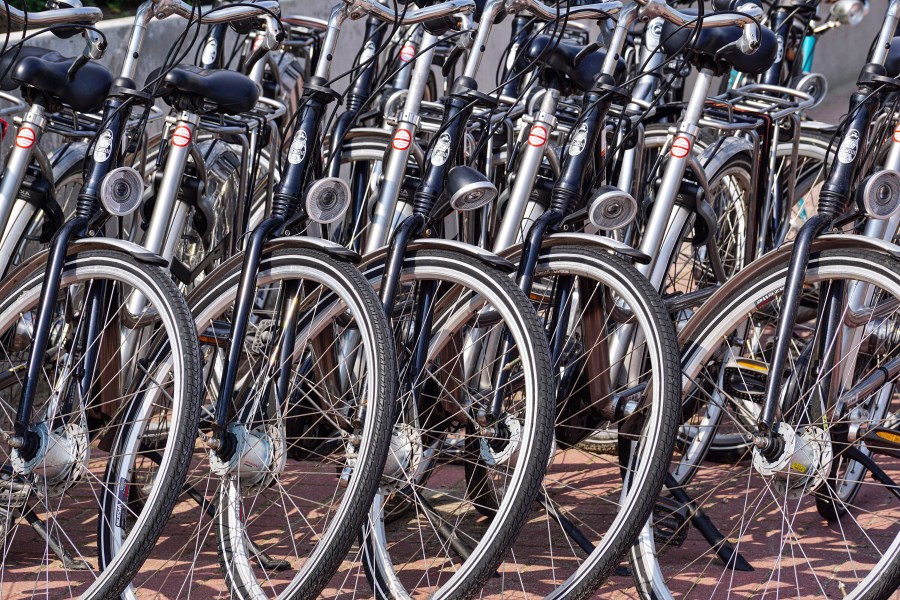
Photo by Susanne Jutzeler, suju-foto from Pexels
Chou, E., 2022. Los Angeles City Council votes to ban bike repair entrepreneurs on public sidewalks – Daily News. [online] Dailynews.com. Available at: <https://www.dailynews.com/2022/06/21/los-angeles-city-council-votes-to-ban-bike-repair-entrepreneurs-on-public-sidewalks/> [Accessed 7 August 2022].
Sandiego.gov. 2022. City of San Diego Climate Action Plan. [online] Available at: <https://www.sandiego.gov/sites/default/files/san_diegos_2022_climate_action_plan_0.pdf> [Accessed 8 August 2022].
Sandag.org. 2010. Riding to 2050: The San Diego Regional Bicycle Plan. [online] Available at: <https://www.sandag.org/uploads/publicationid/publicationid_1674_14591.pdf> [Accessed 8 August 2022].
(In case that link doesn’t work, try: https://www.sandiego.gov/sites/default/files/san_diegos_2022_climate_action_plan_0.pdf )
Sandag.org. 2011. 2050 Regional Transportation Plan. [online] Available at: <https://www.sandag.org/uploads/2050RTP/F2050rtp_all.pdf> [Accessed 8 August 2022].
(In case that link doesn’t work, try: https://www.sdforward.com/pdfs/Final_PDFs/AppendixU16.pdf )
Sdgenews.com. 2022. SDG&E and Cajon Valley Union School District Flip the Switch on Region’s First Vehicle-to-Grid Project Featuring Local Electric School Buses Capable of Sending Power to the Grid | SDGE | San Diego Gas & Electric – News Center. [online] Available at: <https://www.sdgenews.com/article/sdge-and-cajon-valley-union-school-district-flip-switch-regions-first-vehicle-grid-project> [Accessed 8 August 2022].
Documentcloud.org. 2022. Inflation Reduction Act of 2022. [online] Available at: <https://www.documentcloud.org/documents/22122281-inflation_reduction_act_of_2022> [Accessed 8 August 2022].
© 2022 Zakariyas James. First shared here at theruminationcompilation.wordpress.com.
 The Rumination Compilation