Civic Ineptitude: Signals in a Nation of Noise

Some time ago, I wrote a song with a lyric I find myself repeating more often to coworkers, and even in online conversations:

“Pay attention to what you pay attention.”

It’s the simplest way I’ve found to gesture toward the problem of the signal-to-noise ratio and how its manipulation breeds civic ineptitude.

Most of what we take in, whether from commerce or politics, isn’t meant to sharpen judgment. It’s engineered to trap us inside a single topic, to overload the civic ear. Not to expand participation, but to shrink it under the weight of constant input. Inputs irrelevant to both daily life and future prospects.

Democracy likes to sell the story that people can separate signal from static, that citizens have reviewed all sides of a problem and reached true understanding. The reality rarely matches the pitch.

Defining Civic Ineptitude

Civic ineptitude is a manufactured incapacity, not an accidental occurrence. It’s not that people are unwilling to participate, it’s that they are overloaded with inputs designed to trap attention in outrage and trivia. Citizens debate endlessly but rarely govern themselves or the institutions meant to be by the people, for the people. They are trained to consume noise to the point they delegate their sovereignty to an outside source, until they no longer truly think for themselves.

Commerce & Politics: The Social Noise Complex

Politics delivers daily scandal, a viral hearing, or a televised confrontation in all caps. These moments are designed to impress upon viewers the breaking news matters more than they could ever know. They digress from legislative maneuvers that might actually impact daily life and repress the viewer’s ability to think independently.

The churn promises significance but rarely explains consequences without exaggeration. Slow, structural signals (like infrastructure, demographics, environmental planning, national debt) fade into silence because they don’t trend. Because the ones in charge don’t need your input anymore, just your compliance.

Commerce is louder still. Advertising and financial media bombard us with promises of autonomy through consumption. New gadgets, lifestyle upgrades, and speculative bets are sold as independence. But the true signal, legitimate questions of sovereignty, labor, and national debt, goes unheard. Instead, the illusion of participation is kept alive by trading apps, side hustles, and brand loyalty. It looks like engagement but it’s only noise. Sometimes they’re blatant about it: “escape from real life, escape the burden of civic duty.”

While headlines focus on tech scandals, trillion-dollar corporate buybacks reshape ownership of the entire economy. Credit, conspicuous consumption and engineered complacency drive the system.

Historical Shifts that Made It So

This condition has roots. The 24/7 news cycle rewarded outrage over substance. The modernization of the Smith–Mundt Act blurred propaganda into domestic media. The dollar’s divorce from gold made inflation and debt permanent features, not temporary policies.

Citizens are still taught to treat dollars as solid. In reality, the currency became an abstraction, an IOU backed only by government promise. A system that once had a natural limit (gold convertibility) turned into one that could expand infinitely. The public was never educated on what that shift meant, because understanding it would expose the truth: debt is not a temporary emergency but the backbone of fiscal policy. The so-called debt ceiling is theater, not restraint.

When the money supply lost its anchor, spending lost its discipline. Citizens could still count dollars in their wallet, but they could no longer count on those dollars to mean the same thing tomorrow. The disconnect between appearance and reality became the foundation of modern civic ineptitude.

Even right now, the news is trying to convince every citizen the reason other governments and foreign banks are dumping U.S. Treasury Bonds is because of tariffs. They can’t let you doubt the longevity of the dollar too, you know?

Present-Day Illustration

The imbalance is obvious: the public spends weeks locked onto scandals, while consequential legislation moves quietly in the background. The pattern is clear:

  • 2008 financial collapse: While the public debated Wall Street outrage, Congress passed the $700 billion TARP bailout with little scrutiny.
  • Post-9/11: Fear of terrorism overshadowed the Patriot Act, quietly expanding surveillance.
  • Pandemic: Debate over masks and mandates eclipsed multi-trillion-dollar stimulus packages, shaping long-term debt obligations.

Here’s the next one: In about two weeks (from the time I published this) CISA, the Cybersecurity Information Sharing Act of 2015, will be hitting the 10 year expiration date and needs to be re-enacted/rewritten.

Why? Because in 2018, Congress created CISA, the Cybersecurity Infrastructure Security Agency, an agency with almost unrestricted authority over citizen communications, a component of the Department of Homeland Security. (Notice the acronyms are identical, blurring law and agency. Hardly an accident.)

Since the Agency’s creation, Congressional Oversight Committees have run multiple investigations that uncovered the Agency is apparently more concerned with what you and I say online, rather than cyber attack threats. Working in tandem with social media platforms, CISA has censored comments and posts, employed “narrative intervention” tactics, and surveilled US citizens unconstitutionally with the Mis-, Dis, and Malinformation (MDM) team.

CISA was disbanded in 2022, but government power rarely disappears, it reincarnates. When the new CISA passes (and it will) the agency will return, maybe under a new acronym, but with the same powers reborn.

I fully expect the law to be revived with further additions that exacerbate this issue of government weaponization upon the citizenry of the United States. I also fully expect only a sliver of the populace to even know it happened.

Why? The spectacle is always designed to be louder than the substance. Outrage consumes the civic ear while policy slips by unnoticed, and the government is always watching, waiting for us to be distracted or disinterested in what they’re doing this week.

The Democratic Mirage

Democracy promises citizens can separate signal from static. In reality, engagement is mediated by distraction. Civic aptitude is nearly nonexistent.

Candidates are products of party machinery, donor networks, and lobbying groups. Not public deliberation. Most voters respond to slogans, sound bites, and marketing repetition. The candidate becomes a brand, politics becomes advertising.

Appointments reveal where real power sits and why the candidate was dangled before us. Positions of influence often benefit industry, private networks, and political machines—not citizens. Just look at the last 25 years of questionable appointments:

George W. Bush

  • John Bolton – U.S. Ambassador to the UN (2005)
    Bolton was openly hostile to the UN and multilateral diplomacy, which made his appointment look like sabotage by placement. Bush didn’t even wait for Congress to vote on the appointment, he just signed off on it while Congress was in recess. 
  • Also appointed over 700 judges in the wake of 9/11, judges who provided no opposition to warrantless surveillance requests from the then-created Department of Homeland Security. 

Barack Obama

  • Mark A. Patterson – Chief of Staff to the Treasury Secretary (2009)
    Patterson was a former Goldman Sachs lobbyist, put into a senior Treasury role just after Goldman benefited from TARP bailout policies. 
  • Gary Gensler – Chairman of the Commodity Futures Trading Commission (2009)
    Former Goldman Sachs partner, placed in charge of regulating derivatives, the very instruments central to the 2008 crisis. 
  • Jack Lew – Director of the Office of Management and Budget (2010) then Treasury Secretary (2013)
    Former Citigroup Chief Operating Officer, another bank complicit in the 2008 derivatives scandal. 

Donald Trump (First Administration)

  • William Perry Pendley – Acting Director, Bureau of Land Management (2019–2021)
    Pendley had spent much of his career arguing for selling off federal lands, yet was appointed to oversee them.

Joe Biden

  • Gary Gensler – SEC Chairman (2021)
    Another Great Financial Crisis banker appointed by Obama, later reappointed under Biden to lead the SEC.

Donald Trump (Second Administration)

  • Ed Martin – U.S. Attorney for D.C. (2025)
    Martin had no prior experience as a federal prosecutor or judge, but was appointed to one of the most powerful legal posts in the country.

This is the democratic mirage: the appearance of choice, the ritual of participation, the illusion of sovereignty. All sustained by noise. The decisions made behind closed doors have had lasting impacts on these last 25 years, and more than likely, will for the next 25.

Returning to Attention

Civic ineptitude is not stupidity; it’s engineered overload. The signals of governance, sovereignty, and responsibility are still there, but faint, competing against an industrial volume of noise.

The question isn’t whether people can still hear them. The question is whether anyone remembers how to listen.

Pay attention to what you pay attention.


If this piece resonated, you may also find these worth your attention:

Market Forces: Foreign Factors & Domestic Actors

Precision Consumer 2030: Wellness as a Window Into You

© 2025 Zakariyas James. First shared here at theruminationcompilation.wordpress.com.

When Ledgers Rewrite Culture: The Social Side of Sound Money

The technocrats will eventually tell you Basel III was a technical fix. The pundits will call BRICS a geopolitical contest. Both are true in their limited ways but us real people do not live inside policy memos or summit communiqués and will have our own perspective. We live in the real world of habit, rituals and desire. As the scaffolding of global finance is quietly remodeled (physical bullion regaining status and liquidity rerouting to the Global South) the most consequential shifts will be cultural, not merely fiscal.

This is the story no headline quite tells: how an accounting reclassification becomes a tiered, shared experience.

The West: From Immaterial Credit to Material Anxiety

In economies that grew comfortable with digital balances and endless credit aka “easy money”, the cultural shift will feel different, it will be slower and then sudden. Crack-up boom. Daily life is calibrated to cheap, frictionless money: mortgages, subscription living, bulk pricing. When policy nudges value back toward the tangible, the result will be a new kind of cognitive dissonance.

Expect changes in language first, personally, interpersonally and then communally/politically. Conversations will shift from “How much can I borrow?” to “What is real?”

Nostalgia will warp itself into politics. Calls for protectionism, reclaiming physical assets, other varying populist sentiments will resonate with people who discover a mismatch between their actual costs and their imagined abundance.

Mutual Aid and Parallel Economies: Gardens and Barter

When trust in fiat frays, communities adapt. We’ve seen it in Argentina, Zimbabwe and during wartime rationing but the west will have variation:

• Community gardens reappear as survival infrastructure, where calories mean more than currency. As fiat fails, big chain grocer prices will madden the masses and local growers will become pseudo-heroes.

• Barter centers allow exchange without the reach of taxation or failing banks. I expect this to be a mainstay of the West post-wealth transfer as citizens will lose respect and trust in the institutions they blindly followed. “Why give them taxes when they got us into this mess?”

• Local scrip or informal IOUs return as a temporary patch for frayed systems. This is already happening in terms of the Goldback movement in 7 states of the U.S., with two more announced but not yet active at the time of writing. In the U.K., the Bristol Pound (backed by sterling) is the closest example as it is a functioning local currency but lacks association to precious metals.

What begins as improvisation can calcify into an alternative, parallel economy. Trust, not credit, becomes the currency. Skills, not stocks, will pay the dividends. Trickle-down economics will be exemplified by the kind ones in the community, not the corporations.

Rituals, Class and the Story of Ownership

Ownership is never neutral: it’s class-status and identity. The form of possession matters as much as the fact of it.

In BRICS-aligned nations, gold is held whole. A coin is a coin, a bar is a bar. Jewelry is worn not just for ornament but for sovereignty. Wholeness is permanence: the signal that your wealth cannot be deleted by a keystroke or dissolved in a bankruptcy court.

In the West, scarcity will force a different adaptation: tokenization. Instead of outright ownership, assets will be broken into fractions and sold back as digital claims. Families will cling to ledger entries representing “one-tenth of a coin” or “a fraction of a house.” Cities and corporations will tokenize infrastructure just to stay liquid, slicing the material world into abstract coupons.

This isn’t innovation though, it’s desperation disguised as fintech. Tokenization is a coping mechanism for a civilization that can no longer afford wholeness, that can’t afford endless growth. It lets people pretend to own what they cannot hold.

The divide will cut deeper than economics. To the bullion-rich nations, the West will look like addicts trading scraps of paper to simulate the real thing. To Western citizens, the sight of others wearing or storing full reserves will feel like betrayal: their leaders sold them futures, while others secured permanence.

The new class line will be brutal and obvious: whole vs. fractioned, real vs. synthetic, permanent vs. provisional. One side will pass their wealth on intact. The other will spend their lives juggling slices.

This approach isn’t unique to the U.S. though; across the West, similar experiments have emerged. In 2018, the U.K.’s Royal Mint launched a gold-backed cryptocurrency: The Blockchain-based coin, called Royal Mint Gold (RMG), is a digital representation of gold stored in The Royal Mint vault. One RMG coin may be equal to one gram of gold but in a world of hard assets, I’m not sure how attractive this digital placeholder will be over the real deal. But you know, this might be the best the West might have to offer.

Theology, Disillusionment and the Question of Faith

Religion bends around money’s shape. In the West, Christian sermons may reach for familiar motifs: Judas’s thirty pieces of silver, the dangers of idolatry, the fleeting nature of wealth. But overuse risks cliché and invites criticism of hypocrisy. Different branches of Christianity may fracture in their responses:

Catholicism could lean into what’s lasting ie liturgy and sacrament as the “true store of value” against a collapsing fiat world. Evangelical Protestantism may frame gold resurgence as a divine order reasserting itself: God’s money returning into life after man’s failed experiment with paper. Prosperity gospel will struggle the most, almost collapsing entirely, as its glitzy promises seem outlandish in a world where even the faithful cannot finance new SUVs on credit.

The collapse of fiat’s aura may also push in two opposite directions across the board:

• Renewed Faith: A turn back toward God, with bullion framed as a sign of “end-times upon us”. The sentiment might find greater hold in non-denominational settings, though I imagine it’ll be common to the point of standardization.

• Rising Atheism: A wave of disillusionment, rejecting not only money but the institutions and faiths that blessed the old order and inevitably request tithes in the form of precious metals.

Theology will not be a bystander; it will be a contested arena for interpreting what gold’s return “means.” I fully expect the sermons post-wealth transfer to be extremely centered around Proverbs 3:13-14, along with stern reminders that the coveting of money is the root of all evil.

Secrecy Replaces Display: the Death of Flex Culture

Today’s culture of flaunting lifestyles, enabled by credit, will become dangerous in a metals-driven economy. Buy now, pay later schemes have almost entirely ensnared millennials and Gen-Z. But in a metals-driven economy, this visibility becomes dangerous.

• Those who stacked metals early will avoid attention, adopting aloofness and secrecy. This is already a norm, as it is for the general prepper, though the lengths these people will take to ensure privacy and security will impress just about anyone.

• Those who struggle amidst the post-wealth transfer will conceal their “bad luck” by retreating from the shame of scarcity both online and in real life.

• The algorithmic culture of flaunt-and-scroll will erode, replaced by discretion and silence.

Social media will have its reckoning in the post-wealth transfer world. Without a doubt, the failure of fiat will dismantle decades of “flexing” and the result will be admittedly cathartic for those who used to subscribe to content creators of all sorts, as the seemingly synchronized decline in quality of leisure is observed, the subscribers will realize it’s not just them, it’s just normal.

Everyday Behavior: Thrifting , Working and Timing

Culture is habit, and habits follow incentives. As money rewires, so too does the cadence of daily life.

• Work: jobs built on speculation, abstract consulting and branding will thin out. The booming will be in agriculture, repair trades, personal security, medical basics and food logistics. The gig worker who once delivered takeout may now be fixing farm equipment. The “creative consultant” and “affiliate marketer” will look more like a hustler without a market.

• Consumption: novelty becomes a liability. The fast-fashion buyer becomes the thrift-shop regular. The broken appliance gets repaired, not replaced. Mending, patching and improvising will become core skills, especially among the young who never learned them.

• Time Horizons: in unstable regions, people will hesitate to sign a 12-month lease or take out student loans for degrees tied to paper economies. Short-term survival dominates. But where gold and silver are treated as security, the opposite emerges: multi-decade infrastructure projects, new family compounds, community institutions.

The cultural split will be sharp. In one town, neighbors trade tools, seeds, weekend labor. In another, boarded-up shops and “for sale” signs multiply. The wealth transfer will redraw which places feel livable, which don’t and it’ll happen far faster than governments can manage.

Media, Narrative, and the New Moral Economies

How people interpret this shift will depend on who controls the story.

• State media in bullion-rich nations will frame accumulation as sovereignty and “what we deserve”. Depending on the nation, newscasters may invariably parrot state-sponsored rhetoric related to the “defeat of the West” and support re-election for many leaders within the Global South.

• Western outlets may cast it as loss, betrayal and “temporary”. On the other hand, I imagine investigative journalism may rise as the citizens of the West hunger for truth, valuable information and explanations of how the shift happened when decades went by of leaders and institutions saying it wouldn’t.

• Social platforms will fracture the narrative into memes; without a doubt humor will veer further into dark comedy, especially as the humor of Gen-Z prevails online as they are the growing bulk of the most active user base. Humor heals to a degree and humor will find a way to soften the financial blow.

Stories will shape behavior and politics, not spreadsheets and quarterly updates. The way media summarizes the drop in sales, the rise in unemployment, how things are the “new normal” will be at odds with how the common people view things.

Migration, Mobility and the Geography of Belief

Money moves people as much as goods. As liquidity tilts eastward, migration will not only follow jobs but a deeper quest for security.

For Western immigrants who left the Global South, the arc may reverse. A banker’s son who once left Lagos for London may find himself heading back. Skills, connections, and a sense of Western fragility will travel with him. A daughter who studied in Boston may bring her expertise home. Accreditation knowledge leaves one region and finds roots in another.

Western nations losing both talent and capital gained through immigration may find themselves hollowed out. Skilled professionals will no longer see New York or Paris as the obvious endgame. Families will weigh where their real, tangible savings feel safest.

Diasporas will change their tunes and ties. They won’t just wire money home; they will re-anchor their futures there. This will be a cultural migration as much as a physical one. My own mother, like millions of others, came here to the U.S. on the promise of stability, safety, and opportunity. In a post-wealth transfer world, that promise may not hold. The dream of “making it in the West” could erode, replaced by a dream of returning to one’s motherland or fatherland and not as escape, but as reclamation.

Closing Reflection

The mechanics of money are written in ledgers; the consequences are written in kitchens, altars and the streets. Basel III’s technical recalibration and BRICS’ geopolitical choreography are the inorganic architecture. The organic architecture will be cultural: how we talk about value, how we teach children to save, whom we trust which rituals we carry forward, how we consume, how we view leisure.

If you want to understand the future, don’t look at trading floors, prospectus statements or anything of the sort. Listen to the markets filled with people like you and people nothing like you: what songs are being sung at weddings, what words children learn about wealth, how neighbors share food in hard seasons, how people talk about their government. Those small things are the real indicators of where an economy has landed in the human heart and how people conceptualize worth.

When ledgers rewrite culture, ‘sound money’ becomes less about accounting conventions and more about the sounds in the marketplace, the voices in prayer halls, the silence at the dinner table.


This write-up is a cultural assessment of the banking changes coming into play that I’ve outlined in Basel III and the Return of Gold: A Comparative History.

© 2025 Zakariyas James. First shared here at theruminationcompilation.wordpress.com.
Basel III and the Return of Gold: A Comparative History

When the Bank for International Settlements finalized Basel III in 2019, it didn’t make headlines. But in elevating physical gold bullion to a Tier 1 asset (and relegating paper contracts and futures to near-irrelevance), the rules of global finance shifted as profoundly as they did in 1933, 1944, or 1971.

To understand the magnitude of this change, it helps to compare it with the last century’s monetary resets.

1933 — U.S. Gold Confiscation & Revaluation
• What changed: Franklin Roosevelt suspended the domestic gold standard, forcing Americans to hand in their gold at $20.67/oz. Months later, the government revalued gold to $35/oz.
• Effect: Citizens lost bullion, the state gained reserves, and the U.S. Treasury booked an overnight windfall that supported Depression-era finance.
• Parallel to today: A rule change, not a war, restructured wealth by reclassifying gold’s role. Value didn’t vanish—it was reassigned.

1944 — Bretton Woods & Dollar Hegemony
• What changed: Allied powers agreed to anchor global currencies to the U.S. dollar, itself pegged to gold at $35/oz.
• Effect: Nations no longer settled accounts in gold directly; they settled in dollars. The U.S. consolidated financial supremacy by holding the world’s largest bullion hoard.
• Parallel to today: Liquidity was centralized under one system. The illusion of stability masked a transfer of gold’s role into state-backed paper claims.

1971 — Nixon Closes the Gold Window
• What changed: President Nixon suspended the dollar’s convertibility into gold. The Bretton Woods system collapsed, leaving a purely fiat world.
• Effect: Currencies floated, debt exploded, and dollar dominance survived only because oil and global trade continued to be priced in dollars.
• Parallel to today: A pivot disguised as necessity. Rules were rewritten mid-game to preserve credit expansion, even as trust in the old system eroded.

2019 — Basel III Redefines Gold’s Value
• What changed: Physical gold was upgraded to Tier 1, recognized at full value on bank balance sheets. Paper gold contracts and futures were risk-weighted down to ~10%.
• Effect: Sovereigns and central banks suddenly had incentive to accumulate bullion, not paper promises. The East has led record purchases, while Western markets cling to futures.
• Parallel to history: Like 1933, 1944, and 1971, the change was regulatory and quiet—but it redefined gold’s place in the system. Instead of removing gold, Basel III restores it to the balance sheet.

The Throughline

Across each reset, the same pattern emerges:

• Gold is never eliminated. It is reclassified, revalued, or hidden behind paper substitutes.

• Fiat credit is preserved. Whether by confiscation, substitution, suspension, or regulation, the system shifts rules to extend its lifespan.

• The burden of adaptation is global. Citizens in 1933, allied nations in 1944, world markets in 1971—all had no choice but to adjust. Basel III sets up the East as the next adjustment point.

As analyst Lena Petrova notes, “We are being told a story of multipolarity, but what we’re really seeing is continuity. The structure doesn’t vanish—it relocates.” The “relocation” now is not merely geographic (West to East) but material: away from paper contracts toward bullion. The BIS and World Bank aren’t losing control; they are orchestrating the transfer. To preserve fiat credit, bubbles must migrate, and liquidity must sink somewhere new.

If the 20th century required world wars to enforce its financial resets, the 21st may achieve the same outcome more subtly but no less disruptively. Basel III is the quiet hinge-point: a reminder that while money changes form, its gravity keeps circling back to the same metal.

What Comes Next, A New 1971 Moment?

If 1933 was confiscation, 1944 was consolidation, and 1971 was suspension, then Basel III may be the preparation stage for a fourth great reset. The difference this time is that it is not centered in Washington, London, or Paris, but in Beijing, Moscow, and the capitals of the Global South.


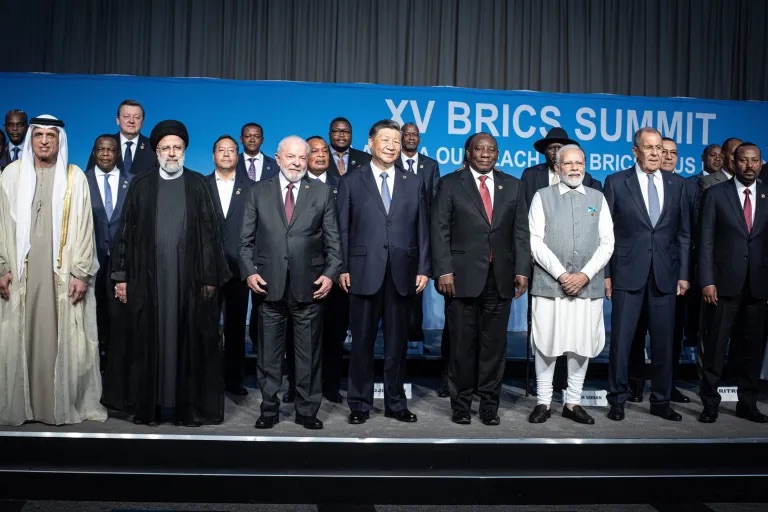
The BRICS bloc has already signaled its intent. Its member nations—Brazil, Russia, India, China, South Africa, and now a widening circle of others—are exploring settlement systems that bypass the U.S. dollar. Without a peg, such systems risk fragmentation. The glue, as history shows, is gold.

• Eastern central banks are buying record tonnage of bullion, not futures contracts.

• Western banks remain tethered to paper claims, increasingly downgraded by Basel III rules.

• Liquidity migration is not a conspiracy but a pattern: when one region’s fiat exhausts credibility, another inherits the burden and backstopped by gold.

As Petrova observes, “This is not about destroying the dollar—it is about keeping fiat alive by shifting its weight onto new pillars.” Those pillars may look multipolar, but their load-bearing material is the same as it has always been.

The Shape of the Next Reset

If history holds, the shift will not be announced openly. It will arrive by necessity disguised as inevitability:

• A commodity crisis forcing nations to accept settlement in a BRICS-linked system.

• A financial shock exposing the fragility of Western futures markets.

• A global liquidity squeeze that can only be relieved by bullion-backed credit.

The pivot could take many forms: gold-linked settlement units, hybrid currency baskets, or digital instruments backed by physical reserves. But the essence will echo 1971: a silent rewriting of the rules, enforced globally, with citizens and smaller nations adjusting afterward.

Closing Reflection

The world has seen this cycle before. Gold is confiscated, concealed, dismissed, and restored again under new terms. Each reset claims permanence, but each is temporary scaffolding for the next.

The question is not whether BRICS will displace the dollar, but whether fiat itself can endure without a metallic skeleton. If the 20th century taught us that wars were the price of financial rearrangement, the 21st may show whether quiet regulation and rebalancing can achieve the same outcome or whether conflict remains the final enforcer of monetary truth.

Photo credit: PER-ANDERS PETTERSSON/GETTY IMAGES

© 2025 Zakariyas James. First shared here at theruminationcompilation.wordpress.com.

America’s Warpath Towards Corporate Control

Do you feel it shifting yet?
It is subtle, but unmistakable. The United States is stepping beyond ordinary economic support, slipping into direct ownership of private enterprise. Owning ten percent of Intel is not a bailout, it’s a strategic maneuver.
The Intel chip foundry, powering every drone, missile system, satellite and cyber-defense operation is now partially tethered to Washington. This is the war economy coming alive again.
Let us walk this through.
(Cue the Battle Hymn of the Republic)

Intel as the New Arsenal

On August 22, 2025, the administration converted federal CHIPS Act grants into a ten-percent equity stake in Intel. The stake carries no voting rights, yet it signals Intel’s further integration into the national defense apparatus; chips are now synonymous with weapons.
While the government claims this move will not interfere with day-to-day operations, history shows that ownership (even without governance) aligns strategic interests with influence.
Consider SkyWater Technology, a U.S.-based semiconductor foundry specializing in radiation-hardened chips for high-altitude craft and satellites. With deep collaborations with the Defense Advanced Research Projects Agency, it stands as the only American-owned pure-play foundry of its kind, making it a likely candidate for future government equity. If Intel is the visible fortress of U.S. semiconductor capacity, SkyWater may be the shadow arsenal woven into defense.
This is not mere industrial policy, it is war economy logistics; the state is embedding itself into the supply chains critical for military readiness.

A Repeating Playbook

In both World Wars, the U.S. government nationalized railroads, seized control of the telephone system and created the Defense Plant Corporation to build and lease munitions factories. These assets were returned or privatized in peacetime and the pattern has been repeated: wartime central planning, privatization in peace. Today, semiconductors are the new artillery; Intel’s stake could be the new assembly line.
Likewise, the Department of Defense’s $400 million investment in MP Materials, the only significant rare-earth mining company in the U.S., mimics wartime strategy: securing magnet supply chains for guidance systems, drones and missiles.

What Industries Are Next?

Semiconductors were just the opening salvo. The war economy model is poised to extend into:
• Rare-earth elements and strategic metals: MP Materials already shows the model.
• Battery minerals such as lithium, graphite, and cobalt: critical for advanced munitions and energy systems.
• Oil and natural gas infrastructure: needed to sustain fleets, aircraft, and command centers.
• Advanced manufacturing for aerospace, hypersonics, and AI systems.

Silver’s Role in Military Tech and Munitions

Silver is indispensable in modern warfare for its superior conductivity and reliability. It features prominently in military electronics from radar and guidance systems to circuit boards.
• Conservative estimates put cruise missiles silver usage at about 15 per missile.
• Defense contractors manufacture silver-zinc batteries for missile families such as Patriot, Tomahawk, Hellfire, THAAD, and JDAM to power guidance, telemetry and control systems.
This demand makes silver a strategic resource and yet supply remains volatile. It is likely to become a target for government safeguarding or supply-chain oversight. If not from a military perspective, the government may involve themselves in the industry solely to manipulate cost of acquiring the metal for all industrial use.

U.S.–Ukraine Minerals Partnership

On April 30, 2025, the United States and Ukraine signed a landmark minerals agreement establishing a United States–Ukraine Reconstruction Investment Fund, equally managed by both governments. Ukraine retains ownership of its subsoil and resources, while 50 percent of new project revenues (across rare earths, lithium, titanium, uranium, graphite, oil, and gas) will flow into the fund. U.S. military aid counts as contributions and there are no debt provisions on past aid.
Ukraine’s parliament has since ratified the deal, envisioned as both a reconstruction and strategic investment vehicle. However, actual economic benefits are projected to take a decade or more due to damaged infrastructure, outdated geological data, and active conflict zones as many resource-rich areas remain under Russian control.

Strategic State War Economics

This is not European-style dirigiste planning in peacetime, it is America preparing its economy for conflict. From railroads and refineries to rare-earth mines, semiconductor fabs, critical minerals and silver-dependent munitions. The pattern is clear: when the United States identifies a threat, it turns not merely to regulation or subsidies but to ownership and control.

Ownership as Armament

America is once again rewiring capitalism for conflict. The Intel stake may feel disconcerting because it is not a standard industrial policy, it is war economy policy.
Will this be temporary, like past wartime interventions, or permanent like the Tennessee Valley Authority? That is the question.

In some respects, these recent developments from our government resembles a form of economic warfare conducted in the open but rarely acknowledged as such. The factories, the mineral rights, the intellectual property, they have all become fields of contest rather than fields of commerce. A document that circulated decades ago, Silent Weapons for Quiet Wars, framed the notion that a population could be subdued not by force of arms but by systems of policy, scarcity and control. Ignoring whether it should be viewed as allegory or leaked strategy, the thesis lingers: today’s corporate stakeholdings and mineral seizures may not be silent weapons in the literal sense but they echo the idea that war has shifted into quieter, more pervasive forms. If the weapon is silent and the war is quiet, how would we recognize we are even at war at all?


For more insight as to how likely it is the U.S. is prepping for a major conflict, see Critical Minerals: The Silent Tell of a War Economy.

© 2025 Zakariyas James. First shared here at theruminationcompilation.wordpress.com.

The Volumes on Vitality: Part Four

Even though the farmer is the man, the farmer has a few friends to thank. The crops and various yields we concern ourselves with, or at least the ones we place the highest value on, severely depend on interactions with other creatures that we tend to overlook or altogether neglect.

As of late, the neglect is reaching a potential maximum that may herald in a world in which some recipes seem too costly or altogether impossible to alter for sake of substitution. Bats, bees and other pollinators are invaluable aids to humanity, yet they’re slowly and quietly going into the long night…moreso than the TV screens care to tell you.

Going Batty

Bats (those cool, nocturnal insectivores) are being wiped out across 40 states by Pseudogymnoascus destructans (white-nose syndrome), a fungus that shatters their hibernation, fat reserves and wings. The result: millions dead, entire colonies erased.
Their absence carries a price tag. Bats provide $3.7 to $53 billion in pest control services each year by eating the insects that would otherwise chew through corn, cotton, rice and other staples. In field studies, excluding bats from cornfields meant 60% more pests and 50% more crop damage in just two nights (Kunz et al, 2011).
Counties hit by the fungus see $2.84 per acre rental declines, idle farmland, a 31% jump in pesticide use and a 7.9% rise in infant mortality which ends up costing society $39 billion. Still today, the fungus spreads. Tangentially, they’re also the largest pollinator group of agave, the basis of tequila; so maybe enjoy it while you got it?

Now the bees…

Between mid-2024 and early 2025, U.S. beekeepers lost 62% of their colonies, totaling over 1.1 million hives gone. These pollinators add $34 billion annually to U.S. agriculture; almonds alone require 1.4 million hives each spring, with hundreds of millions of dollars at stake in pollination contracts.
The causes are hardly mysterious: Varroa mites, viruses, pesticide exposure, habitat loss, and extreme weather (Goulson et al., 2015). In Texas, heat and drought drove a 66% colony collapse; a staggering loss far beyond the norm.
Globally, inadequate pollination already reduces fruit, vegetable and nut production by 3–5%, contributing to hundreds of thousands of premature deaths each year from diet-related disease. Fewer pollinators mean smaller harvests, higher prices and a poorer diet for millions.

Cattle Craze

In early 2024, H5N1 appeared in U.S. dairy herds. A trade group quickly pushed to rename it Bovine Influenza A Virus (BIAV), softening the optics even as infections spread to 17 states and hundreds of herds. Viral shedding was found in milk and wastewater, human cases were recorded, and federal surveillance quietly receded.
The direct food-safety risk is managed through pasteurization, but the economic risk comes from reduced production, herd health declines, and tighter export margins in an already tariff-heavy trade environment (USDA ERS, 2024).

Poultry Problems

The same virus has hit poultry far harder. Since 2022, over 166 million birds have been culled nationwide, across all 50 states and Puerto Rico—marking the largest, longest avian influenza outbreak in U.S. history.
The fallout has been rough, to say the least. Wholesale egg prices more than doubled in early 2025, retail prices hit $5–$9 per dozen and store shelves in some areas went bare between shipments. In February 2025, the USDA launched a $1 billion response plan, including $500 million in biosecurity upgrades, $400 million in farmer relief and $100 million for vaccine research. Wholesale egg prices later fell 64%, retail by 27% and still the USDA forecasts a 41% increase in egg prices for 2025 overall.
Meat production also tightened as infected flocks were destroyed, pushing poultry prices upward and reshuffling supply chains.

None of this even covers the detriment to pest management we owe to millions of other birds we’ve lost to H5N1 recently; they may be bird species we don’t ingest but their contributions to food production shouldn’t be dismissed.

The Hidden Truth Beneath Rising Prices
• Bats gone = higher pest pressure, greater crop losses.
• Bees gone = pollination deficits, reduced yields, higher produce prices.
• Cattle infected = production hits, export challenges.
• Poultry culled = eggs and meat scarce, prices surge.
We call it inflation, trade friction, “market shifts,” but the ledger is ecological and measured in wings lost, colonies collapsed and flocks erased.
These losses don’t happen in a vacuum. They’re amplified by poor government stewardship: from underfunded wildlife agencies to reactive rather than preventative biosecurity. Corporate malpractice often doubles the damage, whether through chemical overuse, disease mismanagement, or lobbying for optics over truth (Food Tank, 2024). Climate disruption compounds every weakness, making winters too warm for pest cycles to break, summers too hot for bees to forage and droughts too long for forage crops to survive (IPCC, 2019). And all of this is made more volatile by consumer demands for cheap, abundant, uniform products causes pressure for producers to cut corners in ways that weaken ecological resilience further.
The true cost of our food is not just in the grocery bill. It’s in degraded ecosystems, distorted market signals, and an agriculture system that burns through its biological capital faster than it can be replenished.

The runaway printing of fiat isn’t helping either but ultimately, the more we ignore the interlocking causes, the more expensive eating will become. Whether it’s denoted in dollars, observed in personal health or in the declining stability of the systems that feed us, we’ll see the cost sooner rather than later and it won’t be easy to stomach.

Sources

• Boyles, J.G., Cryan, P.M., McCracken, G.F., & Kunz, T.H. (2011). Economic Importance of Bats in Agriculture. Science, 332(6025), 41–42.https://science.sciencemag.org/content/332/6025/41


• Kunz, T.H. et al. (2011). Ecosystem Services Provided by Bats. US Forest Service Report. https://www.landcan.org/pdfs/wns%20kunz%20april%205%20%202011.pdf


• Environmental Health Journal (2020). Economic and Health Impacts of Bat Declines. https://www.science.org/doi/10.1126/science.adg0344

• Survey Reveals Over 1.1 Million Honey Bee Colonies Lost, Raising Alarm for Pollination and Agriculture https://honeybeehealthcoalition.org/survey-reveals-over-1-1-million-honey-bee-colonies-lost-raising-alarm-for-pollination-and-agriculture/


• Bee Informed Partnership, 2025 National Honey Bee Loss Survey Results. http://web.archive.org/web/20231218173803/https://beeinformed.org/citizen-science/loss-and-management-survey/


• Calderone, N.W. (2012). Insect Pollinated Crops and US Agriculture. PLoS ONE, 7(5): e37235.
https://journals.plos.org/plosone/article?id=10.1371/journal.pone.0037235


• Almond Board of California, 2024 Annual Report. Annual Publications | Almond Almanac | Growing Good


• Goulson, D. et al. (2015). Bee Declines Driven by Combined Stressors. Science, 347(6229).
https://science.sciencemag.org/content/347/6229/1255957


• Pollination loss removes healthy foods from global diets, increases chronic diseases causing excess deaths. https://hsph.harvard.edu/news/pollination-loss-removes-healthy-foods-from-global-diets-increases-chronic-diseases-causing-excess-deaths/


• USDA Economic Research Service (2024). Cattle and Beef Market Reports.
https://www.ers.usda.gov/topics/animal-products/cattle-beef/


• USDA APHIS (2022–2025). Avian Influenza Outbreak Reports.
https://www.aphis.usda.gov/aphis/ourfocus/animalhealth/animal-disease-information/avian/avian-influenza


• USDA Press Release (Feb 2025). $1 Billion Avian Influenza Response Plan.
https://www.usda.gov/media/press-releases/2025/02/15/usda-announces-1-billion-avian-influenza-response


• USDA Economic Research Service (2025). Poultry and Egg Price Outlook.
https://www.ers.usda.gov/topics/animal-products/poultry-eggs/


• Examining Corporate Influence Over Food and Farm Bill – Food Tank https://foodtank.com/news/2024/07/examining-corporate-influence-over-food-and-farm-bill/


• Intergovernmental Panel on Climate Change (2019). Climate Change and Land.
https://www.ipcc.ch/srccl/

© 2025 Zakariyas James. First shared here at theruminationcompilation.wordpress.com.
Bird Flu & The Great Disappearing Act


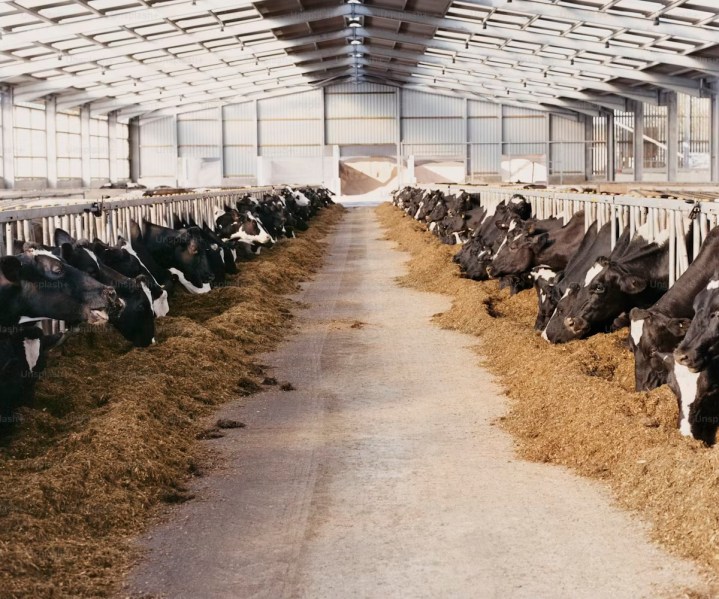
In early 2024, cows started testing positive for a virus we’ve long associated with birds H5N1, also known as Highly Pathogenic Avian Influenza (HPAI). The phrase bird flu in cattle started showing up in news alerts and government bulletins, albeit intermittently. But now, hundreds of infected dairy herds later, the illness is being given a new name.

Not by virologists. Not by the CDC.
By a trade group.

The American Association of Bovine Practitioners (AABP) declared it will no longer refer to the virus in cattle as HPAI. From here on out, they’re calling it Bovine Influenza A Virus (BIAV) and they’re urging federal agencies, diagnostic labs and state health officials to follow suit.

The reason?
To help the public “better understand” the difference between bird flu in birds and the milder form now spreading through cows.

They also say the change will “help maintain confidence in the safety and accessibility of dairy and beef products.”

Which might be the most honest sentence in the entire press release.


In 2024, the U.S. exported nearly 2.8 billion pounds of beef, generating over $10 billion in international sales.
China, a cornerstone of those exports, is now largely off the table. American beef faces a 32% tariff there, alongside widespread delistings of U.S. facilities.

With the Trump administration’s tariffs raising tensions across North America, maintaining consumer trust (both domestic and foreign) has never been more financially urgent for the beef lobby.
You don’t move that kind of product if people start panicking about biosecurity, let alone the potential for animal-to-human spillover.


At least 17 states have now reported H5N1 infections in dairy cattle.
Human cases have already occurred. Wastewater and milk sampling show signs of persistent viral shedding.

But the renaming of the virus comes at a time when the federal government is reportedly scaling back H5N1 surveillance efforts. Staff reductions, limited testing and quiet policy shifts are leaving fewer eyes on a virus that’s crossing species lines with alarming ease.

There’s a strange convenience in the timing.

A virus known for devastating poultry industries is now embedded in America’s dairy system. And just as public concern might begin to swell, a new label appears.

Not one rooted in viral evolution or scientific consensus but in consumer confidence.

The virus didn’t disappear.
Just the name.


Meanwhile, American consumers are seeing beef prices climb steadily, often far faster than official inflation numbers suggest.

Major media outlets and government agencies largely frame these increases as a natural outcome of supply and demand or temporary inflationary pressures. But the reality is more complex.

For a deeper look at how inflation numbers get manipulated and what that means for prices like beef, see: Shadow Inflation & the Price of Freedom


Tariffs imposed by the current administration on beef imports from key trading partners like Canada and Mexico (sometimes as high as 25%) have disrupted supply chains and added costs that producers pass down the line.

Meanwhile, retaliatory tariffs from export markets such as China have shrunk overseas demand, squeezing domestic producers from both ends.

Add to that rising feed, fuel, and labor expenses and the fallout from widespread H5N1 infections in dairy herds (costs they simply can’t eat) it’s clear that American beef is caught in a pressure cooker.


Consumers are left to wonder:

  • How much of the rising beef price is due to trade policy?
  • How much stems from inflation?
  • And how much reflects an industry quietly trying to manage the optics of a virus now entrenched in the very livestock they rely on?

The American Association of Bovine Practitioners and the current administration say people won’t get sick from bird flu in cows unless, of course, they drink the milk raw.

But if the virus isn’t a threat, why does every regulatory body recommend only pasteurized milk?


The answers are complicated.
But what is certain is this:

The story told about beef, bird flu, and prices is being carefully served to us on a dirty platter.

© 2025 Zakariyas James. First shared here at theruminationcompilation.wordpress.com.
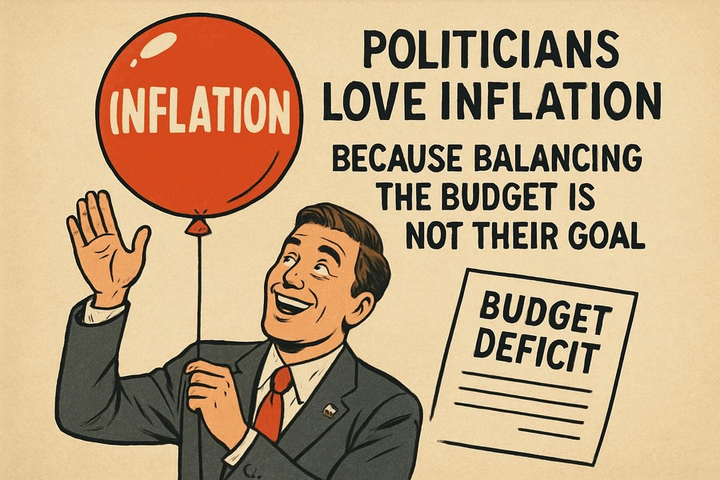
Shadow Inflation & the Price of Freedom

You’re not losing your mind, you’re losing your purchasing power.

Everything from groceries to rent to basic utilities has crept into unaffordable territory, but somehow the government insists inflation is around 3.3%. To most of us, that number feels like a punchline with no setup.

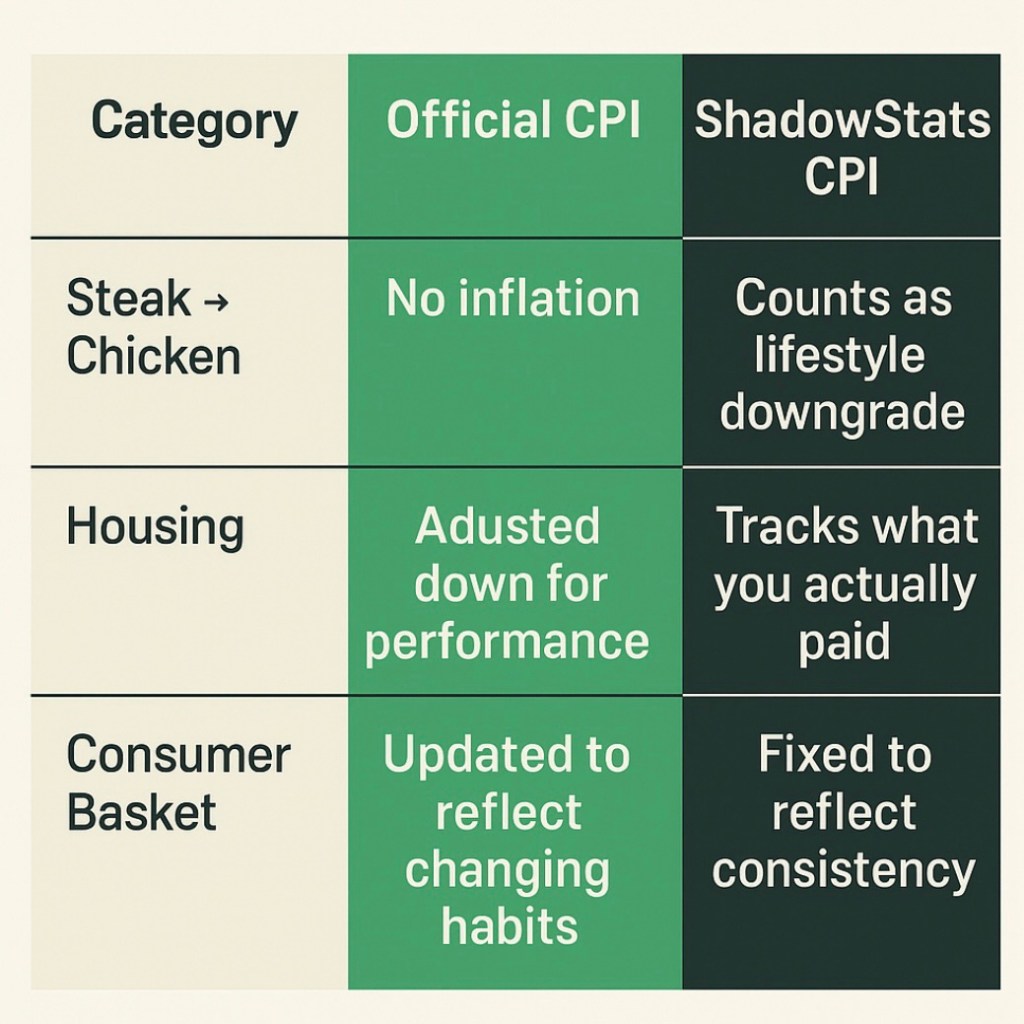
ShadowStats, which calculates inflation using methods from before the 1980s CPI revisions, suggests it’s actually over 9%. That sounds far more in line with what you feel in your bones and your wallet, doesn’t it?

The difference isn’t just mathematical, it’s philosophical. It determines whether you believe our society is slowly progressing or quietly deteriorating.

And at the center of that delusion sits the green tech movement: an ideal pushed by agreements between supranational organizations and state governments, built on commodities like silver, which ironically is one of the few tangible lifeboats left in an era of untethered money, misrepresented data, and unsustainable goals.


CPI: The Numbers Game That Makes Poverty Look Like Progress

In the early 1980s, the U.S. government began quietly redefining inflation. It didn’t look good on paper to say retirees needed 10% annual increases in Social Security checks. It looked even worse for Treasury bondholders expecting “real” returns.

So instead of wrestling inflation down, policymakers redefined how it was measured.

They introduced terms like:

  • Substitution: If steak gets too expensive, CPI assumes you switch to chicken. Inflation problem solved.
  • Hedonic adjustment: If your laptop is twice as fast, they say you’re paying less for it—even if it cost you more dollars (source, second bullet point).
  • Owner’s Equivalent Rent (OER): Instead of tracking what you pay in housing, they estimate what your home might rent for, based on surveys. (Crazy isn’t it?)

These methods were sold as ways to make CPI “more accurate,” but what they really did was make inflation more palatable to policymakers and debt managers. They also did it to make sure you and I kept racking up debt and consuming more each quarter.

Official inflation numbers rely on mechanisms that hide the erosion of lifestyle:

These adjustments treat your survival adaptations like buying cheaper food, delaying car repairs, moving back in with family, etc as market choices rather than signs of stress.

You’re not living worse, they say you’re just living differently.

Here’s what the former Fed Chairman Alan Greenspan said in 1995:

“If you are measuring the cost of living, you must measure the cost of maintaining a constant standard of living. If you substitute chicken for beef, you are not maintaining the same standard.”(https://www.nytimes.com/1995/12/04/us/inflation-gauge-may-be-too-high-experts-say.html)

The BLS has been doing the opposite for decades.


Green Tech: The Utopian Offramp Built on Industrial Scarcity

Enter the Sustainable Development Goals and the “just transition” to a greener future. Electric vehicles. Wind turbines. Solar panels. Battery storage. Carbon offsets. All tied to the years 2030 and 2050 as I’ve outlined in more than a few posts on this blog.

The problem? Every one of these systems relies heavily on silver, a finite, mined metal with growing industrial scarcity. According to the Silver Institute, solar panel production alone is expected to account for over 25% of annual silver demand by the end of this decade.

The price of silver has risen 43% year-to-date as of July 2025. Gold is up roughly 22%. Compare that to:

2025 YTD Return

NASDAQ +15%

S&P 500 +10%

DJIA +5.5%

So let’s check the math. If inflation is only 3.3% (official CPI), then those stock market gains look decent. But if ShadowStats is right, and inflation is closer to 9%, then:

  • The Dow Jones is posting a negative real return.
  • The S&P 500 is barely breaking even.
  • Even the NASDAQ, with its AI hype and tech surge, is only modestly positive in real terms.
  • Only silver and gold are delivering substantial real returns after adjusting for actual inflation.

This is the moment where you realize: only one entity will be paying for the widespread retrofitting and implementation of all this green tech that needs silver and it’s you. Either through willing compliance or taxation by the government so they can buy it with your wages and make you use it.


Hedonics, Hopium, and the Silver Choke Point

The CPI tells you that your phone is getting cheaper, even if you spent more on it, because it has better specs (source, first bullet point).

The ESG movement tells you your energy is getting cleaner, even if your utility bills are rising, because it’s coming from renewables.

But here’s what they don’t tell you:

  • Silver is irreplaceable in high-efficiency solar, circuit boards, EV contacts, and grid storage.
  • No large-scale replacement exists.
  • We are burning through reserves faster than we are discovering new viable deposits.

That means the very commodity needed to “fix” the future is becoming more expensive, even in inflation-adjusted terms. And that creates a dilemma no policy paper can solve.


Silver: The Honest Asset in a Dishonest System

In a world where official CPI is engineered to deflate your sense of decline, silver doesn’t lie.

  • It doesn’t get adjusted for quality.
  • It doesn’t get substituted.
  • It doesn’t get hedonicized.

It just reflects what a scarce, in-demand physical asset actually costs in a world of paper promises and underpriced labor.

And unlike fiat currencies or ESG credits, silver is outside the system. That’s why central banks don’t talk about it, and why retail investors who understand its utility in both monetary protection and energy transition are quietly accumulating at Costco before getting a hot dog and soda.


The Fatal Irony of Sustainable Progress

We are trying to build a green future using a grey metal whose supply cannot scale with our policy ambition. The Sustainable Development Goals require a miracle of material availability that simply doesn’t exist.

If silver prices are outpacing even ShadowStats’ inflation, then the affordability of the clean tech utopia vanishes on arrival. And if real inflation is devouring your market returns, then the dream of using “compound growth” to escape stagnation is mathematically dead.


Compliance or Sovereignty: There Is No Third Option

If you’re not holding assets that outpace real inflation (like silver or gold or the next randomly pumping stock) then you’re not preserving wealth. You’re slowly converting it into obedience.

Because what happens when your savings can’t keep up?

  • You’ll be offered government rebates for heat pumps.
  • Carbon credits for commuting less.
  • EV mandates.
  • Sustainability scorecards tied to your bank account (like that Aspire card I mentioned a few posts ago).
  • Access granted in exchange for compliance.

If you can’t buy your way out of the system, you’ll be forced to conform to it.

Green tech won’t be a lifestyle choice. It will be a behavioral requirement coded into policy, enforced by banks, and justified by a CPI that says “everything’s fine.”


Final Thought: Scarcity Isn’t the Problem—It’s the Lie

ShadowStats reveals how far we’ve drifted from price reality. Silver shows how tangible scarcity still has economic weight, how truth leaks out where it can’t be hedged.

And if you’re still counting on index funds and CPI-adjusted retirement accounts to protect you, ask yourself:

What happens when the growth you’re chasing is just inflation in disguise?

Silver isn’t just a hedge. It’s a mirror. And the reflection it shows is too uncomfortable for mainstream narratives to tolerate.

© 2025 Zakariyas James. First shared here at theruminationcompilation.wordpress.com.
Offspring Offsetting an Inherited Carbon Footprint

I can’t say for certain when, or even if, the things I will write about in this post will happen; admittedly I hope I’m dead wrong overall but deep-down, I see this becoming our future.

I don’t think it’s necessary to be reiterating the approaching global carbon footprint system but for those unaware: in due time, our consumer practices, all objects purchased & accounted for, will come with notations on the receipts of not just how much legal tender was used to procure the objects but how much carbon was released to create the objects & how much carbon is ultimately released to physically get them to you, the consumer. My favorite real-life example of this burgeoning system is the DO Black card from MasterCard that came out in 2019 but there’s a slew of others already available for public use & others on the way.

Though it seems to be a newfangled form of accounting & a tool for conscious conservation efforts on a personal scale, the question of “what are you doing to reduce your carbon footprint” is hardly a novel inquiry & a plastic card with a monthly carbon limit is not the sole solution we will be propositioned with.

Immediately following the advent of the climate movement & all rhetoric revolving around personal carbon emissions, a consensus was beginning to form in academia, politics, economics & in the bedroom: that children are the worst emitters of carbon.

In 2009, statisticians at Oregon State University published a paper titled, “Family planning: A major environmental emphasis” wherein the first paragraph suggests having one less child will combat climate change on a personal level. Saturated with negative sentiments of western lifestyles, lines like, “[u]nder current conditions in the U.S., for instance, each child ultimately adds about 9,441 metric tons of carbon dioxide to the carbon legacy of an average parent – about 5.7 times the lifetime emissions for which, on average, a person is responsible” are strung together & culminate in a passive-aggressive suggestion that the west forgo rearing children for the sake of…other children, I guess.

But it was well-received; faculty from other universities wrote their own papers with the same topics & arguments, non-government organizations reposted the article on their blogs & even comedians were referencing the paper itself, as seen in a bit done by Doug Stanhope a little over ten years ago now:

He cusses a good amount fyi.

The idea of restricting & reducing creation for the sake of conservation has slowly evolved from academic assertions, comedic input & political banter to just about an every day conversation for just about every single thing.

One of the articles I find most interesting & equally alarming comes from the online publication “Science Alert” where the concept of a digital carbon footprint is discussed & detailed as a remnant of corporate & civilian impact on the environment by way of data storage & use of memory space. The very last paragraph in the article says, “[y]ou can even make a start yourself by deciding which photos and videos you no longer need. Every file stored on the Apple iCloud or Google Photos adds to your digital carbon footprint,” which leads the ultra-cynic in me to believe they are slowly advocating for the self-induced destruction of self-documentation & digital relics of our families: “delete your family photos & family history for the environment or pay an inflated rate to compensate others for your narcissism” is really all I see that turning into, up to a point.

Though, here in California, like we always do, we took this idea a step further & started to run with it.

It was only a few months ago when a Smithsonian Magazine article came out with the title, “California Has Legalized Human Composting” & a subheading saying, “By 2027, Golden State residents will have the choice to turn their bodies into nutrient-rich compost”.

Though it seems conscientious & admirable to willingly forego a traditional form of burial or even cremation (which I’ve already seen ridiculed online as the “worst method” because of carbon release) I doubt this option has anything to do with ecological efforts & has everything to do with the next generation of children.

Imagine, a couple in America give birth to a child in 2030 & successfully provide the child the resources & nutrition they need until 18 years of age. Imagine, the parents die on the day after the 18th birthday, successfully leaving behind a small portion of liquid cash & a negative carbon footprint; surely, the IRS & any presiding authorities will tax the cash transferred from estate to beneficiary but how will the child offset the increased carbon footprint they inherited from their parent’s knowing the value of the footprint was exacerbated by the child’s existence?

Will little Sally, Sarah, Sue, Simon, whatever they may be called, have the option of cremating their parents to reduce the inherited carbon footprint? Will little Jack & Jill have the option of purging data centers & servers of their parents digital documents & photos of themselves as infants to reduce the inherited carbon footprint?

Today, the question of “what are you doing to reduce your carbon footprint?” is almost entirely presented to adults & in scenarios wherein the adolescent members of society are queried the same way, the answers are predetermined & practiced in school settings ie recycling, reusing, excessive hand sanitizer use in lieu of washing hands with water & soap; today, the answers from adults vary between “being conscious of where my consumables come from”, “cutting back on using this/that resource”, or the big one, “not having kids”.

Examples from Reddit:

Another example:

In 20-30 years, the question of “what are you doing to reduce your carbon footprint?” will be presented to kids that grew up in a world where they were told that they themselves are the problem; that their parents selfish decision to give them life is what will ruin the rest of ours & they will have evidence of this sentiment almost everywhere they look. From legislative & authoritative bodies like the UN & the WEF, all the way to regular people online, the children of today will have incontrovertible evidence that their existence was called into question by those who were never going to raise them or impact their lives in any positive way…and they will act in kind when asked, “do you think this life has value when considering how much carbon their lifestyle creates, or created?” Just in case anyone read it wrong, they will not act kindly – they will reciprocate these public calls for the extermination & restriction of specific life-forms; they will look to their predecessors & see a precedent that allows them to view life & death as parts of a financial equation that may or may not provide them financial gain. Maybe they’ll know there’s nothing to gain from this admittedly prematurely postulated position I’ve posed but maybe they’ll act accordingly just to spite the ones that started this game of hating the next generation, a sort of “treat others the way they treated me” mentality.

All I know is we are on a slippery slope of involving & equating the external adjudication of postmortem affairs with climate change narratives & finances in a way we have not thoroughly grasped or even imagined.

Do what you will in this life but remember: future generations will know what was done unless something is done to hide the truth. In 20-30 years, what will be the truth? That we’re doing all of this for the next generation? That we’re doing all of this for the environment? We’ll see.

Thanks for reading.

Works Cited:

Akristersson, A. (2019, April 30). Do black – the world’s first credit card with a carbon limit. Mastercard Newsroom. Retrieved October 23, 2022, from https://www.mastercard.com/news/europe/sv-se/nyhetsrum/pressmeddelanden/sv-se/2019/april/do-black-the-world-s-first-credit-card-with-a-carbon-limit/

Family planning: A major environmental emphasis. Life at OSU. (2017, October 5). Retrieved October 24, 2022, from https://today.oregonstate.edu/archives/2009/jul/family-planning-major-environmental-emphasis

YouTube. (2010). Voice of America – Abortion Is Green. YouTube. Retrieved October 23, 2022, from https://m.youtube.com/watch?v=YkgDhDa4HHo.

Jackson, T., & Hodgkinson , I. R. (2022, October 2). ‘dark data’ is leaving a huge carbon footprint, and we have to do something about it. ScienceAlert. Retrieved October 23, 2022, from https://www.sciencealert.com/dark-data-is-leaving-a-huge-carbon-footprint-and-we-have-to-do-something-about-it

Kuta, S. (2022, September 21). California has legalized human composting. Smithsonian.com. Retrieved October 23, 2022, from https://www.smithsonianmag.com/smart-news/california-has-legalized-human-composting-180980809/

© 2022 Zakariyas James. First shared here at theruminationcompilation.wordpress.com.

Analyzing the City of San Diego Climate Action Plan

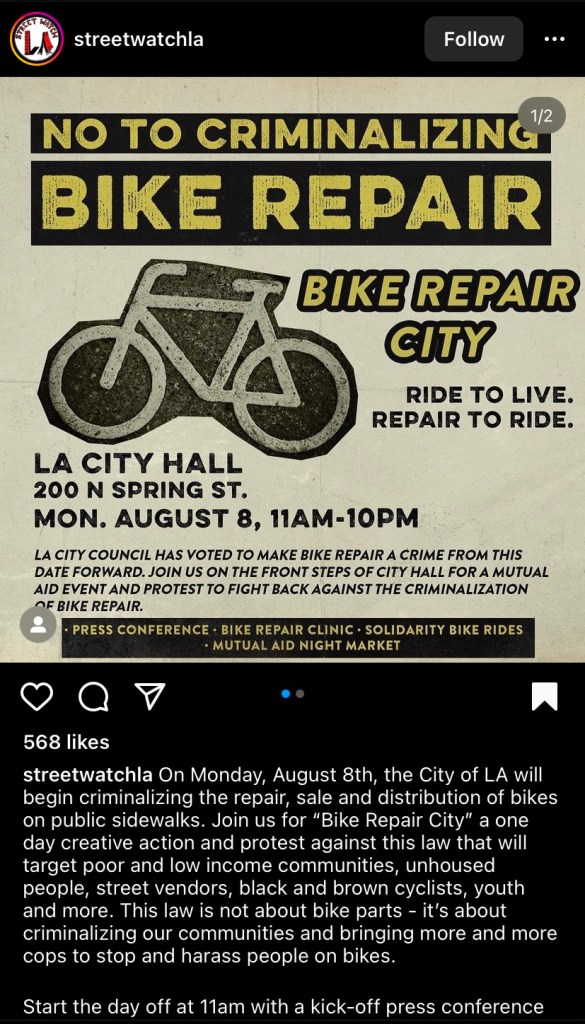
A friend of mine sent me a DM over the weekend, an Instagram post about bikes.

The City of Los Angeles on August 8th will regard the public repair, sale & distribution of bicycles as “chop shops”, legally defined as: three or more bicycles;— a bicycle frame with the gear cables or brake cables cut;— two or more bicycles with missing parts;— five or more bicycle parts.

On the surface & even from a distance this new ordinance seems fickle, overreaching, unnecessary or long overdue – the opinions vary as greatly as the personalities & cultures of California itself.

Unbeknownst to most, this new ordinance is a sign of the times to come. An indication of the veracity with which the governing bodies & authorities are willing to display in their endeavor to see predetermined plans finally implemented across the populous.

Just this past week, the neighboring City of San Diego enacted their own legislative frameworks regarding bikes too! Mayor Todd Gloria, members of SANDAG & affiliated organizations presented the 2022 edition of the Climate Action Plan, even though only weeks prior, what was reported to be over 4,000 citizens expressed discontent & preferences requesting the withdrawal of the plan altogether.

Without a doubt, a majority of the citizenry’s dissatisfaction with the proposed Climate Action Plan stems from public awareness of the plan’s origins itself; the goals of conscious stewardship & leveraging local abilities are not foreign to the citizenry of San Diego but the citizenry do not wish to yield agency & authority to international conglomerates & contractual agreements they are hardly party to. For clarification, as stated on pages 32 & 33 of the updated 2022 draft, “[t]he ICLEI Community-wide Protocol methodology was utilized for determining the City’s science-based fair share CAP goal for this program which is described in more detail in Appendix C.”

For those that have already read my post, “Environments & Requirements”, you may skip this video from a 2009 city council meeting in San Carlos, CA showing council members ignoring the words of the citizenry & implementing an ICLEI-derived plan. For those now coming across this site, I’d recommend watching & comparing the disregard of the San Carlos council members to the disregard of our politicians today as far climate legislation is concerned.

The folks seen in 2009 & the folks seen last week are of like mind: they simply wish to oversee their lands themselves; they uniformly wish to see the lands & its resources benefit the locals to the greatest degree. The politicians seen in 2009 & today are the same: they wish to see their plans fulfilled, no matter the cost as increased taxes will foot the bill.

Proposed taxes & suggested economic frameworks of San Diego’s 2022 version of CAP range from gallon per capita water limits, an increase in funding for tree rebate programs I covered a bit in “The Products of a New Environment” & transportation ordinances that all relate to a 2050 plan the City of San Diego has been pushing since at least 2010 involving…you guessed it: bikes. If you look to page 56 of the 2022 CAP, under Strategy 3: Mobility and Land Use, you see the City’s obsession with bikes & disdain for internal combustion engine vehicles at once:

“Shifting away from a car-centric transportation system starts with a loading priority for our roadways, prioritizing and protecting the most vulnerable modes such as walking and biking, and enhancing public transit for improved efficiency and performance. The loading priority concludes with shared, commercial, and personal electric vehicles, underscoring a commitment to the full transition of all vehicles from combustion engines and fossil fuels. The City will reduce vehicle miles traveled (VMT) for trips through transportation infrastructure and technology improvements, transportation demand management (TDM) programs, and land use changes.”

It should be noted that this 2022 plan is simply a foundation for the 2050 plan titled “Riding to 2050: The San Diego Regional Bicycle Plan” but there are a number of proposed actions relating to Greenhouse Gas (GHG) emissions & other climate issues that will be enacted along the way as 2035 is a mid-point target year from now to 2050. Among the myriad of proposals to curb GHG emissions, one of marked interest is found in the 2022 edition of the CAP on page 69:

1) Reduce GHG emissions and water use of total beef, pork, chicken, turkey and dairy purchases by 20%.
2) Increase local, healthy, and sustainable foods to 20% of total food purchases prioritizing locally sourced, valued workforce and animal welfare.

Interestingly enough, in the entire CAP document, only one page is devoted to “Measure 5.3: Local Water Supply” & simply discusses the aforementioned gallon per capita limit; in one week the Federal government is going to impose water restrictions on 40 million people due to the state of the Colorado River basin, yet the City of San Diego has apparently nothing to say on the matter.

At the moment, the City of San Diego is primarily focused on regulator technology & economic frameworks that will advance the 2050 plan. In all fairness, San Diego has been this way since it entertained ICLEI & other entities; in the 2010 version of “Riding to 2050: The San Diego Regional Bicycle Plan”, published while Jerry Sanders was Mayor, on page 49, “encouragement programs” are proposed as an economic method of enticing, to some perspectives coercing, citizens & businesses into participating in these programs where ride-sharing & biking are the preferred forms of transportation.

An excerpt on these programs:

Encouragement programs are generally characterized by their focus on encouraging people to bicycle more frequently, particularly for transportation. Encouragement programs increase the propensity for bicycle trips by providing incentives, recognition, or services that make bicycling a more convenient transportation mode. The following encouragement programs are recommended for implementation in the region and described in more detail in the remainder of the section:
⁃ Bike Sharing Program
⁃ Pilot Smart Trips Program
⁃ Employer Incentive Programs
⁃ Bicycle Friendly Community Designation
⁃ San Diego Region Bike Map
⁃ Identification and Way-finding Signage
⁃ University-base Bike Orientation

In the version published in 2011, the concept of ride-share programs is expanded & marginally defined a bite more with examples like the Guaranteed Ride Home Program (which I had no clue existed until today) & iCommute, a vanpool program with a subsidy of $400 per month per vanpool. By 2015, under the direction of then Mayor Kevin L. Faulconer, the ride-share programs expanded into a contract with DecoBike but ended in 2019 after the City of San Diego claimed a breach of contract occurred on the companies end – though this is disputed by DecoBike.

In terms of high occupancy transportation, all versions of the climate plans advocate for electric vehicle fleets; the most common form is tied to K-12 & collegiate school bus programs. This past July, a San Diego based company, Nuvve Holding Corp., announced a joint venture with San Diego Gas & Electric where eight electric school buses in the Cajon Valley Union School District will connect to the grid & serve as a pilot program for the next five years, not only for state-wide school transportation use but also for the federal Build Back Better plan as Nuvve Holding Corp. announced a Memorandum of Understanding with the US Department of Energy some time ago regarding V2G & V2X technology.

An often overlooked aspect of the V2X technology that appeals to governing bodies is the “connected vehicle” nexus & data mining capabilities thereof. In these evolving iterations of climate plans related to the years 2025, 2030 & 2050, digital details are a prerequisite of all vehicles that will be on the road for a consortium of reasons that summarily present as regulatory technology. In early plans, connected vehicles simply refers to vehicles capable of emitting wireless data vehicle-to-vehicle & vehicle-to-infrastructure so as to aid in the flow of traffic; as we’ve seen with newer plans & in European counterparts, intelligent speed limits, excessive tracking & the aforementioned prioritization of biking civilians are the culmination of these mandated advances in vehicle technology.

I have yet to address the cost of all these mandated applications of higher-end vehicle-to-everything technologies; I’ve considered making a whole post on the expected costs incurred for civilians in the wake of these subnational & national mandates stemming from international contractual agreements but I’ll simply point out that the average all-electric bus costs $400,000 & in the Inflation Reduction Act of 2022, eligible “clean” vans, SUVs & pickup trucks qualify for a rebate of $80,000 upon purchase & other vehicles for $55,000. I really can’t imagine how much these all vehicles will cost in total but if the rebates are already close to some people’s yearly income, I can imagine most will not be buying these vehicles, unless on an already strained credit line.

So, I guess we’ll all bike to work, right?

But what if your bike breaks down & you live in a city like Los Angeles where you can’t rely on your local handy-folk to lend a helping hand anymore because of a city ordinance? Guess you’ll pull out your card anyways & pay for a ride on an EV bus, rent a ride-share bike or pay for a ride on the rail transit system.

From what I can gather, the Guaranteed Ride Home Program only covers three rides per year; seems like baseball, three strikes & we’re left outside.

Amazingly, the word “homeless” shows up only one time in the entire 2022 San Diego Climate Action Plan, whereas the word “bike” shows up 49 times. I wonder, if one is left outside, what is the plan, what are the options & allowances afforded by a City that can’t even type the word “homeless” more than once in a 238 page document?

Thanks for reading.


San Diego’s approach can be better understood in the context of global economic pressures outlined in Market Forces: Foreign Factors and Domestic Actors.


Works Cited:

Photo by Susanne Jutzeler, suju-foto from Pexels

Chou, E., 2022. Los Angeles City Council votes to ban bike repair entrepreneurs on public sidewalks – Daily News. [online] Dailynews.com. Available at: <https://www.dailynews.com/2022/06/21/los-angeles-city-council-votes-to-ban-bike-repair-entrepreneurs-on-public-sidewalks/&gt; [Accessed 7 August 2022].

Sandiego.gov. 2022. City of San Diego Climate Action Plan. [online] Available at: <https://www.sandiego.gov/sites/default/files/san_diegos_2022_climate_action_plan_0.pdf&gt; [Accessed 8 August 2022].

Sandag.org. 2010. Riding to 2050: The San Diego Regional Bicycle Plan. [online] Available at: <https://www.sandag.org/uploads/publicationid/publicationid_1674_14591.pdf&gt; [Accessed 8 August 2022].

(In case that link doesn’t work, try: https://www.sandiego.gov/sites/default/files/san_diegos_2022_climate_action_plan_0.pdf )

Sandag.org. 2011. 2050 Regional Transportation Plan. [online] Available at: <https://www.sandag.org/uploads/2050RTP/F2050rtp_all.pdf&gt; [Accessed 8 August 2022].

(In case that link doesn’t work, try: https://www.sdforward.com/pdfs/Final_PDFs/AppendixU16.pdf )

Sdgenews.com. 2022. SDG&E and Cajon Valley Union School District Flip the Switch on Region’s First Vehicle-to-Grid Project Featuring Local Electric School Buses Capable of Sending Power to the Grid | SDGE | San Diego Gas & Electric – News Center. [online] Available at: <https://www.sdgenews.com/article/sdge-and-cajon-valley-union-school-district-flip-switch-regions-first-vehicle-grid-project&gt; [Accessed 8 August 2022].

Documentcloud.org. 2022. Inflation Reduction Act of 2022. [online] Available at: <https://www.documentcloud.org/documents/22122281-inflation_reduction_act_of_2022&gt; [Accessed 8 August 2022].

© 2022 Zakariyas James. First shared here at theruminationcompilation.wordpress.com.

The Products of a New Environment

Are you certain that you’ll reap what you’ve sown?

For the moment, I seek to address those in the southwestern portion of the United States of America & ask those reading from elsewhere to keep an open mind & an open eye. We’re just about halfway into our summer season but we’re nowhere near close to beginning the actual battles that’ll come in respect to water rights & land rights for those in the southwest & eventually the entire nation.

As most are aware, more than a few bodies of water & rivers they connect to are depleting at exigent rates like Lake Powell, Lake Mead & the Colorado River Basin. To note, the “U.S. Bureau of Reclamation officials gave all seven states until August 15 to create a plan to save between 2 million and 4 million acre-feet of water. If they fail, the federal government will take control and impose its own cuts as water use exceeds supply and an ongoing megadrought continues to sap water from the Colorado River.” To clarify, the seven states in question are Arizona, California, Colorado, Nevada, New Mexico, Utah & Wyoming – by August 15th, nearly 40 million people will be subject to regulations & contractual agreements they’ll probably be hearing about for the first time.

Though one could dive deeper into the legal acumen involving water use, I will not be doing that here. I am admittedly more concerned with the present nature of genetic ownership in regards to gardening & farming – I find the issue to be a bit more murky than Leak Mead is at the moment & I believe predetermined agreements between corporations & legislative bodies will exacerbate any water issue regardless of civilian conservation efforts going forward.

Are you certain the things you’ve grown are things you own?

To illustrate the point of a future scuffle regarding “right to grow”, one must only look to existing laws that provide precedent for such an incident.

In a Nature Biotechnology paper from 2015, four authors found that,

“Nonetheless, with the data that can readily be gleaned publicly, our analysis of mapped and referenced patent sequences across the three crop genomes revealed DuPont and its affiliates as the holder of the largest collection of gene patents. It holds more gene patents than Monsanto or the rest of the US industry—including small and medium biotech companies and governmental research institutes and universities—put together (Fig. 1).
Uniquely in the United States, plants and their products can be protected by patents and by other IP mechanisms at the same time. Plant varieties can be protected by a specific plant patent under the Plant Patent Act of 1930 for asexually reproducible plants; by a plant variety protection (PVP) certificate under the Plant Variety Protection Act of 1970 for sexually reproducible plants or tuber-propagated plant varieties; or, since 1985, by utility patents.
Because several types of protection can be granted at the same time—for example, either a plant patent or a PVP certificate with a utility patent—and exclusive rights extend for 20 years, any IP right holder on any of the crops can in principle benefit not only by enforcing their IP rights but also by holding off competition in the market and potentially delaying innovation on certain technologies, especially when the granted rights are under utility patents. Utility patents have a broader scope, including protection on the plant itself, its diverse uses, its progenies and the method used to produce it, and they have an impact on follow-on innovations.”

In summation, bioengineered materials are property, in some way, of corporations that produced them. This fact itself is what lies at the core of most debates around commercial agriculture practices & genetically modified organism (GMOs) as “the biotech industry argues that genetic engineering can be used to create “nature-identical,” non-GMO products. This false claim supports the development of new GMOs in the food supply while side-stepping the current definition of bioengineering and avoiding BE disclosure. Without transparent and reliable GMO labeling, Americans are kept in the dark about what goes into their food” & who really owns it.

The Invasion of the Garden Snatchers

The commercial aspect of gardening, rife with rebranding & business-to-business marketing schemes like any other discernible industry has notably unique moments wherein legislation concerning biological conservation can be tweaked or outright ignored.

While most Californians by now are aware of the issue of the moderately invasive nature of the Eucalyptus globulus (Tasmanian Blue Gum) & the impact it has on soil erosion & fueling fires, certain corporations that operate in the southwest are tactically circumnavigating subnational & national legislation meant to curb the sale of invasive species & they’re becoming increasingly bold in their endeavors.

In all honesty, I work for a large nursery that supplies plants to a number of states & I thoroughly enjoy my job so I won’t be disclosing business practices I can directly speak to that correlate here. Sorry Too Short, this is the one time I don’t want to blow the whistle. That said, I will do my best to display the matter as a basic schematic so as to allow application to any business that potentially falls under the model to be properly scrutinized in a like manner.

Linked here are the 6 agencies overseeing the invasive species list; if you live in California, look at one of the lists the next time you go shopping at a store that has a garden center. For the past year & change that I’ve worked in the industry, a number of the listed plants have been available for purchase & the number of invasive species being sold on the market is growing.

Through genetically manipulating invasive species, commercial growers are able to market the plants as “new varieties” or “regional friendly” – no determinations, to my knowledge, are required by legislation to assess the nature of hybridized or genetically modified plant varieties in regards to local impact on the environments where these lab-produced plants are introduced & established. As the Non-GMO group put it in their blog post, “nothing in nature exists in a vacuum, and it is unnatural to assume that it would.” So it could be said that these lab-produced edible & non-edible plants on the market are potentially as detrimental as the organisms they are based on, unfortunately only time & focused attention will tell.

At the present time, companies like SDG&E are facilitating programs wherein “qualifying SDG&E customers can receive a $35 rebate for planting or potting a 1- or 5-gallon tree/plant species.”

Specifically, under the “native trees” category, the Black Willow is native to the East Coast of the US, not the Southwest; furthermore, the other two Willow species listed are more commonly found in wetlands as their root systems take so much water that is advised not to plant them near septic tanks or drainage fields. Intriguing choices to say the absolute least, though when you look to the “regionally-friendly” trees & see the number of invasive species, it doesn’t seem to matter much anymore. Either SDG&E is misinformed or they’re willing to let the public stay misinformed about the future cost of those $35 since it’s all for “local biodiversity, improving air quality, and sequestering carbon.”

That “sequestering carbon” bit is how a lot of these GMO trees are being pushed on the market & into the ground lately & why the Lorax is one of my favorite films of all time.

Artificial Trees & Grasslands Please

Mass sapling-planting campaigns are nothing new; most of anyone who could read this is probably aware of at least 1-3 moments wherein a company or country just threw a bunch of saplings in the ground. My mothers homeland just went crazy with the idea last year & planted 350 million of them.

Without a doubt, the only certainty at all, is that the most interesting & equally terrifying campaigns are the ones that involve the interplay between genetically modified trees & the cap-and-trade carbon-credit scheme.

MasterCard, a proponent of the cap-and-trade scheme, has a credit card called Aspiration: Zero Carbon Footprint where they “plant a tree every time you make a purchase—and let you round up to plant one too. Using this card just once a day can plant enough trees that, once grown, will counteract your daily negative carbon footprint (unless you’re a real gas-guzzler). Spend daily with Zero to neutralize your footprint and earn up to 1% cash back. Use your rewards to plant more trees or receive a statement credit.”

Call me crazy whatever way suits you, merely afford me a bit more of your time if you’ve yet to read Part 3 of “The Volumes on Vitality” specifically the section on utility tokens.

The “statement credit” Zero Card is vaguely proposing in lieu of planting more trees is rather reminiscent of the utility token FreeWater quickly mentioned on their own site & digital advertisements, along with carbon credits as a whole. Aspirations’ “join us in our mission to plant 125 Million trees by 2030” remark on their website, coupled with the self-implementation of a carbon-credit schematic makes it clear they are probably aware of one of the contracts I mentioned in the blog post that precedes this one. Good old “market forces”!

Another company, Living Carbon, genetically modifies trees in a way that causes “modified poplar trees [to] store up to 53% more carbon than control trees.” In the interview for the article, the CEO Maddie Hall said, “if we were to double the acreage that we have today up until 2030, we would be able to actually plant enough trees to remove 1.66% of global emissions in 2021.” I can’t wait to see how many companies try to buy these GMO trees, then reason to the government & relevant regulating bodies that the trees in question warrant greater carbon capture credit values than purchases of regular trees.

It’s odd though – there is a respectable amount of science regarding carbon capture practices that point out that grass is more of a reliable carbon sink than trees for two reasons: grass grows faster & grass stores the carbon in the soil unlike trees that store carbon in their wood above soil. The carbon above the soil line is pure fuel in the event of a forest fire & hardly the safer choice considering a sizable portion of the US is in a drought & is expected to remain so for the foreseeable future. All this considered, we have a stark prevalence of tree planting campaigns across the globe & across the market & water restrictions across the Southwest that directly impact civilian grass lawn upkeep. It seems as though not all things are considered equally, I should say.

Due in large part to the unequal use of water from the Colorado River Basin, one can see exactly what it looks like when water is continuously taken from one environment & used/left in another. The canopy alongside the canal that exists now is a testament to what Lake Mead will look like (check out 12:16-17:08) in due time, should the water levels continue to recede at the rate they have as shown in the beginning of the video.

But as a whole, what will our collective future be like in regards to water rights & land rights? I often wonder, did the people who wrote the film adaptation of the Lorax just get oddly lucky in retrospect or were they prematurely portraying a theoretical situation where GMO trees modified to capture increased levels of carbon replace natural trees in a system where carbon credits & debits become commonplace across the globe?

Will we prevail through this unifying struggle or will we communally fail, leaving behind only remnants of our attempts to simply survive, much like the Hohokam people who long ago built the canals that the city of Phoenix, Arizona finds inspiration from today?

I don’t imagine these compounding issues can be swept under the rug – we’re talking about the earth itself, where can we sweep it? There needs to be better application of the best practices available to every region afflicted with constrained access to the basics of life, greater attention paid to the outcome of our efforts & actual transparency between civilian, regulator & market. The cool thing is, the civilian is the foundation of the coupled latter & Dr. Seuss said it well enough, “Unless someone like you cares a whole awful lot, nothing is going to get better. It’s not.”

This is not to say we all need to memorize the list of invasive species & self-impose restrictions; on the contrary, in a world where the morality of consumption is debated & designed by market forces & legislation that can oftentimes be overreaching (hello & goodbye 18th amendment) we, the consumer, must become pickier & demand more of the persons seeking to make off with our hard earned money. We must work to see our own requirements met, soon, before there comes a time, for some maybe August 15th, when the only requirements met are those set outside of our control.

Thanks for reading.


P.S. look at Point 5 of the Summary of the Energy Security and Climate Change Investments in the Inflation Reduction Act of 2022:

SDG&E is salivating I bet

And when you find another 20 minutes of your time affordable to this post, watch this video on the pipeline being built for carbon capture:


And to cap it all off, a nice photo I snapped of a moth on my balcony enjoying the pollen of a buddleja davidii.


Works Cited:

Swanson, Conrad. “As Critical Deadline Nears, Only Half of a Plan to Save Colorado River Water Has Been Proposed.” The Denver Post, The Denver Post, 22 July 2022, https://www.denverpost.com/2022/07/22/colorado-river-drought-plan-water-arizona-california/.

Jefferson, O., Köllhofer, D., Ehrich, T. et al. The ownership question of plant gene and genome intellectual properties. Nat Biotechnol 33, 1138–1143 (2015). https://doi.org/10.1038/nbt.3393

Non-Gmo Project. “What Is Bioengineered Food? .” The Non-GMO Project – Everyone Deserves an Informed Choice, 8 Sept. 2021, https://www.nongmoproject.org/blog/what-is-bioengineered-food/.

“National Invasive Species Resource Center.” Resource Search | National Invasive Species Information Center, https://www.invasivespeciesinfo.gov/resources/search?f%5B0%5D=location%3A90&amp;f%5B1%5D=subject%3A268.

“Community Tree Rebate Program – SDGE.” SDG&amp;E Community Tree Rebate Program for Residential Customers, SDG&amp;E, https://www.sdge.com/sites/default/files/15897_sdge_treerebate_fs.04.pdf.

“Ethiopia Plants More than 350 Million Trees in 12 Hours.” AFR100, https://afr100.org/content/ethiopia-plants-more-350-million-trees-12-hours.

“Green Credit Card: Carbon-Neutral &amp; Eco-Friendly.” Aspiration, Aspiration Partners, Inc., https://www.aspiration.com/credit.

Kerlin, Katherine E. “Grasslands More Reliable Carbon Sink than Trees.” UC Davis, 25 Oct. 2021, https://climatechange.ucdavis.edu/climate/news/grasslands-more-reliable-carbon-sink-than-trees.

Millison, Andrew. “The Canal That Accidentally Grew a Forest in the Arizona Desert.” Andrew Millison, YouTube, 29 Nov. 2021, https://m.youtube.com/watch?v=jf8usAesJvo.

“Lake Mead Drought Update!!! Lowest It’s Ever Been!!!” SinCity Outdoors, YouTube, 20 July 2022, https://m.youtube.com/watch?v=3Azy88IiVqU.

© 2022 Zakariyas James. First shared here at theruminationcompilation.wordpress.com.