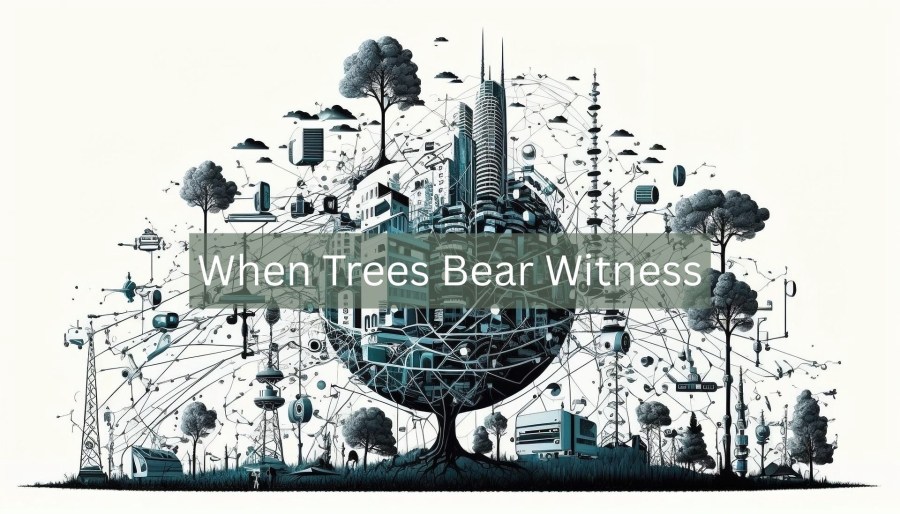
When Trees Bear Witness

Give it some time, the trees will start listening to you. A device once used only to track growth rates is now the seed of something else, a quiet grafting of the forest into the cloud. 

Dendrometers (used to measure the growth of trees and other plants by monitoring changes in diameter) have gotten a recent boost in applicability for more than just forest management teams. Thus far, they’ve allowed forest managers to cut down site visits needed to gather data on tree growth and carbon capture rates, but because of a recent innovation, much more is possible and I want to paint a picture for you. 

As per usual, what begins as a gesture to efficiency, a nod to preservation, may warp into something far more insidious.

The company Treemetrics, working alongside the European Space Agency, created sensors that link through wide-area networks and satellites, feeding streams of data into a platform called Forest HQ. If your tree is growing, Forest HQ knows. The forest becomes an extension of the cloud, feeding numbers related to diameter growth, height, location—change of all sorts. So, the forest is no longer a place. It is a feed. The company calls this project the Internet of Trees.

The logic is seductive: better measurement equals better care. Carbon accounting strengthens climate response. Carbon credits for the cap-and-trade markets gain more authenticity. But inside that necessity lies a governance architecture: every tree, instrumented; every growth curve, visible; every beat of the forest, rearranged as data. A swarm of data waiting to be further monetized or weaponized—unfortunately, humans do one or the other. Often both. 

I know what I will soon describe may seem altogether far fetched, but it does not take much imagination to see the scope widen in the way I expect given the right amount of time.

The slope is not hard to imagine. Already, forests are wired with listening devices meant to detect chainsaws, trucks and any other prohibited criteria. Artificial intelligence runs on-site, flagging the sounds of illegal logging before they reach the cloud. It is admittedly clever, even noble. But anything involving criminalization soon collapses into categories: nuance is stripped, anomalies are flagged, people are reduced to signals. 

We’ve seen this arc before. The Global Positioning System was once sold as a gift for navigation: finding your way home, never getting lost. Now it’s the backbone of precision strikes and geofencing. Closed-circuit television cameras were rolled out for “public safety.” Now they’re stitched together in networks that can track a face across an entire city and can even recognize your gait amongst a crowd. Social media began as a way to connect with friends and now it’s a sprawling apparatus of profiling, targeted persuasion and behavioral nudging.

Each began as benevolent. Each hardened into control.

For a good number of technologies, the arc of applicability tends to bend toward something darker. Monetized until meaningless or weaponized against anyone not in control of the weapon. 

What begins as protection of ecology can just as easily become the monitoring of people. A hiker’s footsteps, a group of protestor’s chants; any human activity can be parsed as anomaly, pinged to headquarters. With the right contracts, the forest becomes surveillance infrastructure, camouflaged in green.

What if Forest HQ evolves from tracking growth to performing guard duty? What if the forest ceases to be wild and becomes a grid, mapping bodies as much as making bark? 

Conveniently, this year a viral post showcased a new service from XFinity that uses WiFi signals to detect motion in your home, “without relying on sensors or cameras.” The technology has existed for years, but only now is it being pitched as household convenience. Tracking once reserved for homes and offices will soon extend to the wilderness.

You can opt into this service, which routers and WiFi connected objects around you don’t give the option to opt out?

This shift matters not only technologically but culturally. What happens when forests are no longer trusted as wild refuges, but feared as watchtowers? What happens to the human imagination when trees are not symbols of mystery or sanctuary, but extensions of a monitoring state? Jokes about birds not being real will lose their humor. Children will hesitate or outright refuse to climb a tree.

Surveillance always arrives dressed as care. It comes with drones, dashboards and dragnet data streams in the name of stewardship and security. But benevolence, left unexamined, can harden into coercion. The trees will stop watching silently; they start reflecting, transmitting, bearing witness.

And so the question lingers: at what point does monitoring, however noble its pitch, become policing? 

Throughout our history, the wild was once where we went to disappear. Now it has the potential to be where we are found most easily. 


For more reading on how technological advancement affects our interaction with nature and cultivated products, see The Products of a New Environment.

© 2025 Zakariyas James. First shared here at theruminationcompilation.wordpress.com.
Something to share

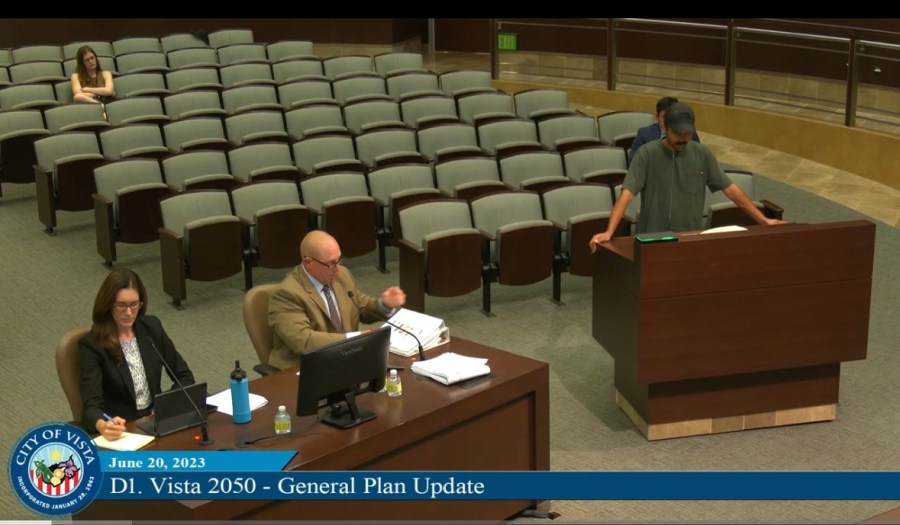
Last year, I spoke at a city council meeting in Vista, California where the focus was on the “General Plan”. This “General Plan” is Vista’s version of California state’s “Climate Action Plan”. Since 2011, California law has mandated that every city have a General Plan, but only recently have cities started hosting meetings and workshops to involve community members in discussing what citizens want in the plan and marginally clarifying what citizens should expect the plan’s fruition to really look like.

For context, prior to the meeting, I prepared 3 questions to ask the city officials regarding the General Plan & provided each a copy of the questions to follow along as I spoke. Admittedly, I didn’t expect anything other than outright dismissal of my questions but I was extremely wrong. I got a response I need to share with you.

Before I do that, I want to separately address any potential readers based on geography:

⁃ Citizens of Vista, if possible, start going to the meetings for the General Plan & listen to what’s coming. I know it’s hard to carve out time with all that life sends our way but if you have any level of concern for future of the city (or your place in the city) show up to one of these specific meetings & listen to the plan they have in mind for the city, bearing fully in mind what Commissioner Looney says from 6:30-9:42 in the video below.

⁃ Citizens elsewhere, google whatever state you live in along with the words “climate action plan”. If your state has has one, check & see if a law was passed requiring the city you live in to adopt a climate action plan (CAP) or general plan as well. Since 33 states already have, I’d almost bet on it, so if it happens to be so, I suggest watching the clip below & asking yourself “is what Commissioner Looney says from 6:30-9:42 going on in my city too?”

Sorry this is a long video (by today’s standards) but I wanted to show every city member’s response unedited.


If anyone wants to watch the entirety of the meeting:

Thank you for your time, I value it tremendously.

© 2024 Zakariyas James. First shared here at theruminationcompilation.wordpress.com.

Offspring Offsetting an Inherited Carbon Footprint

I can’t say for certain when, or even if, the things I will write about in this post will happen; admittedly I hope I’m dead wrong overall but deep-down, I see this becoming our future.

I don’t think it’s necessary to be reiterating the approaching global carbon footprint system but for those unaware: in due time, our consumer practices, all objects purchased & accounted for, will come with notations on the receipts of not just how much legal tender was used to procure the objects but how much carbon was released to create the objects & how much carbon is ultimately released to physically get them to you, the consumer. My favorite real-life example of this burgeoning system is the DO Black card from MasterCard that came out in 2019 but there’s a slew of others already available for public use & others on the way.

Though it seems to be a newfangled form of accounting & a tool for conscious conservation efforts on a personal scale, the question of “what are you doing to reduce your carbon footprint” is hardly a novel inquiry & a plastic card with a monthly carbon limit is not the sole solution we will be propositioned with.

Immediately following the advent of the climate movement & all rhetoric revolving around personal carbon emissions, a consensus was beginning to form in academia, politics, economics & in the bedroom: that children are the worst emitters of carbon.

In 2009, statisticians at Oregon State University published a paper titled, “Family planning: A major environmental emphasis” wherein the first paragraph suggests having one less child will combat climate change on a personal level. Saturated with negative sentiments of western lifestyles, lines like, “[u]nder current conditions in the U.S., for instance, each child ultimately adds about 9,441 metric tons of carbon dioxide to the carbon legacy of an average parent – about 5.7 times the lifetime emissions for which, on average, a person is responsible” are strung together & culminate in a passive-aggressive suggestion that the west forgo rearing children for the sake of…other children, I guess.

But it was well-received; faculty from other universities wrote their own papers with the same topics & arguments, non-government organizations reposted the article on their blogs & even comedians were referencing the paper itself, as seen in a bit done by Doug Stanhope a little over ten years ago now:

He cusses a good amount fyi.

The idea of restricting & reducing creation for the sake of conservation has slowly evolved from academic assertions, comedic input & political banter to just about an every day conversation for just about every single thing.

One of the articles I find most interesting & equally alarming comes from the online publication “Science Alert” where the concept of a digital carbon footprint is discussed & detailed as a remnant of corporate & civilian impact on the environment by way of data storage & use of memory space. The very last paragraph in the article says, “[y]ou can even make a start yourself by deciding which photos and videos you no longer need. Every file stored on the Apple iCloud or Google Photos adds to your digital carbon footprint,” which leads the ultra-cynic in me to believe they are slowly advocating for the self-induced destruction of self-documentation & digital relics of our families: “delete your family photos & family history for the environment or pay an inflated rate to compensate others for your narcissism” is really all I see that turning into, up to a point.

Though, here in California, like we always do, we took this idea a step further & started to run with it.

It was only a few months ago when a Smithsonian Magazine article came out with the title, “California Has Legalized Human Composting” & a subheading saying, “By 2027, Golden State residents will have the choice to turn their bodies into nutrient-rich compost”.

Though it seems conscientious & admirable to willingly forego a traditional form of burial or even cremation (which I’ve already seen ridiculed online as the “worst method” because of carbon release) I doubt this option has anything to do with ecological efforts & has everything to do with the next generation of children.

Imagine, a couple in America give birth to a child in 2030 & successfully provide the child the resources & nutrition they need until 18 years of age. Imagine, the parents die on the day after the 18th birthday, successfully leaving behind a small portion of liquid cash & a negative carbon footprint; surely, the IRS & any presiding authorities will tax the cash transferred from estate to beneficiary but how will the child offset the increased carbon footprint they inherited from their parent’s knowing the value of the footprint was exacerbated by the child’s existence?

Will little Sally, Sarah, Sue, Simon, whatever they may be called, have the option of cremating their parents to reduce the inherited carbon footprint? Will little Jack & Jill have the option of purging data centers & servers of their parents digital documents & photos of themselves as infants to reduce the inherited carbon footprint?

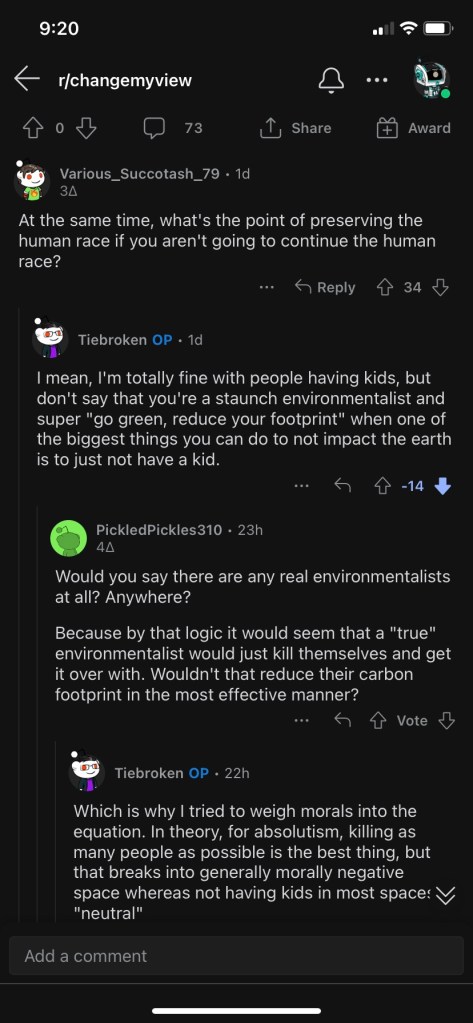
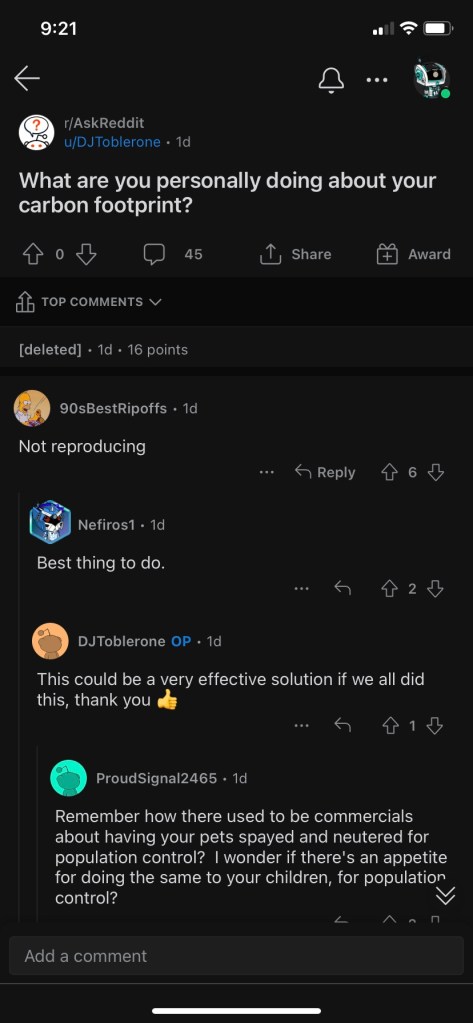
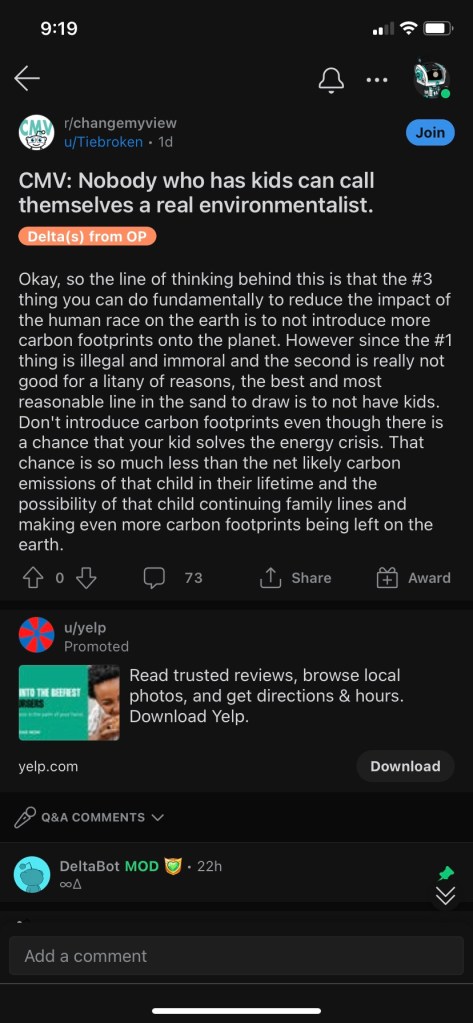
Today, the question of “what are you doing to reduce your carbon footprint?” is almost entirely presented to adults & in scenarios wherein the adolescent members of society are queried the same way, the answers are predetermined & practiced in school settings ie recycling, reusing, excessive hand sanitizer use in lieu of washing hands with water & soap; today, the answers from adults vary between “being conscious of where my consumables come from”, “cutting back on using this/that resource”, or the big one, “not having kids”.

Examples from Reddit:

Another example:

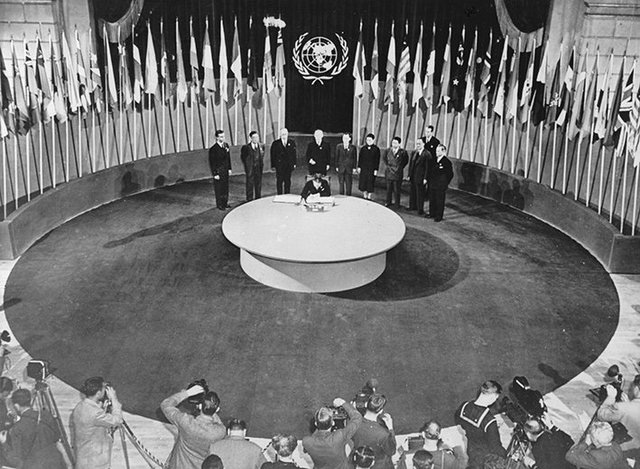
In 20-30 years, the question of “what are you doing to reduce your carbon footprint?” will be presented to kids that grew up in a world where they were told that they themselves are the problem; that their parents selfish decision to give them life is what will ruin the rest of ours & they will have evidence of this sentiment almost everywhere they look. From legislative & authoritative bodies like the UN & the WEF, all the way to regular people online, the children of today will have incontrovertible evidence that their existence was called into question by those who were never going to raise them or impact their lives in any positive way…and they will act in kind when asked, “do you think this life has value when considering how much carbon their lifestyle creates, or created?” Just in case anyone read it wrong, they will not act kindly – they will reciprocate these public calls for the extermination & restriction of specific life-forms; they will look to their predecessors & see a precedent that allows them to view life & death as parts of a financial equation that may or may not provide them financial gain. Maybe they’ll know there’s nothing to gain from this admittedly prematurely postulated position I’ve posed but maybe they’ll act accordingly just to spite the ones that started this game of hating the next generation, a sort of “treat others the way they treated me” mentality.

All I know is we are on a slippery slope of involving & equating the external adjudication of postmortem affairs with climate change narratives & finances in a way we have not thoroughly grasped or even imagined.

Do what you will in this life but remember: future generations will know what was done unless something is done to hide the truth. In 20-30 years, what will be the truth? That we’re doing all of this for the next generation? That we’re doing all of this for the environment? We’ll see.

Thanks for reading.

Works Cited:

Akristersson, A. (2019, April 30). Do black – the world’s first credit card with a carbon limit. Mastercard Newsroom. Retrieved October 23, 2022, from https://www.mastercard.com/news/europe/sv-se/nyhetsrum/pressmeddelanden/sv-se/2019/april/do-black-the-world-s-first-credit-card-with-a-carbon-limit/

Family planning: A major environmental emphasis. Life at OSU. (2017, October 5). Retrieved October 24, 2022, from https://today.oregonstate.edu/archives/2009/jul/family-planning-major-environmental-emphasis

YouTube. (2010). Voice of America – Abortion Is Green. YouTube. Retrieved October 23, 2022, from https://m.youtube.com/watch?v=YkgDhDa4HHo.

Jackson, T., & Hodgkinson , I. R. (2022, October 2). ‘dark data’ is leaving a huge carbon footprint, and we have to do something about it. ScienceAlert. Retrieved October 23, 2022, from https://www.sciencealert.com/dark-data-is-leaving-a-huge-carbon-footprint-and-we-have-to-do-something-about-it

Kuta, S. (2022, September 21). California has legalized human composting. Smithsonian.com. Retrieved October 23, 2022, from https://www.smithsonianmag.com/smart-news/california-has-legalized-human-composting-180980809/

© 2022 Zakariyas James. First shared here at theruminationcompilation.wordpress.com.
Environments & Requirements

So, the Supreme Court of the United States of America attempted to backhand the Environmental Protection Agency.

But did it actually do anything?

In an another example of the Supreme Court redefining & restricting regulatory rights of an agency we see that these Justices, for some time now, have been potentially pondering some sort of idea that the federal government has done enough or what it can. Odd to say, considering this is an extremely active time for the Court as they’ve made a total of 7 decisions since June 23rd of this year; some would say that’s more than enough & some of what’s been done is more than unnecessary.

Solely focusing on the EPA matter though, considering what this decision may mean for our collective future, I wonder if we may witness the beginning of a reinvigorated battle between state economies & the likelihood of various sustainability development goals set by the UN being met by the United States of America by 2030.

Although this recent Court decision emphasizes the States’ right to discern appropriate levels of emission reduction over periods of time, external forces besides the federal government are pushing to incentivize States to move away from coal as much as possible, as soon as possible.

Summarily, the Supreme Court denied the EPA, emboldened by the Clean Power Plan introduced by the Obama Administration in August of 2015, the regulatory power to implement a cap-and-trade economy centered around carbon credits & compliance costs through the form of increased energy prices that would begin this year. The goal of the Clean Power Plan was to reduce carbon emissions by 32% by 2030, a legislative example of a Nationally Determined Contribution (NDCs) spoken of in the Paris Agreement that was adopted in December of 2015.

Every five years, nations that are party to this agreement submit NDCs that detail how their governments will steer their respective nations towards achieving various sustainability development goals set by the UN & its various subgroups like the ICAO (International Civil Aviation Organization) & IMO (International Maritime Organization).

Provided here are the two NDCs the USA has submitted since the inception of the Paris Climate Agreement:

1. Submitted on 03/19/2016

2. Submitted on 04/22/2021

In a portion of the dissenting opinion provided by Justice Kagan, supported by Justices Breyer & Sotomayor, it is said “the effect of the Court’s order, followed by the Trump administration’s repeal of the rule, was that the Clean Power Plan never went into effect. The ensuing years, though, proved the Plan’s moderation. Market forces alone caused the power industry to meet the Plan’s nationwide emissions target-through exactly the kinds of generation shifting the Plan contemplated.”

The “market forces” vaguely presented as proof of some inevitable generation shift are more aptly described in full as the corporate compliance with a global cap-and-trade carbon credit system established by non-government organizations & various conglomerates in the banking & energy industries.

Earlier this year, UN Secretary-General António Guterres spoke at a Powering Past Coal Summit, urging members to reduce coal use in electricity generation “by 80% below 2010 levels by 2030” by “cancel[ling] all global coal projects in the pipeline and end[ing] the deadly addiction to coal, end[ing] the international financing of coal plants and shift investment to renewable energy projects & jump-start[ing] a global effort to finally organize a just transition, going coal plant by coal plant if necessary.”

While the United States federal government itself is not a member of the Powering Past Coal Alliance (a coalition of governments, businesses and organizations) representatives of California, Connecticut, Hawaii, Minnesota, New Jersey, New Mexico, New York, Oregon, Pennsylvania & Washington state all attend the Summits & act as intermediaries, to a degree, that facilitate the economic & legislative maneuvers these international agreements seek to enact.

Cognizant of these extrajudicial environments that enumerate new requirements implemented through “market forces” just about every year, five years at the minimum accounting for NDCs, I have to wonder, what exactly did the Supreme Court do?

What do you think?

Thanks for reading.

Links to ponder in this frame of light:

https://www.financialexpress.com/economy/time-has-come-to-tweak-the-world-order-established-after-world-war-ii-union-minister-hardeep-singh-puri-at-express-adda/2580688/

For decades, these UN sub-groups have been affecting governments on the micro & macro level; here’s a San Carlos, CA city council meeting from 2009 that showcases the process by which they circumnavigate democracy through “rapport building”:

https://m.youtube.com/watch?v=Su7i4cH7eYo

Story from June 23 of this year.

© 2022 Zakariyas James. First shared here at theruminationcompilation.wordpress.com.