
I can’t say for certain when, or even if, the things I will write about in this post will happen; admittedly I hope I’m dead wrong overall but deep-down, I see this becoming our future.
I don’t think it’s necessary to be reiterating the approaching global carbon footprint system but for those unaware: in due time, our consumer practices, all objects purchased & accounted for, will come with notations on the receipts of not just how much legal tender was used to procure the objects but how much carbon was released to create the objects & how much carbon is ultimately released to physically get them to you, the consumer. My favorite real-life example of this burgeoning system is the DO Black card from MasterCard that came out in 2019 but there’s a slew of others already available for public use & others on the way.
Though it seems to be a newfangled form of accounting & a tool for conscious conservation efforts on a personal scale, the question of “what are you doing to reduce your carbon footprint” is hardly a novel inquiry & a plastic card with a monthly carbon limit is not the sole solution we will be propositioned with.
Immediately following the advent of the climate movement & all rhetoric revolving around personal carbon emissions, a consensus was beginning to form in academia, politics, economics & in the bedroom: that children are the worst emitters of carbon.
In 2009, statisticians at Oregon State University published a paper titled, “Family planning: A major environmental emphasis” wherein the first paragraph suggests having one less child will combat climate change on a personal level. Saturated with negative sentiments of western lifestyles, lines like, “[u]nder current conditions in the U.S., for instance, each child ultimately adds about 9,441 metric tons of carbon dioxide to the carbon legacy of an average parent – about 5.7 times the lifetime emissions for which, on average, a person is responsible” are strung together & culminate in a passive-aggressive suggestion that the west forgo rearing children for the sake of…other children, I guess.
But it was well-received; faculty from other universities wrote their own papers with the same topics & arguments, non-government organizations reposted the article on their blogs & even comedians were referencing the paper itself, as seen in a bit done by Doug Stanhope a little over ten years ago now:
The idea of restricting & reducing creation for the sake of conservation has slowly evolved from academic assertions, comedic input & political banter to just about an every day conversation for just about every single thing.
One of the articles I find most interesting & equally alarming comes from the online publication “Science Alert” where the concept of a digital carbon footprint is discussed & detailed as a remnant of corporate & civilian impact on the environment by way of data storage & use of memory space. The very last paragraph in the article says, “[y]ou can even make a start yourself by deciding which photos and videos you no longer need. Every file stored on the Apple iCloud or Google Photos adds to your digital carbon footprint,” which leads the ultra-cynic in me to believe they are slowly advocating for the self-induced destruction of self-documentation & digital relics of our families: “delete your family photos & family history for the environment or pay an inflated rate to compensate others for your narcissism” is really all I see that turning into, up to a point.
Though, here in California, like we always do, we took this idea a step further & started to run with it.
It was only a few months ago when a Smithsonian Magazine article came out with the title, “California Has Legalized Human Composting” & a subheading saying, “By 2027, Golden State residents will have the choice to turn their bodies into nutrient-rich compost”.
Though it seems conscientious & admirable to willingly forego a traditional form of burial or even cremation (which I’ve already seen ridiculed online as the “worst method” because of carbon release) I doubt this option has anything to do with ecological efforts & has everything to do with the next generation of children.
Imagine, a couple in America give birth to a child in 2030 & successfully provide the child the resources & nutrition they need until 18 years of age. Imagine, the parents die on the day after the 18th birthday, successfully leaving behind a small portion of liquid cash & a negative carbon footprint; surely, the IRS & any presiding authorities will tax the cash transferred from estate to beneficiary but how will the child offset the increased carbon footprint they inherited from their parent’s knowing the value of the footprint was exacerbated by the child’s existence?
Will little Sally, Sarah, Sue, Simon, whatever they may be called, have the option of cremating their parents to reduce the inherited carbon footprint? Will little Jack & Jill have the option of purging data centers & servers of their parents digital documents & photos of themselves as infants to reduce the inherited carbon footprint?
Today, the question of “what are you doing to reduce your carbon footprint?” is almost entirely presented to adults & in scenarios wherein the adolescent members of society are queried the same way, the answers are predetermined & practiced in school settings ie recycling, reusing, excessive hand sanitizer use in lieu of washing hands with water & soap; today, the answers from adults vary between “being conscious of where my consumables come from”, “cutting back on using this/that resource”, or the big one, “not having kids”.
Examples from Reddit:
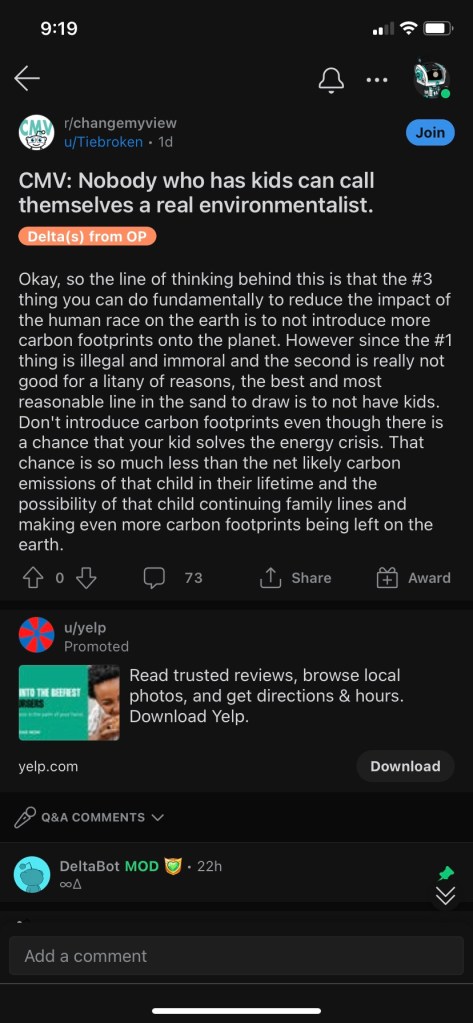
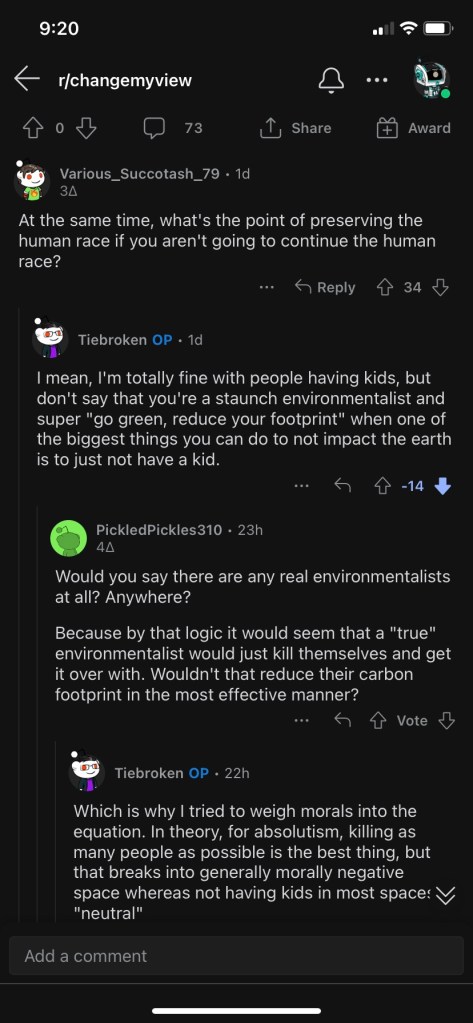
Another example:
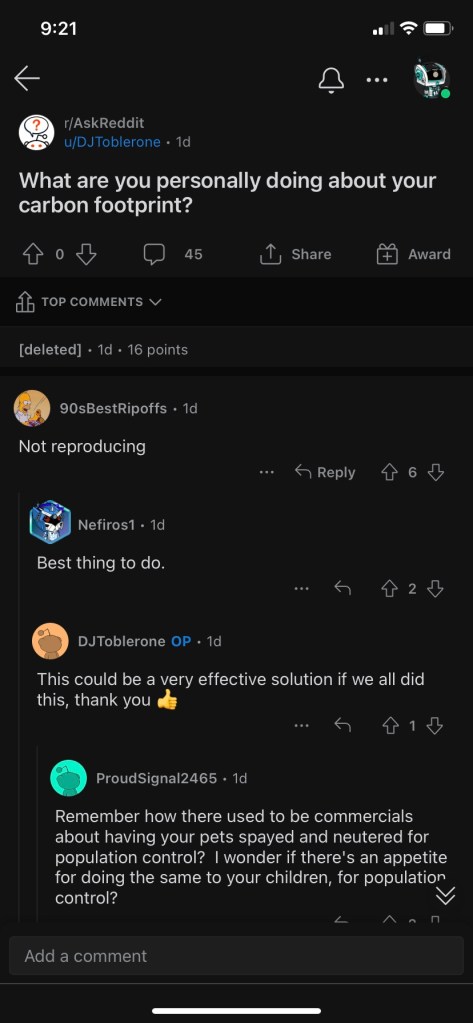
In 20-30 years, the question of “what are you doing to reduce your carbon footprint?” will be presented to kids that grew up in a world where they were told that they themselves are the problem; that their parents selfish decision to give them life is what will ruin the rest of ours & they will have evidence of this sentiment almost everywhere they look. From legislative & authoritative bodies like the UN & the WEF, all the way to regular people online, the children of today will have incontrovertible evidence that their existence was called into question by those who were never going to raise them or impact their lives in any positive way…and they will act in kind when asked, “do you think this life has value when considering how much carbon their lifestyle creates, or created?” Just in case anyone read it wrong, they will not act kindly – they will reciprocate these public calls for the extermination & restriction of specific life-forms; they will look to their predecessors & see a precedent that allows them to view life & death as parts of a financial equation that may or may not provide them financial gain. Maybe they’ll know there’s nothing to gain from this admittedly prematurely postulated position I’ve posed but maybe they’ll act accordingly just to spite the ones that started this game of hating the next generation, a sort of “treat others the way they treated me” mentality.
All I know is we are on a slippery slope of involving & equating the external adjudication of postmortem affairs with climate change narratives & finances in a way we have not thoroughly grasped or even imagined.
Do what you will in this life but remember: future generations will know what was done unless something is done to hide the truth. In 20-30 years, what will be the truth? That we’re doing all of this for the next generation? That we’re doing all of this for the environment? We’ll see.
Thanks for reading.
Works Cited:
Akristersson, A. (2019, April 30). Do black – the world’s first credit card with a carbon limit. Mastercard Newsroom. Retrieved October 23, 2022, from https://www.mastercard.com/news/europe/sv-se/nyhetsrum/pressmeddelanden/sv-se/2019/april/do-black-the-world-s-first-credit-card-with-a-carbon-limit/
Family planning: A major environmental emphasis. Life at OSU. (2017, October 5). Retrieved October 24, 2022, from https://today.oregonstate.edu/archives/2009/jul/family-planning-major-environmental-emphasis
YouTube. (2010). Voice of America – Abortion Is Green. YouTube. Retrieved October 23, 2022, from https://m.youtube.com/watch?v=YkgDhDa4HHo.
Jackson, T., & Hodgkinson , I. R. (2022, October 2). ‘dark data’ is leaving a huge carbon footprint, and we have to do something about it. ScienceAlert. Retrieved October 23, 2022, from https://www.sciencealert.com/dark-data-is-leaving-a-huge-carbon-footprint-and-we-have-to-do-something-about-it
Kuta, S. (2022, September 21). California has legalized human composting. Smithsonian.com. Retrieved October 23, 2022, from https://www.smithsonianmag.com/smart-news/california-has-legalized-human-composting-180980809/
© 2022 Zakariyas James. First shared here at theruminationcompilation.wordpress.com.
 The Rumination Compilation