Wellness as a Window into You
You are being watched.
Not just by a camera or a satellite or a data broker.
But by your smart mirror.
Your fitness ring.
Your gut biome dashboard.
Your digital assistant that noticed you’ve been coughing more lately.
This isn’t surveillance in the dystopian, authoritarian sense. It’s subtler than that. It’s called “precision wellness”. By 2030, so they say especially if certain think tanks have their way, it’ll be normalized. Incrementally, then all at once. After that, it’ll more than likely be dystopian but let’s take a step back.
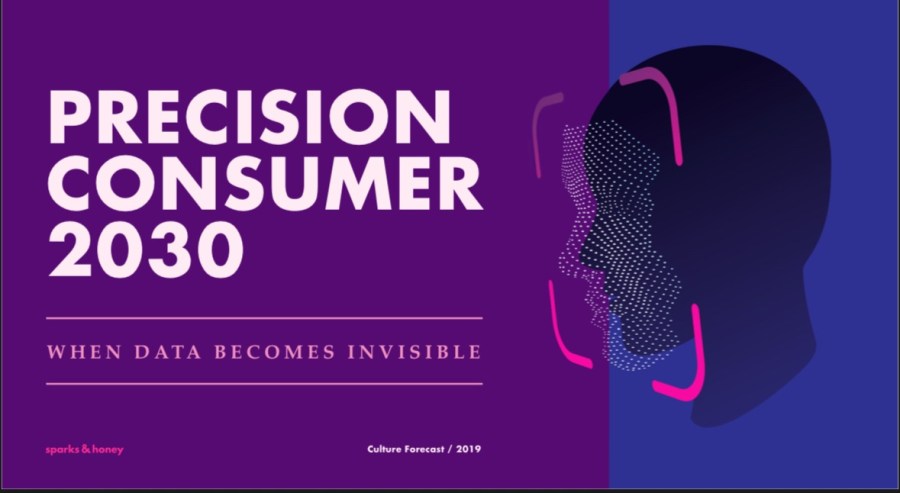
In 2019, a cultural intelligence consultancy called Sparks & Honey released a document titled Precision Consumer 2030—a 125-page playbook detailing the transformation of personal health into a hyper-individualized, AI-optimized ecosystem of apps, trackers, scores, and predictive services. At first glance, it reads like a wellness brochure from the future: designer synbiotics, mood-responsive interiors, “smart” toilets that analyze your waste. But with discerning eyes, what emerges is not just summaries of consumer trends but actually a governance architecture.
That’s because Sparks & Honey isn’t just some boutique agency running ideation workshops for sleepy CPG brands. It is a strategic foresight division of Omnicom Precision Marketing Group, a branch of the $17B Omnicom advertising conglomerate. They deploy an AI platform called Q™, which digests thousands of cultural signals to guide institutional decision-making. And their most prominent collaborator on Precision Consumer 2030 was the World Economic Forum (WEF).
The WEF Connection
Sparks & Honey didn’t just work adjacent to the World Economic Forum. They co-developed and presented the Precision Consumer 2030 initiative at Davos in 2020 alongside corporate partners like IBM, 23andMe, Mount Sinai, and PepsiCo, to name a very short few. Robb Henzi, their SVP of Strategy, also served on the WEF’s Global Future Council on Agile Governance, where he contributed to WEF white papers on regulatory technology (RegTech) and behaviorally responsive governance frameworks.
So when you read Precision Consumer 2030, you’re not just browsing a guess at what’s coming. You’re reading an institutionally aligned proposal, actively disseminated to the very companies, cities, and policymakers tasking themselves with building the future.
This is not fiction. This is how it comes to be.
Your Body, Their API
In the Precision 2030 model:
- Consumers will soon manage a “bio-cloud”—a constantly updating digital twin of their physiology.
- Workplaces will match employees to tasks using biometric stress data.
- Retail will shift from demographic targeting to individual mood-based personalization.
- Health insurance could fluctuate based on real-time metabolic behavior.
This isn’t a question of “if” or “when.” The infrastructure is already here. What Precision Consumer 2030 shows us is the desired end-state of that infrastructure. A system where privacy, bodily autonomy, and informed consent are functionally obsolete.
And nowhere in the document is data security meaningfully addressed. There is no mechanism proposed to protect against biometric theft, psychological profiling, or genetic discrimination. Why would there be? That’s not the concern of predictive market designers. Their job is to make behavior legible, profitable, and manageable.
Wellness as Performance, Surveillance as Care
In this model, health becomes aesthetic; another layer of conspicuous consumption. You don’t just track your well-being; you display it. Your biometric score becomes your new credit score. Your gut biome becomes part of your brand. Your wearable tells others whether you’re exhausted, inflamed, focused, or fertile. It tells others that your affluence is secure enough to secure you another healthy day.
This is the new luxury: the appearance of control over your own biology, delivered through interfaces owned and operated by someone else.
The Sparks & Honey advisory board itself reveals how broad this reach is:
1. Judy Samuelson
Affiliation: Executive Director, Aspen Institute Business and Society Program
Known For:
- Leading voice in rethinking the role of corporations in society.
- Spearheaded the Aspen Principles, which influenced long-term corporate value metrics and social responsibility standards.
- Frequently writes and speaks on stakeholder capitalism and the limits of Milton Friedman’s shareholder-first model.
- Author of The Six New Rules of Business.
Relevance: Brings policy influence and corporate ethics framing to Sparks & Honey’s predictions; grounding their trend work in emerging governance and business ideology.
2. Kahlil Greene
Known As: The “Gen-Z Historian”
Background:
- Former Yale Student Body President, became widely recognized on TikTok and Instagram for distilling American history and social issues for younger audiences.
- Topics often include race, systemic inequality, and generational perspective shifts.
- Strong social media presence with partnerships in youth education, brand consulting, and activism.
Relevance: Represents the youth culture pulse, with the ability to translate institutional messaging into digestible narratives for digital-native generations.
3. Dr. Brian Pierce
Background: Former Director of the Information Innovation Office (I2O) at DARPA (Defense Advanced Research Projects Agency)
Known For:
- Oversaw cutting-edge military research related to artificial intelligence, neuroscience, and human-machine symbiosis.
- Helped lead DARPA’s efforts into predictive intelligence and autonomous systems.
Relevance: Adds high-level expertise in defense-grade AI, surveillance tech, and human-data integration, which reinforces Sparks & Honey’s credibility in biometric and predictive modeling domains.
4. Lynn Greene
Background: Former President of Estée Lauder’s Global Brands
Known For:
- Oversaw Estée Lauder, Clinique, and Origins globally.
- Noted for modernizing brand strategy and integrating emerging beauty tech and AI-driven personalization.
- Played a key role in shifting beauty toward data-informed consumer experiences.
Relevance: Ties Sparks & Honey’s foresight work to consumer behavior, biometric branding, and commercial personalization strategies.
5. Maarten Leyts
Background: Youth culture expert; CEO of Trendwolves (a Belgium-based trend forecasting firm focused on millennials and Gen Z)
Known For:
- Specializes in cross-generational insight, emerging behaviors, and cultural forecasting across Europe.
- Has advised on education, youth employment, and tech adoption trends.
- Published widely on the socio-psychological patterns of Gen Z and post-pandemic youth culture.
Relevance: Adds granular insight into how generational shifts impact consumer behavior, governance models, and cultural adoption of bio-integrated tech.
These aren’t marketers. These are architects of consensus, shaping how commerce, identity, and even biology are interpreted across institutions, over years of focused influence.
The Real Takeaway: This Is the Blueprint
Precision Consumer 2030 is not simply forecasting where health culture might go. It is manufacturing the desirability of its inevitability, corporations on board are working at this very moment to convince you or your younger peers this is sexy, smart and socially significant. Through collaborations with the WEF and a multitude of Fortune 500 partners, Sparks & Honey’s influence isn’t theoretical it’s operational.
As a result, this document (light on footnotes but heavy on framing) should be read the way a legal analyst reads a contract. Or the way a surveyor reads a map of land that isn’t theirs yet.
Because this is a roadmap for cultural submission, where each biometric check-in is repackaged as empowerment. Where every app that helps you sleep better might also be reshaping your insurance score, your employability, and your self-worth. It may even flag you for limited travel and limited consumption of goods and services; it will know more about you than you do and make decisions based of information you wouldn’t even know how to read or process.
But that’s no excuse to say you didn’t see it coming.
They published it.
They presented it.
(Then they scrubbed the paper from their website.)
Now they and a bunch of companies you probably give your money to or might even work for are building the infrastructure to make sure you can’t opt out.
Below, you will find a download of Precision Consumer 2030. Read it over and start to look at what’s on the shelves and on the way with this paper in mind.
Update: and just like that, President Trump has a very relevant idea that sounds like just another step in Precision Consumer 2030.
Trump Administration Is Launching a New Private Health Tracking System With Big Tech’s Help
President Donald Trump is expected to deliver remarks on the initiative Wednesday afternoon in the East Room. The event is expected to involve leaders from more than 60 companies, including major tech companies such as Google and Amazon, as well as prominent hospital systems like the Cleveland Clinic.
© 2025 Zakariyas James. First shared here at theruminationcompilation.wordpress.com.


 The Rumination Compilation