You’re not losing your mind, you’re losing your purchasing power.
Everything from groceries to rent to basic utilities has crept into unaffordable territory, but somehow the government insists inflation is around 3.3%. To most of us, that number feels like a punchline with no setup.
ShadowStats, which calculates inflation using methods from before the 1980s CPI revisions, suggests it’s actually over 9%. That sounds far more in line with what you feel in your bones and your wallet, doesn’t it?
The difference isn’t just mathematical, it’s philosophical. It determines whether you believe our society is slowly progressing or quietly deteriorating.
And at the center of that delusion sits the green tech movement: an ideal pushed by agreements between supranational organizations and state governments, built on commodities like silver, which ironically is one of the few tangible lifeboats left in an era of untethered money, misrepresented data, and unsustainable goals.
CPI: The Numbers Game That Makes Poverty Look Like Progress
In the early 1980s, the U.S. government began quietly redefining inflation. It didn’t look good on paper to say retirees needed 10% annual increases in Social Security checks. It looked even worse for Treasury bondholders expecting “real” returns.
So instead of wrestling inflation down, policymakers redefined how it was measured.
They introduced terms like:
- Substitution: If steak gets too expensive, CPI assumes you switch to chicken. Inflation problem solved.
- Hedonic adjustment: If your laptop is twice as fast, they say you’re paying less for it—even if it cost you more dollars (source, second bullet point).
- Owner’s Equivalent Rent (OER): Instead of tracking what you pay in housing, they estimate what your home might rent for, based on surveys. (Crazy isn’t it?)
These methods were sold as ways to make CPI “more accurate,” but what they really did was make inflation more palatable to policymakers and debt managers. They also did it to make sure you and I kept racking up debt and consuming more each quarter.
Official inflation numbers rely on mechanisms that hide the erosion of lifestyle:
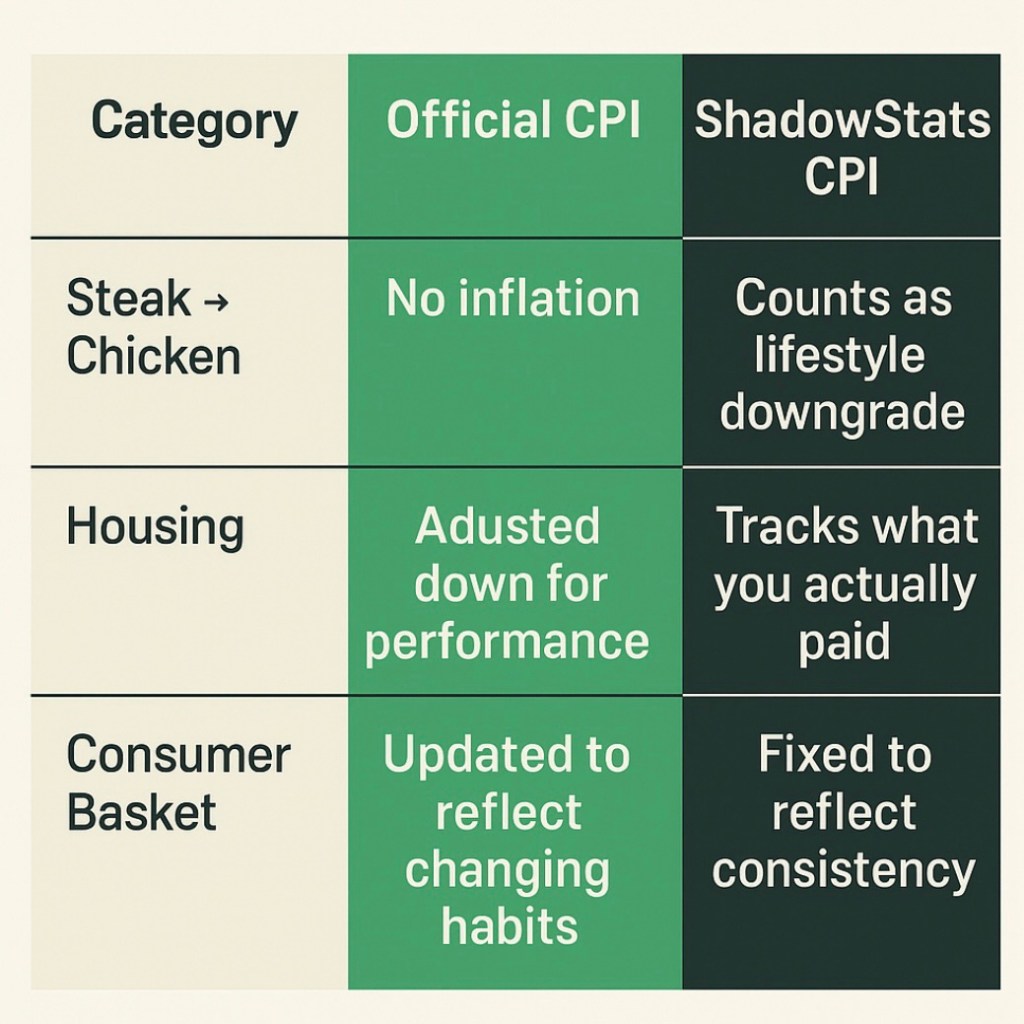
These adjustments treat your survival adaptations like buying cheaper food, delaying car repairs, moving back in with family, etc as market choices rather than signs of stress.
You’re not living worse, they say you’re just living differently.
Here’s what the former Fed Chairman Alan Greenspan said in 1995:
“If you are measuring the cost of living, you must measure the cost of maintaining a constant standard of living. If you substitute chicken for beef, you are not maintaining the same standard.”(https://www.nytimes.com/1995/12/04/us/inflation-gauge-may-be-too-high-experts-say.html)
The BLS has been doing the opposite for decades.
Green Tech: The Utopian Offramp Built on Industrial Scarcity
Enter the Sustainable Development Goals and the “just transition” to a greener future. Electric vehicles. Wind turbines. Solar panels. Battery storage. Carbon offsets. All tied to the years 2030 and 2050 as I’ve outlined in more than a few posts on this blog.
The problem? Every one of these systems relies heavily on silver, a finite, mined metal with growing industrial scarcity. According to the Silver Institute, solar panel production alone is expected to account for over 25% of annual silver demand by the end of this decade.
The price of silver has risen 43% year-to-date as of July 2025. Gold is up roughly 22%. Compare that to:
2025 YTD Return
NASDAQ +15%
S&P 500 +10%
DJIA +5.5%
So let’s check the math. If inflation is only 3.3% (official CPI), then those stock market gains look decent. But if ShadowStats is right, and inflation is closer to 9%, then:
- The Dow Jones is posting a negative real return.
- The S&P 500 is barely breaking even.
- Even the NASDAQ, with its AI hype and tech surge, is only modestly positive in real terms.
- Only silver and gold are delivering substantial real returns after adjusting for actual inflation.
This is the moment where you realize: only one entity will be paying for the widespread retrofitting and implementation of all this green tech that needs silver and it’s you. Either through willing compliance or taxation by the government so they can buy it with your wages and make you use it.
Hedonics, Hopium, and the Silver Choke Point
The CPI tells you that your phone is getting cheaper, even if you spent more on it, because it has better specs (source, first bullet point).
The ESG movement tells you your energy is getting cleaner, even if your utility bills are rising, because it’s coming from renewables.
But here’s what they don’t tell you:
- Silver is irreplaceable in high-efficiency solar, circuit boards, EV contacts, and grid storage.
- No large-scale replacement exists.
- We are burning through reserves faster than we are discovering new viable deposits.
That means the very commodity needed to “fix” the future is becoming more expensive, even in inflation-adjusted terms. And that creates a dilemma no policy paper can solve.
Silver: The Honest Asset in a Dishonest System
In a world where official CPI is engineered to deflate your sense of decline, silver doesn’t lie.
- It doesn’t get adjusted for quality.
- It doesn’t get substituted.
- It doesn’t get hedonicized.
It just reflects what a scarce, in-demand physical asset actually costs in a world of paper promises and underpriced labor.
And unlike fiat currencies or ESG credits, silver is outside the system. That’s why central banks don’t talk about it, and why retail investors who understand its utility in both monetary protection and energy transition are quietly accumulating at Costco before getting a hot dog and soda.
The Fatal Irony of Sustainable Progress
We are trying to build a green future using a grey metal whose supply cannot scale with our policy ambition. The Sustainable Development Goals require a miracle of material availability that simply doesn’t exist.
If silver prices are outpacing even ShadowStats’ inflation, then the affordability of the clean tech utopia vanishes on arrival. And if real inflation is devouring your market returns, then the dream of using “compound growth” to escape stagnation is mathematically dead.
Compliance or Sovereignty: There Is No Third Option
If you’re not holding assets that outpace real inflation (like silver or gold or the next randomly pumping stock) then you’re not preserving wealth. You’re slowly converting it into obedience.
Because what happens when your savings can’t keep up?
- You’ll be offered government rebates for heat pumps.
- Carbon credits for commuting less.
- EV mandates.
- Sustainability scorecards tied to your bank account (like that Aspire card I mentioned a few posts ago).
- Access granted in exchange for compliance.
If you can’t buy your way out of the system, you’ll be forced to conform to it.
Green tech won’t be a lifestyle choice. It will be a behavioral requirement coded into policy, enforced by banks, and justified by a CPI that says “everything’s fine.”
Final Thought: Scarcity Isn’t the Problem—It’s the Lie
ShadowStats reveals how far we’ve drifted from price reality. Silver shows how tangible scarcity still has economic weight, how truth leaks out where it can’t be hedged.
And if you’re still counting on index funds and CPI-adjusted retirement accounts to protect you, ask yourself:
What happens when the growth you’re chasing is just inflation in disguise?
Silver isn’t just a hedge. It’s a mirror. And the reflection it shows is too uncomfortable for mainstream narratives to tolerate.
© 2025 Zakariyas James. First shared here at theruminationcompilation.wordpress.com.
 The Rumination Compilation
One thought on “Shadow Inflation & the Price of Freedom”