[Update – October 2025: When this piece was first published in July 2025, silver traded at $38.32 per ounce. As of this update, it sits near $51.60 — a 34% increase in less than four months. Every dollar rise in silver’s spot price compounds the already-underestimated cost of “green” manufacturing, storage, and infrastructure. The same scarcity dynamics I described below are now playing out in real time.]
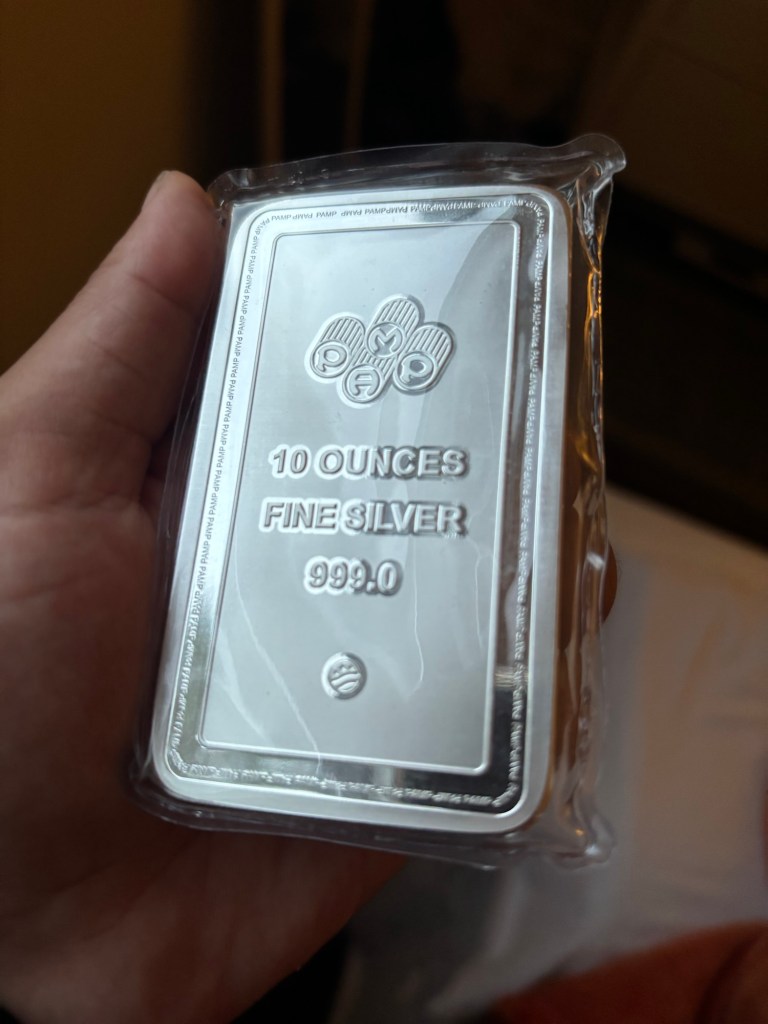
There’s something ironic in how silver doesn’t match the weight it now carries, even when labeled on bullion.
It’s the best conductor of electricity, it’s antimicrobial and for thousands of years it acted as a monetary metal. For centuries it has been ornamental or a tool of commerce or consumption (think silverware) and now it finds itself increasingly involved in the infrastructure of a repeatedly promised future: solar panels, electric vehicles, grid storage systems, and the increasingly complicated web of “green” innovation spurred on by Sustainability Development Goals created by the U.N.
Excited conversations on TV and other blog posts discuss these technologies as if they’re incorporeal though. Guaranteed but incorporeal. As if solar energy arrives by virtue of political will or increased taxation, that EVs emerge from factories every quarter to appease shareholders and to respond to inevitable increases in consumer acceptance.
“People will want EVs when the range per full charge surpasses ICE gas mileage!”
But silver is physical. It is mined, refined, shipped, spent. However, there is only so much of it and fiscally speaking, only so much that it can be used on before the next thing that requires it is just too expensive.
Paper or Physical?
The silver market is quiet in the way illusions are quiet.
Prices have remained strangely stagnant; even as demand rises from every direction, prices have been relatively flat. Silver is only up about 94% in the last 4-5 years, even amidst the obvious increase in solar panel production & EVs all over.
But there’s a clear reason: most of the silver traded in financial markets isn’t silver at all. It’s “paper silver”—contracts, ETFs, and other abstractions that represent claims on silver rather than silver itself.
This paper silver is stacked and restacked, layered so thick that for every ounce of physical metal, there are about 300 paper claims for every physical ounce. These instruments are cheap and convenient. They give the appearance of liquidity. They help manufacture downward pressure on a metal that is worth more each and every day that governments push the green future they’ve committed to with Sustainability Development Goals.
But try to build a solar panel with an ETF. Try to wire a battery with a futures contract. Buy a paper claim for a 1,000 ounces of silver and try to claim ownership; it’s a bit more convoluted & difficult than you’d think.
But that’s because markets pretend there is abundance when the mines quietly say otherwise.
Domestic Dependence
The U.S. mines very little silver on the global scale.
Most of it comes as a byproduct—scraped from zinc, lead or copper operations already past their prime. Mexico, Peru, and China dominate the supply chain.
Still, federal and state initiatives in the U.S. continue pushing solar incentives, EV mandates, and infrastructure investments without asking the most basic question: is there enough material to meet these goals?
Independence in energy policy without independence in materials is not independence at all. It is an illusion with a timer or an attempt at convincing the public that independence exists at all. How can each nation experience independence in a global economy attempting to deal with a global problem like environmental protection?
The Math That Isn’t Discussed
There are roughly 260 million licensed drivers in the United States. If half of them eventually drive electric—an optimistic yet increasingly standardized projection—that’s 130 million EVs.
Each EV contains roughly 25 to 50 grams of silver. Taking the midpoint:
130,000,000 × 40g = 5.2 billion grams of silver
= 167 million troy ounces
That’s one-fifth of the entire global silver production in a year (~800 Million ounces) just for U.S. EVs.
Now consider rooftops. There are around 82 million owner-occupied homes in the U.S. Maybe 60% are viable for solar. That’s 49 million rooftops.
Each home installation uses about 700 grams of silver, on average:
49,000,000 × 700g = 34.3 billion grams of silver
= 1.1 billion troy ounces
That’s more than all the silver the world mines in a year, just for U.S. homes. We expect this for all the nations involved in international agreements like the Paris Climate Accords and the 2050-centered plans from the U.N. so these figures throw a lot of things into question.
This doesn’t cover batteries, none of the redundancy systems, commercial arrays, or military contracts. No export demand. No global population growth. Just drivers and rooftops. Already unfeasible. This doesn’t even cover the actual dollar cost of simply buying the necessary amount of silver.
At the time of writing, silver is trading hands at $38.32 USD.
So that 167 million Troy ounces needed for just the vehicles? That’s just shy of $6.4 billion and that’s a figure expected to be paid in part by us, the consumer, upfront and more than likely down the road through taxpayer funded subsidies to accelerate EV adoption.
(There’s about an average of 62 ounces of pure Lithium in an EV battery; at $1.93 an ounce for refined lithium, it’s obvious the real price constraint will eventually be silver.)
The 1.1 billion Troy ounces needed for the solar panels? That’s about $42 billion, another cost we can attribute to the federal deficit and consumer spending.
These are not “if” numbers. These are baseline assumptions. The kind that policy was supposed to be built on.
Technology Without Materials
We’ve been taught to think of green energy as a software problem. That with the right code, the right algorithm, the right policy tweak, we can unlock a clean, efficient, endlessly scaling future.
But materials don’t scale like software.
Silver is not a “tech solution.” It is a finite, mined resource that lives in geological time. Once it’s pulled from the ground, used in a panel or circuit, it is largely unrecoverable. There is no efficient way to recycle the trace amounts embedded in electronics or laminated into photovoltaic cells.
So while the software runs smoother every year, the hardware gets scarcer. Especially now that Costco is selling silver to the masses; it’s estimated they’ve already sold anywhere from 20-30 million Troy ounces of silver since January of 2024.
Industry is now competing with citizens of nations dealing with currency devaluation and governments with bad budgeting in its blood.
Quiet Disappearances
If silver were priced according to its utility—its indispensability to the green transition—its value would be multiples higher. But that would disrupt the illusion. It would wake the markets. It might even force a reckoning with how we plan, and who gets access to these technologies when scarcity arrives. (On another note, it would also break a couple banks since there’s a large short position affecting silver price discovery but that’s a whole other story you should read up on elsewhere.)
So the system does what it’s good at. It mutes the signal.
Silver’s price is managed, its physical demand obscured by the over-issuance of paper derivatives. Meanwhile, physical silver disappears—not in vaults, but into solder points, busbars, and circuitry. Into machinery that will work until it breaks and be too costly to recover when it does.
This is not theoretical. It is measurable. It is ongoing. It is irreversible on any policy-relevant timeline.
The Consequences of True Price
Here’s the part no one likes to say out loud:
If silver ever reaches a price that reflects its real utility and real scarcity, millions of people will be priced out of vehicle ownership—permanently. This can especially said with certainty for any jurisdictions that mandate EV adoption by way of phasing out ICEs or increasing daily taxation for driving an ICE vehicle like London does already.
But not because of a shortage of cars. Because of the materials required to build them. If silver doubles, triples, or reaches the kind of price discovery that gold once saw, the cost to manufacture electric vehicles and solar panels will skyrocket. That cost won’t land on corporations. It’ll land on people.
The very people these transitions were supposed to serve.
Middle-income households. Rural drivers. Lower-tier homeowners trying to insulate themselves from rising energy bills. They’ll be handed a clean-energy future they can’t afford to participate in.
Not Fragile Like Glass—Fragile Like a Lie
This isn’t just about silver.
It’s about what happens when we shift from one form of dependency to another and pretend the second is progress. Fossil fuels were finite and demonized for being dirty. But critical metals are finite, dirty until refined and polished; will they be demonized or will we make a beast out of the burden of allocation for these green dreams?
Silver is not the only material with a bottleneck. But it may be the first one to snap and it has reason to be called the most important material in the effort to advance green technology adoption across the U.S. and the other nations party to the U.N. climate goals.
And when it does, we’ll realize we didn’t build a transition. We built a fantasy. One that is clean on the surface, fragile underneath, just waiting for the first real demand to break it.
What we’re probably heading towards is a two-tier society built upon who has precious metals & who doesn’t.
Sounds sort of like we’re regressing to a world of kings and peasants doesn’t it?
When this piece was first written, I estimated the silver cost of producing 167 million EVs using $38.32/ozt spot price. At today’s $51.60, the same calculation jumps from roughly $6.4 billion to $8.6 billion, a reminder that “sustainability” priced in fiat ignores the finite nature of the materials that make it possible.
For more content related to silver, I’d recommend the Bald Guy Money YouTube channel, David Jensen’s Substack and Maneco64 on YouTube as well. These 3 individuals have the best grasp on why silver is probably one of the most interesting metals, it’s got conspiracy, history, importance for the future, it’s got it all.
© 2025 Zakariyas James. First shared here at theruminationcompilation.wordpress.com.
 The Rumination Compilation
One thought on “An Ounce of Silver & More than An Ounce of Delusion”